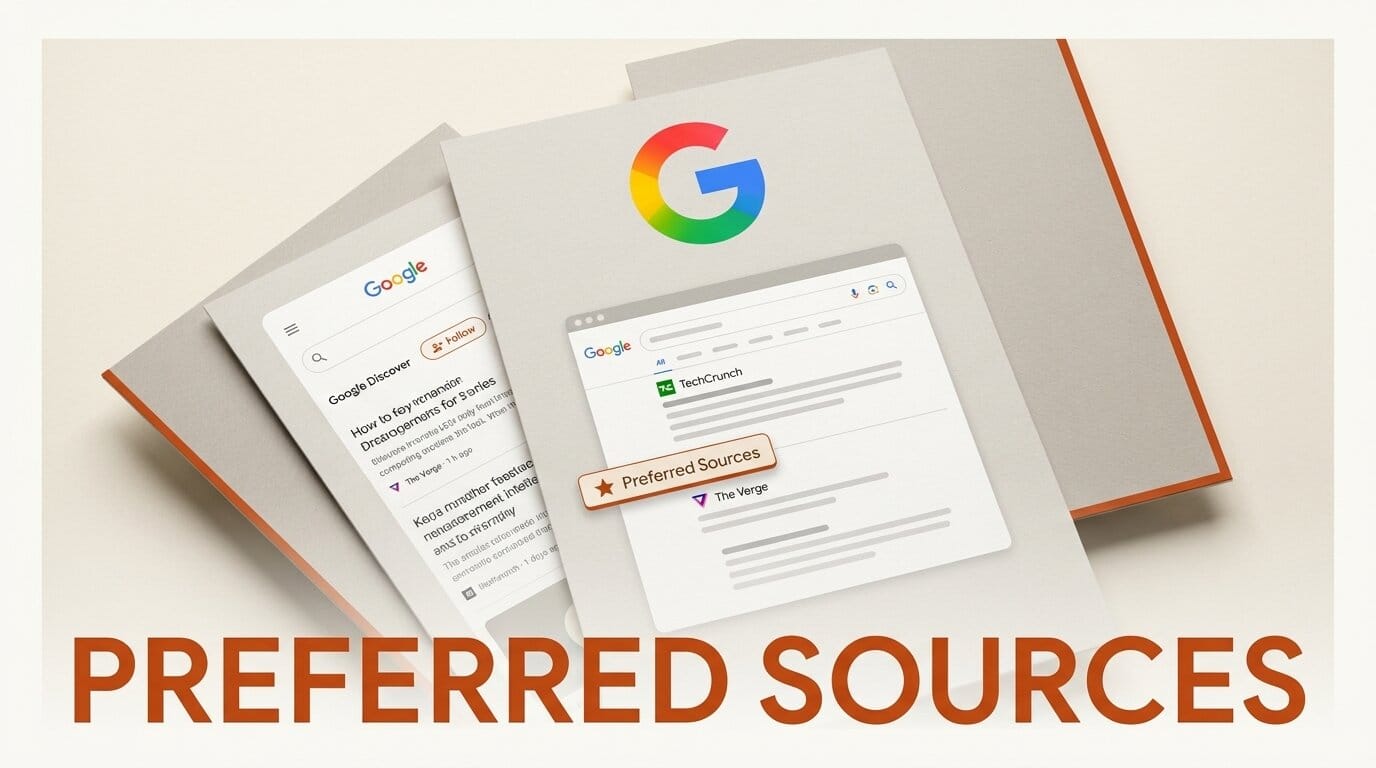
Google released an embeddable Preferred Sources button for publishers on August 20, 2026. Readers click it on your site to mark you as a preferred source, after which Google highlights your content in Search, Discover, and Google News. Google says people are twice as likely to click through to a preferred source when one is available.
Try it: add the button this week
This is a same-day task, not a strategy. Google's announcement covers the button and how to embed it. Put it where a reader is already convinced, which is the end of an article or beside your subscribe form, not in the navigation bar where it competes with everything else.
Then verify from the reader side. Open Google's source preferences page in a signed-in browser and confirm your site appears after you click your own button. If it does not, the embed is wrong and no amount of traffic will fix it.
Why it matters for creators
Preferred Sources is the first Google surface that lets an audience you already earned protect your visibility from ranking changes. AI Overviews and AI Mode have been compressing publisher click-through for two years. A reader-set preference is a signal Google honours regardless of how a given query ranks.
The catch is that it only works if you have readers to ask. A site with no returning audience gains nothing from a button that converts existing loyalty into distribution. For everyone else, it converts an email list or a social following into search visibility, which is the harder direction to move traffic.
Key details
Launch date: August 20, 2026.
Where it applies: Google Search, Discover, and Google News.
Measured lift: readers are twice as likely to click a preferred source when one is available.
Existing adoption: more than 345,000 unique sources had been selected since Preferred Sources rolled out in AI Mode, AI Overviews, and Top Stories in May 2026.
Coming next: natural language commands for managing sources in the Discover feed, announced for Android.
What to do next
Embed the button, then ask once. A single line in your next newsletter pointing readers at the button will outperform leaving it on the page and hoping. The mechanic rewards publications with a direct relationship to their audience, which means the work is in the ask, not the install. TechCrunch's write-up has additional context on how this fits Google's response to AI-driven traffic loss.