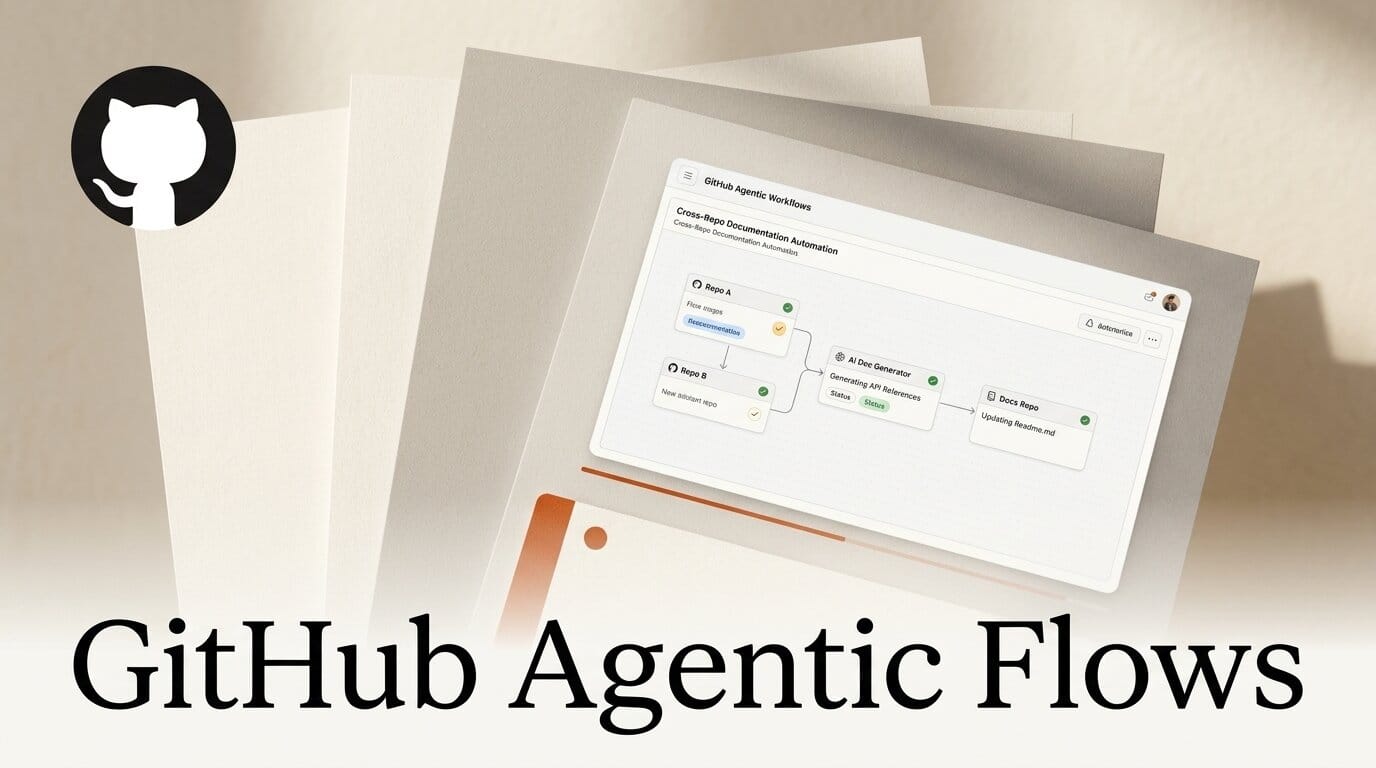
GitHub published a working example of GitHub Agentic Workflows on July 8, 2026: an agent that watches one repository for merged features, drafts the documentation, and opens a reviewed pull request in a separate docs repository. GitHub describes the system as "GitHub Actions, but with a model as the work-item processor" plus guardrails that pass security review.
Try It: Automate a Post-Merge Task
You do not need a special product to try this. Add a markdown workflow file at .github/workflows/pr-docs-check.md with YAML frontmatter that declares the tools, permissions, and safe-output constraints, followed by a plain-English prompt describing the job. Run gh agentic workflows compile to generate the companion .lock.yml standard Actions workflow, commit both, and the agent runs automatically on merged pull requests. The same pattern works for changelog drafting, dependency notes, or release summaries, not just docs.
Why It Matters for Creators
Documentation is the classic task that slips when a team ships fast. Wiring an agent into the merge event turns "we will document it later" into a pull request that a human only has to review. The guardrail design matters here: the agent reads diffs and linked issues, drafts against your existing conventions, and hands off to a "safe-outputs handler" that materializes the pull request through a scoped GitHub App, so the model never gets broad write access.
Key Details
What it does: Detects merged features in one repo, drafts docs, opens a pull request in the docs repo, routes it to the feature's subject-matter expert.
Measured results: Over 30 days on the microsoft/aspire project, 396 product pull requests produced 82 documentation pull requests, all merged, with a median time-to-merge of 44.8 hours and 96 percent merged within a week.
Setup: A markdown workflow plus gh agentic workflows compile. Full docs live at gh.io/gh-aw.
What to Do Next
Pick the smallest recurring post-merge chore your team keeps skipping and prototype it as an agentic workflow on a low-risk repo first. Keep the safe-output constraints tight, review the first dozen pull requests by hand, and only widen the agent's scope once the drafts consistently match your conventions.