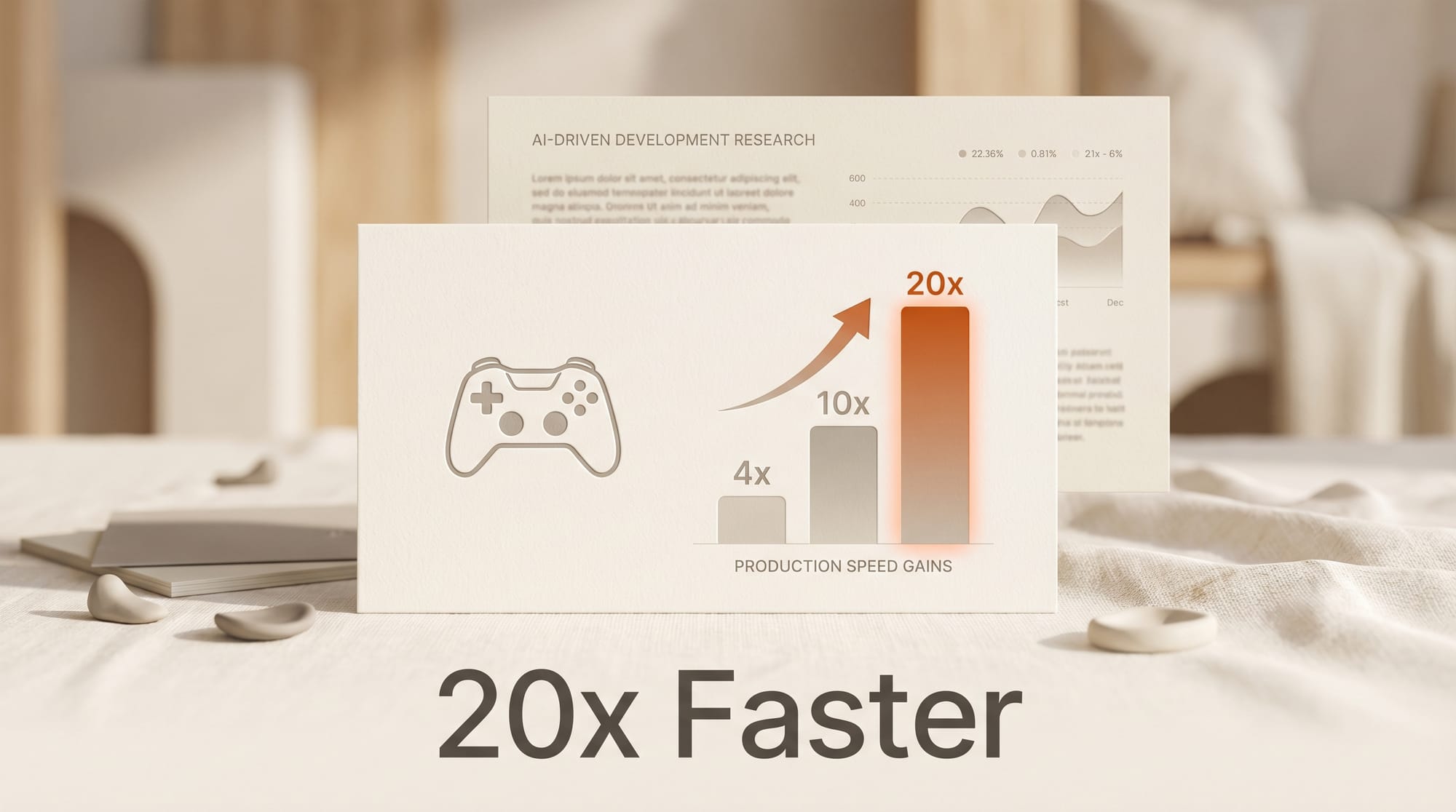
Game studios reorganizing around AI are completing vertical slice prototypes 4x faster and generating UI assets up to 20x faster, according to new research from Wharton's Generative AI Lab published April 10, 2026. The study, based on 20 structured interviews with PMs, engineers, designers, CTOs, and executives at AAA, mid-size, and indie studios across the US and EU, identifies four distinct stages of AI adoption, and finds that only a small fraction of studios have reached the most productive tier.
For the broader landscape, see our complete producer guide to AI music and audio in 2026.
What Happened
Researcher Zimran Ahmed at Wharton GAIL conducted 60-90 minute interviews with studio leaders to map how game development teams are integrating AI into their workflows. The resulting report, Beyond Copy and Paste: How Game Studios Are Reorganizing Around AI, outlines four adoption stages:
- Stage 1: Copy-and-Paste AI. Individuals use LLMs independently; the organization structure is unchanged.
- Stage 2: Workflow Pilots. Top-down automation initiatives that frequently stall when they hit tacit knowledge embedded in teams.
- Stage 3: Read/Write AI / Boundary Crossing. Individual contributors begin handling cross-team tasks without formal handoffs.
- Stage 4: AI-First Studio. Small generalist teams, markdown-based documentation, and AI embedded into core processes from the start.
Of the 20 studios interviewed, only 3 reached Stage 4, and all three were built around AI from their founding, not retrofitted.
Why It Matters
The productivity gap between stages is not incremental. Studios at Stage 4 reported compressing a four-month vertical slice prototype down to four weeks (4x), reducing a 30-icon UI asset batch from weeks to the same day (10-20x), cutting the dev-to-QA review cycle from weeks to a single day (5-10x), and updating financial models from a 2-3 day process to on-demand (~15x faster).
These numbers matter because they reframe the competitive landscape. A three-person AI-first indie can now iterate at a pace that previously required a full department. The bottleneck is no longer headcount. It is organizational design.
The research connects directly to broader shifts in AI agents reshaping creative workflows, where the pattern of individuals absorbing cross-functional tasks is accelerating across industries, not just games.
Key Details
The report identifies tacit knowledge as the primary obstacle to Stage 2 and Stage 3 transitions. Top-down automation pilots frequently fail because the knowledge needed to complete a task lives in people's heads, not in documentation or processes that AI can read.
Stage 4 studios solve this by defaulting to markdown-based documentation and building AI access into every layer of the workflow from day one. They do not bolt AI onto existing processes. They design the process around AI capability.
Ahmed notes in the report: "Strategic planning, team alignment, and culture-building all require human-to-human collaboration." The implication is that AI handles the execution layer while humans retain ownership of direction and coordination, a distinction that echoes the labor dynamics playing out in the WGA's four-year deal on AI and creative work.
What to Do Next
If you work in or around game development, the Wharton report is worth reading in full. The four-stage framework applies beyond games. Any creative production pipeline that relies on cross-team handoffs faces the same structural constraints.
Start by identifying where your team sits. Most studios and creative agencies are at Stage 1 or early Stage 2. The jump to Stage 3 requires individuals to be empowered to cross team boundaries using AI, which means documentation needs to be accessible to AI tools, not locked in Confluence pages or Slack threads. The full PDF report includes the complete interview methodology and stage-by-stage breakdown.