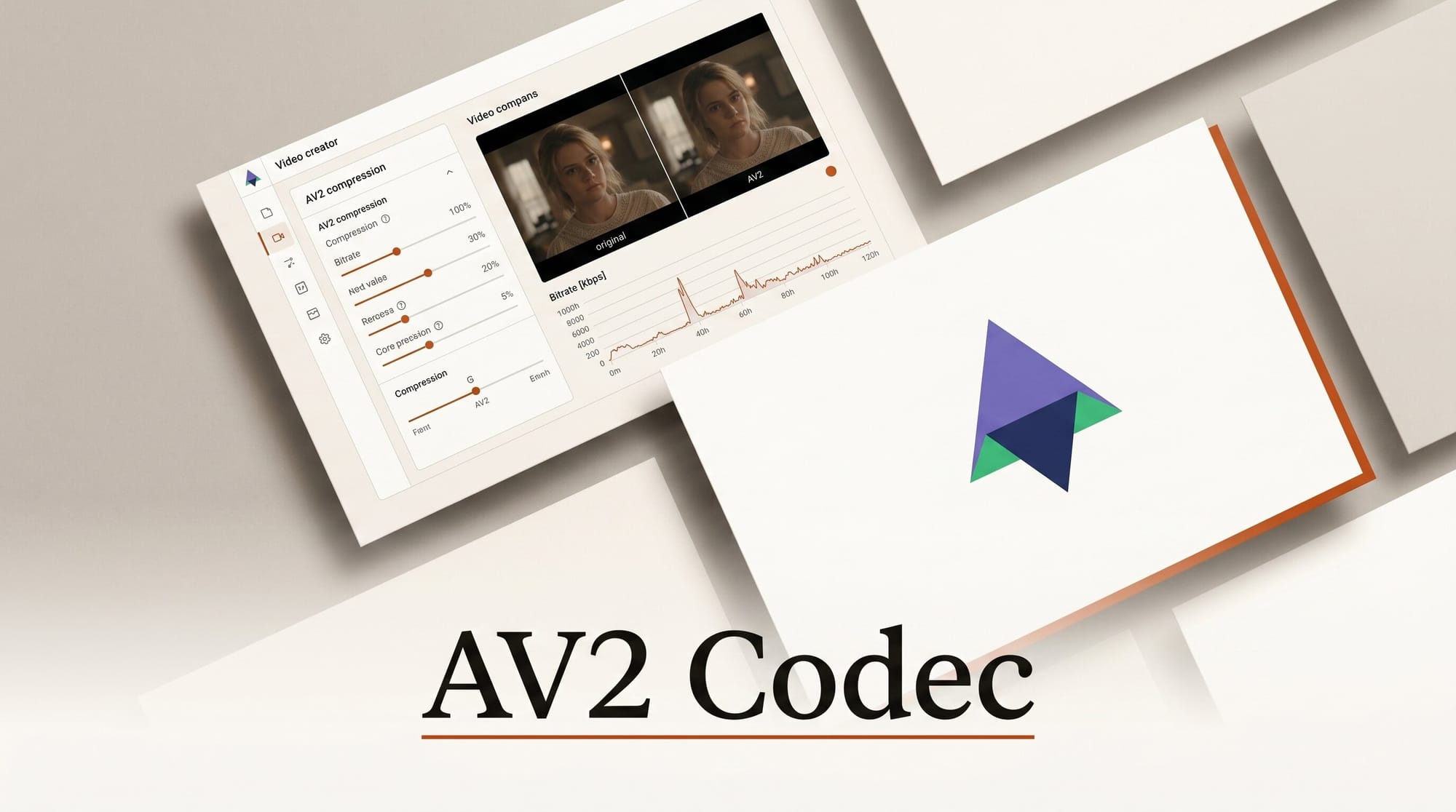
The Alliance for Open Media released AV2 v1.0.0 on May 28, 2026. Available at av2.aomedia.org, this is the first stable release of the royalty-free video codec that succeeds AV1, which powers YouTube, Netflix, and most major streaming services today.
What Happened
AV2 v1.0.0 ships with the complete bitstream specification, decoding semantics, syntax browser, and the AVM reference encoder and decoder. According to Linuxiac, VideoLAN simultaneously released dav2d, an early CPU decoder for the new format. The spec is backed by a consortium that includes Amazon, Apple, Cisco, Google, Intel, Meta, Microsoft, Mozilla, Netflix, Nvidia, Samsung, and Tencent under the AOMedia patent policy.
Why It Matters
AV2 achieves up to 40% better compression than AV1 at equivalent visual quality. That gain means streaming platforms can deliver the same content at a fraction of the bandwidth cost, or significantly higher resolution at current bitrate budgets. The Alliance for Open Media engineered AV2 specifically for streaming, broadcasting, real-time conferencing, and AR/VR delivery.
For video creators, this is a downstream improvement: when platforms adopt AV2 encoding, your uploads are automatically delivered with better clarity. AI-generated video stands to benefit most. Generative video outputs are typically large files with dense, complex motion, and a 40% compression improvement meaningfully reduces delivery costs and improves playback quality on slower connections. For an example of how the field is already attacking AI video efficiency from a compute angle, see PARE and Wan2.1 video model optimization. AV2 also expands support for AR/VR formats and multi-program delivery, both growing areas for AI-assisted production.
Key Details
- Released: May 28, 2026 (AV2 v1.0.0 / AVM reference implementation)
- Compression: Up to 40% bandwidth reduction vs AV1 at equivalent quality
- License: Royalty-free under AOMedia patent policy
- Decoder available now: VideoLAN dav2d (early CPU implementation)
- Backers: Amazon, Apple, Cisco, Google, Intel, Meta, Microsoft, Mozilla, Netflix, Nvidia, Samsung, Tencent
What to Do Next
AV2 is not ready for production creator pipelines today. The 1.0 spec is the starting point for hardware vendors, browser engines, and streaming platforms to begin implementation work. Early coverage of the AV2 timeline notes the coalition is broader than AV1s, which could accelerate adoption, but hardware encoding support and browser integration still need to ship first.
Watch for FFmpeg support and Chromium announcements as the early adoption signals. If you encode video programmatically, the AVM reference implementation is already available to test. For AI video creators, no immediate workflow changes are required, but knowing the spec is now locked means platform quality upgrades are on a defined roadmap.