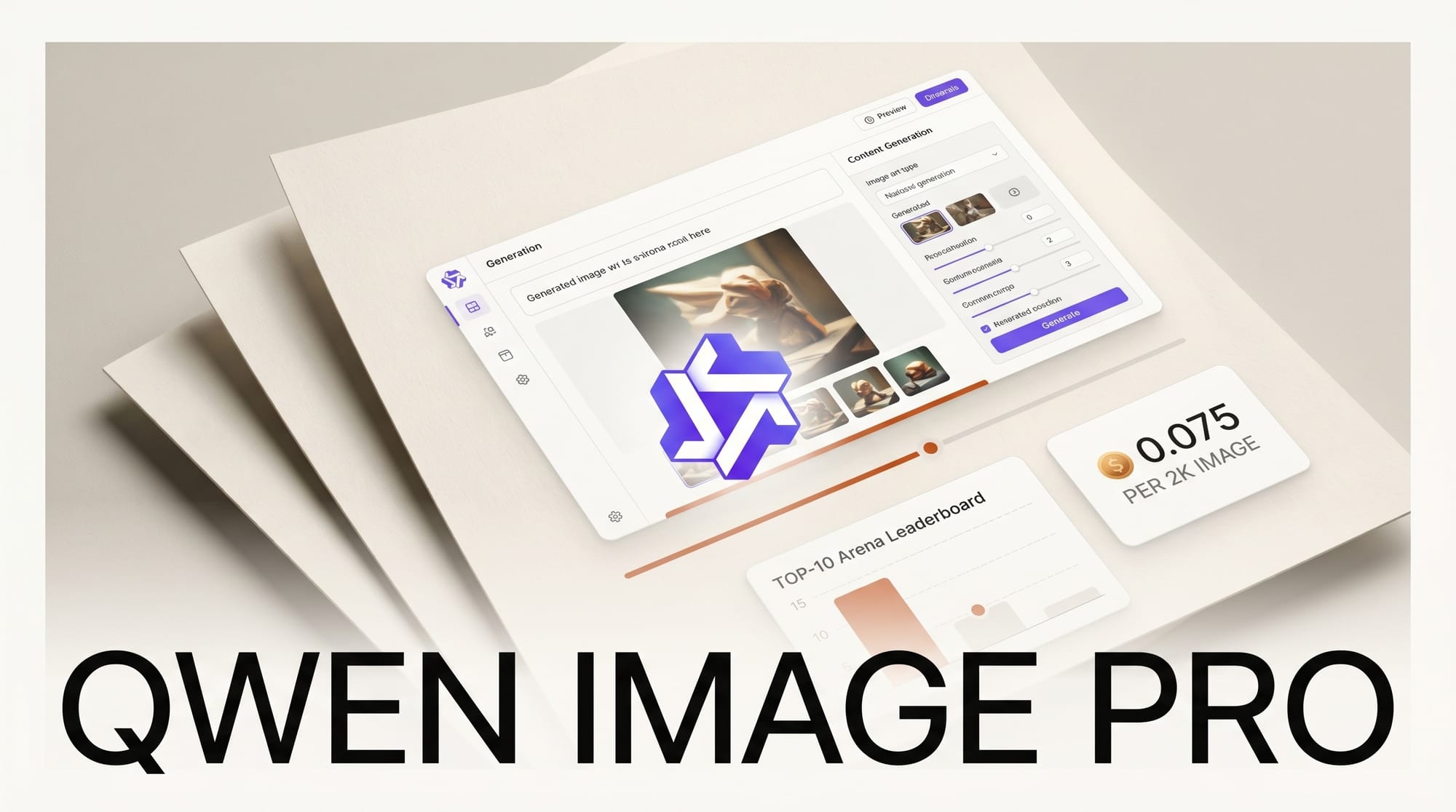
Alibaba's Qwen team announced Qwen-Image-2.0-Pro as a live API on April 25, 2026, at $0.075 per 2K image, debuting at rank 9 on Arena's Text-to-Image leaderboard with a score of 1168. The headline number is the price. Qwen-Image-2.0-Pro is the first top-10 image API to land at this tier, and it lands while the open-source base model stays free to self-host. The split is the story.
Background
Qwen-Image-2.0-Pro sits above the open-weights Qwen-Image-2.0 released February 10, 2026. The base model is MIT-licensed and downloadable. The Pro tier is a paid endpoint accessible only through the Alibaba Cloud Model Studio API or the ModelScope demo. As of launch, the official Hugging Face repository carries no Pro checkpoint and the license field reads "Alibaba Proprietary." The Pro variant is not, and per Alibaba's stated roadmap will not be, open-source.
The leaderboard math frames the launch. Pro lands at rank 9 globally with a score of 1168. The open base sits at rank 20 with 1133. That 35-point gap is what paying buyers get for the API premium, alongside higher resolution defaults, multilingual text rendering, and stronger instruction following on long prompts. Sub-rankings tell a sharper story: rank 6 in Portraits, rank 7 in Photorealistic and Cinematic Imagery, rank 7 in Art. Pro is competitive at the top end of every category that pays for image work.
This launch arrives in the same week as OpenAI's GPT-5.5 with native 3D generation, ComfyUI v0.20.1's bundled-node release, and Anthropic's Claude for Creative Work connector suite. The image-generation market is no longer a one-axis race on quality; it is a four-axis race on quality, price, integration, and openness. Qwen is the only vendor pulling all four levers at once.
Deep Analysis
The two-tier strategy: open base, paid Pro endpoint
Most labs pick one license posture. Midjourney is closed, paid, and run-only. Stability is open and self-hostable. Black Forest Labs runs both an open model line (FLUX.1-dev) and a paid hosted line, but the hosted line is a copy of the open weights, not a tier above. Qwen is doing something structurally different: keep the open base free to download and fine-tune for the ComfyUI-and-LoRA crowd, charge for a strictly better Pro endpoint behind the API for studios that want consistent quality without GPU operations.
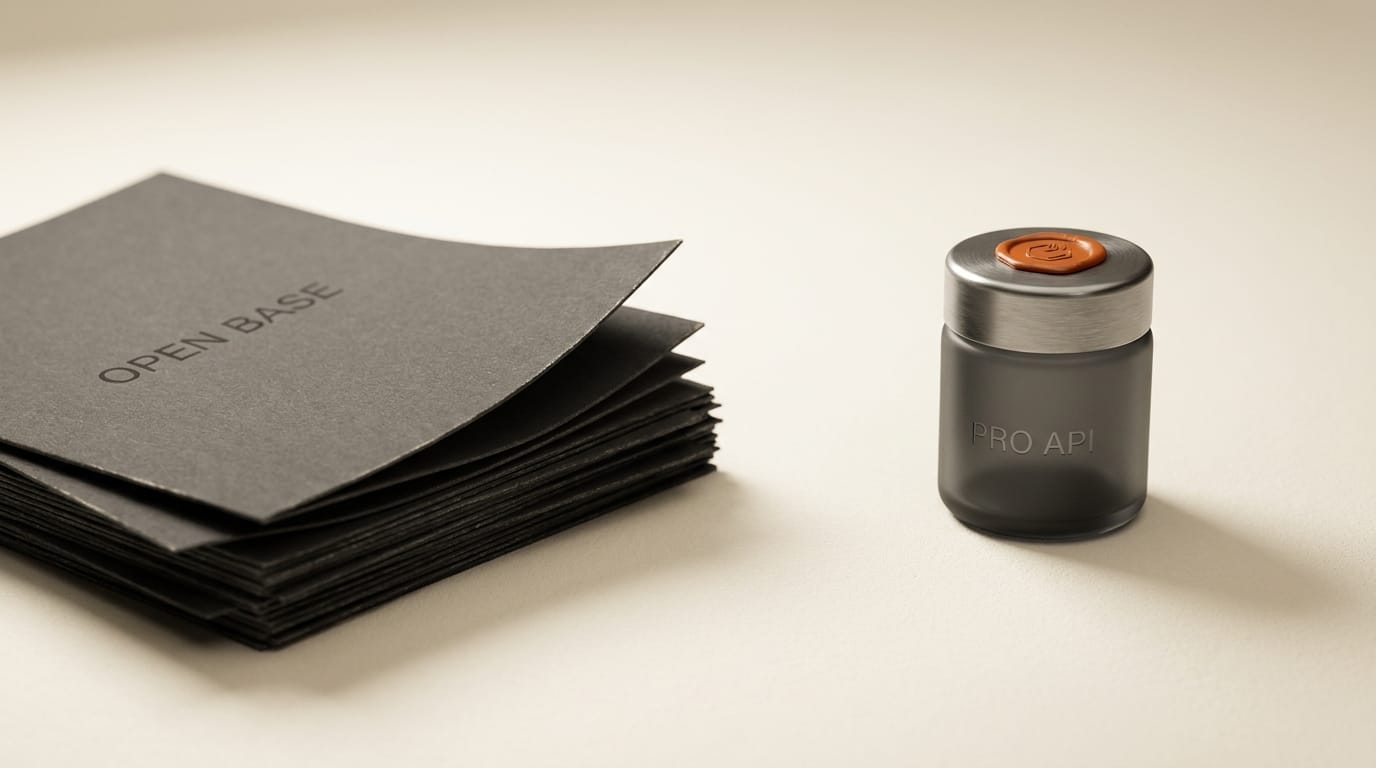
This works because the buyers are different. A creator self-hosting Qwen-Image-2.0 base wants the ability to fine-tune characters, train style LoRAs, and integrate the model into a graph in ComfyUI. They will not pay $0.075 per image to do that. A studio rendering 10,000 keyframes per month for client work wants reliability, leaderboard-grade quality, and someone else holding the GPU. They will pay $0.075 because the alternative is paying staff to keep self-hosting infrastructure running. Each segment leaves the other alone, and Qwen captures revenue from one without losing community goodwill in the other.
Pricing analysis: how $0.075 reshapes the market
Pricing is the mechanism here. Qwen-Image-2.0-Pro at $0.075 per 2K image is well under what the rest of the top-10 charges for comparable resolution. Midjourney V8.1 lands closer to $0.40 per render at typical usage. FLUX hosted endpoints sit around $0.05 to $0.06 per 1K image but charge premiums for 2K. GPT-Image-2 at OpenAI's API tier runs above $0.10 per high-quality output. Qwen-Image-2.0-Pro is the cheapest top-10 model at native 2K, full stop.
That is a price-floor reset, not an incremental discount. It means three things for the rest of the market. First, the $0.10-plus tier loses its top-of-funnel for studios who care about quality but cannot justify the spread. Second, the under-$0.05 tier (Flux Schnell, low-res Imagen) loses some of its moat because Qwen-Image-2.0 base is free to self-host for that price point. Third, Western labs pricing well above $0.075 will face a "why does Qwen do it for less" question on every procurement call. The competitive pressure runs uphill.
Multilingual text rendering as the under-discussed moat
Buried in the spec sheet is the most strategically interesting claim: Qwen-Image-2.0-Pro renders professional infographics, posters, comics, PPT slides, and other typography-heavy outputs in multiple languages. Western image models have struggled with this for years. Try generating a Cantonese restaurant menu with FLUX or a Japanese movie poster with Midjourney and the typography fails in subtle ways the AI cannot self-correct.
For Alibaba, this is not a feature; it is a market-fit lever. The buyer base for non-Latin-script image generation is enormous and underserved. Chinese, Japanese, Korean, Arabic, and Thai design studios have been forced to render text in Photoshop layers because the image models cannot get the script right. If Qwen-Image-2.0-Pro genuinely solves multilingual typography (early ModelScope tests suggest yes for Chinese and Japanese, mixed for Arabic), the product walks into a market where competitors do not credibly compete. That is a real moat, and it pairs naturally with Alibaba's existing distribution into Asian e-commerce, gaming, and entertainment.
Where Qwen's image stack fits in the broader Alibaba roadmap
Qwen-Image-2.0-Pro is one piece of a larger move. The same week, Alibaba shipped HappyHorse 1.0, which currently ranks first on the Artificial Analysis text-to-video leaderboard, plus the Qwen 3.6 Max preview on the LLM side, and the Qwen 3.6 27B open-weight release. The pattern across image, video, and language is identical: a top-tier proprietary endpoint plus a credible open-weights tier plus aggressive pricing. Alibaba is running the same playbook on every modality.
The strategic implication is that buyers can now standardize on Alibaba across modalities at a price point that no Western lab matches. For a studio in Singapore or Dubai building a multimodal pipeline, the option to run Qwen for image and HappyHorse for video and Qwen 3.6 for LLM, all from the same vendor, with both API and self-host paths available, is structurally novel. Adobe, Google, and Anthropic offer parts of this; nobody offers all four at this price.
Impact on Creators
For solo creators on a budget, the open Qwen-Image-2.0 base is the immediate win. It is free, MIT-licensed, runs in ComfyUI on consumer GPUs, and can be fine-tuned for character consistency. The Pro tier is overkill for individual creator use; the base will get most jobs done.
For studio production, Pro is the compelling option. Render 1,000 keyframes for a client at $0.075 per 2K image and you spend $75. Render the same batch on Midjourney V8.1 and you spend closer to $400. The leaderboard ranks are within striking distance for most styles. The cost differential is now large enough that creative directors will start asking to see Qwen comps in pitches, even on Western projects, because the budget math is too clean to ignore.
For non-English creative work, Qwen-Image-2.0-Pro becomes the obvious choice. If your client deck needs Chinese, Japanese, Korean, or Arabic typography rendered photorealistically, no Western model competes today. Pair Qwen for the image and Adobe Firefly's vector tools or Figma Weave for layout, and you have a multilingual production stack that did not exist six weeks ago.
For ComfyUI users, the existing Qwen base nodes already work in the graph. Adding the Pro API as an external node (curl or partner integration) is straightforward and fits the ComfyUI v0.20.1 release pattern of treating proprietary APIs as graph-callable resources alongside open weights.
Key Takeaways
- Two-tier monetization works. Open base for the community, paid Pro for studios. The buyers do not overlap, so Qwen captures both segments.
- $0.075 is a price-floor reset. Top-10 API quality at the cheapest 2K rate on the market puts pressure uphill on everyone above $0.10.
- Multilingual typography is the real moat. Non-Latin-script creative work is an under-served market and Qwen serves it credibly. Western labs are not close.
- Alibaba is running the same playbook on every modality. Image, video, and LLM all show the same proprietary-plus-open-plus-aggressive-pricing pattern.
- Creator action depends on segment. Solo creators stay on the free base. Studios doing client work test Pro on the next render batch and compare the bill.
- The proprietary license matters. Pro will not show up on Hugging Face. If your workflow requires self-hosted weights, Pro is not for you regardless of how the leaderboard reads.
What to Watch
Three signals over the next 60 days will determine whether this is a one-launch event or a market reset.
First, Western lab response. OpenAI, Google, and Black Forest Labs all publish API pricing and have the budget to cut. Whether any of them moves their high-end image API toward $0.075 in the next two release cycles tells us whether the price-floor reset is sustained competitive pressure or absorbed quietly. Watch the Imagen, GPT-Image, and FLUX hosted price cards for movement.
Second, agency adoption signal. The benchmark to watch is whether agency creative directors start including "Qwen comp" alongside "Midjourney comp" and "FLUX comp" in pitch decks. That is the fastest leading indicator of meaningful market share, because directors test what their next clients will ask for. Six to eight weeks is enough to see this in industry posts on Behance and Threads.
Third, the multilingual typography test in the wild. Early demos look strong, but the market judgment on "does it actually render Korean and Arabic correctly under stress" comes from designers using it for client deliverables. If the answer is yes, Qwen will pick up share fast in Asia and the Middle East regardless of what Western labs do. If the answer is no, Pro becomes a competitive English-language image API at a low price, which is still useful but a much smaller story.