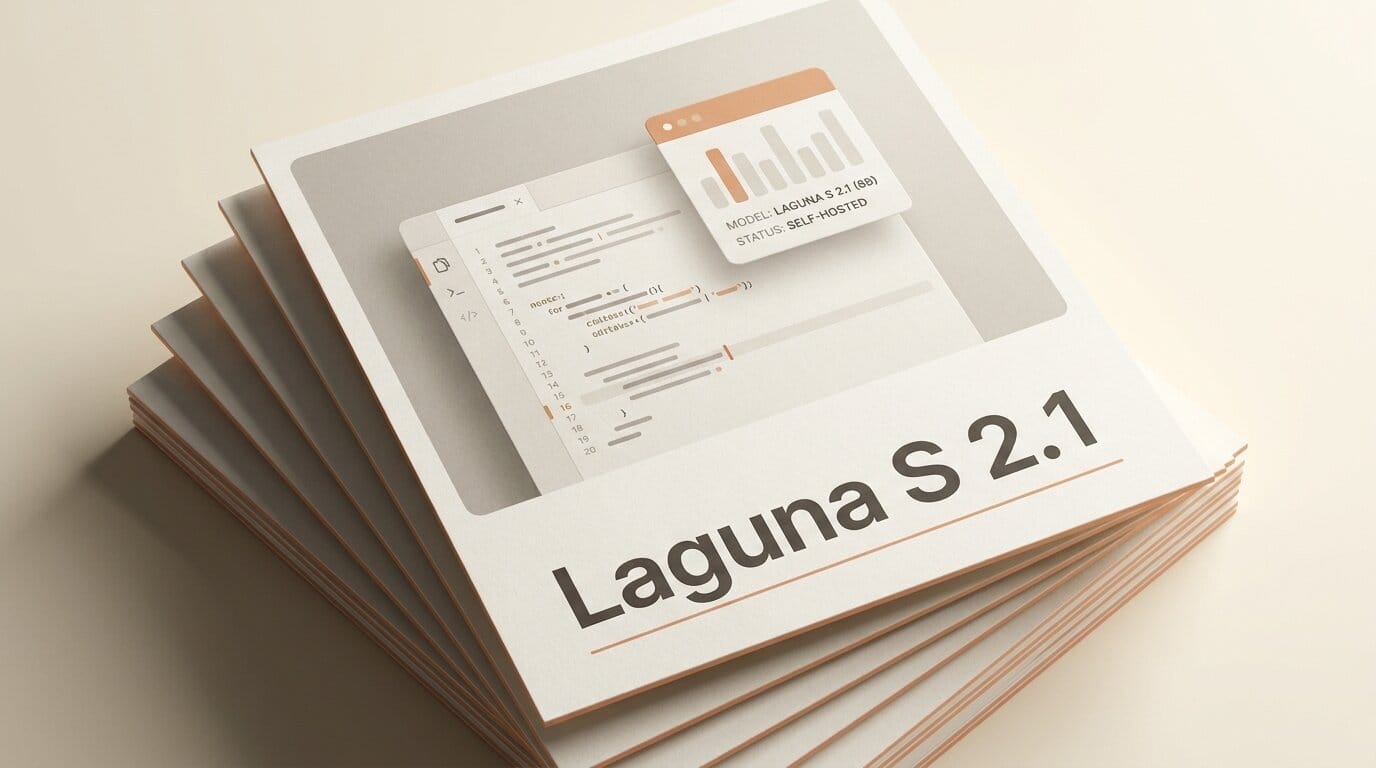
If you want an open-weight coding model you can actually self-host today, Laguna S 2.1 is the strongest answer in mid-2026. Poolside released it on July 21, 2026 as a 118B-total Mixture-of-Experts model that activates only 8B parameters per token, and on that tiny active footprint it beats agentic coding models many times its size. This comparison puts it against the two open-weight giants builders keep asking about, Moonshot's Kimi K3 and DeepSeek V4, on the axes that decide whether you can run a model yourself: active parameters, hardware footprint, license, benchmarks, and cost. Methodology note: the numbers below come from each lab's published specifications and evaluations, not a fresh benchmark we ran, and where a figure is a lab's own relative claim we say so.
Quick Picks
Pick Laguna S 2.1 if you want capable agentic coding running on hardware you own or on a cheap metered endpoint. Its 8B active parameters mean it fits on a single machine while scoring like models with far more compute in play, and you can try it first on a free web chat with no login.
Pick Kimi K3 if you want the largest open model on the table and a huge context window, and you have datacenter-class GPUs or are happy to rent them. It aims at the frontier, and it pays for that ambition in scale.
Pick DeepSeek V4 if you are already invested in the DeepSeek ecosystem and want its broad general capability, and you can serve a 1.6-trillion-parameter model or use a hosted provider that does it for you.

How the Three Compare
The single most important number for self-hosting is not total parameters, it is active parameters per token, because that is what drives the memory and compute you need to serve the model. Here is where the three land.
| Model | Total / active params | Weights available today | License | Minimum viable self-host |
|---|---|---|---|---|
| Laguna S 2.1 | 118B / 8B | Yes, on Hugging Face | OpenMDW-1.1 | Single NVIDIA DGX Spark |
| Kimi K3 | 2.8T (MoE) | Scheduled July 27, 2026 | Open weights | Datacenter-class multi-GPU |
| DeepSeek V4 (Pro Max) | 1.6T / 49B | Staged rollout | Open weights | Datacenter-class multi-GPU |
Active parameters and hardware footprint
This is Laguna's whole thesis. At 8B active parameters it runs on a single local DGX Spark, the kind of hardware a serious individual or small team can own. Kimi K3 is a 2.8-trillion-parameter model and DeepSeek V4 Pro Max activates 49B per token on a 1.6-trillion-parameter base, so both demand datacenter-class multi-GPU serving. If your goal is to take heavy agentic loops off metered APIs and onto your own metal, active-parameter count is the gate, and Laguna is on the right side of it by a wide margin.
Coding benchmarks
On absolute, published numbers, Laguna S 2.1 scores 70.2 percent on Terminal-Bench 2.1 with thinking enabled and 60.4 percent without, plus 59.4 percent on SWE-Bench Pro. Poolside reports that this places it eleventh on Terminal-Bench 2.1, behind only frontier closed models and Kimi K3, and that it surpasses DeepSeek-V4-Pro-Max on multiple benchmarks despite being roughly thirteen times smaller. Read that carefully: Kimi K3 is the one open model that still tops Laguna on this coding benchmark, but it does so at hundreds of times the active parameter count. For most builders, near-frontier coding at 8B active is the more useful trade.
License and weights availability
Laguna ships under the OpenMDW-1.1 license with weights on Hugging Face today, in BF16, FP8, INT4, and NVFP4 precisions, so you can pull it and serve it right now. Kimi K3 is open but its full weights are scheduled to drop on July 27, 2026, so as of this writing you cannot yet self-host it. DeepSeek V4 is rolling out on its own schedule. Availability today, not just an open license on paper, is what separates a model you can deploy this week from one you are waiting on.
Cost to run
If you do not want to own hardware, Laguna is live on a dedicated OpenRouter endpoint at 0.10 dollars per million input tokens, 0.20 dollars per million output tokens, and 0.01 dollars per million cache-read tokens, with a free endpoint offering 256K context. That pricing undercuts the closed coding leaders sharply, and because you can move the same weights to your own server later, you are not locked in. Kimi K3 and DeepSeek V4 are available through their own apps and providers, but their serving cost is dominated by their size.

When Each Model Wins
Laguna S 2.1 wins when self-hosting is the point. If you are wiring a coding agent into a pipeline and want to run heavy, repetitive agentic loops without a metered bill, an 8B-active model that scores near the frontier on Terminal-Bench is the pragmatic choice. It also wins on portability: prototype on the hosted endpoint, then move to your own DGX Spark without changing models.
Kimi K3 wins when you want maximum raw capability from an open model and can serve it, or use it in-app and via API while you wait for the weights. Its 2.8-trillion-parameter scale and one-million-token context target frontier work, and it is the open model that still edges Laguna on this specific coding benchmark. DeepSeek V4 wins for teams already standardized on DeepSeek who want its general breadth alongside coding.
One model that does not belong in this table is Alibaba's Qwen3.8-Max, which shipped as a closed preview rather than an open-weight release, part of a broader pattern of flagship models going closed. If open weights are a hard requirement, it is out, and that is exactly why availability and license belong at the center of this comparison rather than benchmark scores alone.
The Self-Host Workflow: Wiring Laguna Into Your Coding Agent
The reason active-parameter efficiency matters is that it makes a concrete workflow possible. Start on the hosted endpoint to validate quality: point your agent at the OpenRouter Laguna endpoint using an OpenAI-compatible base URL and the model id, and run your normal coding tasks. Once you are satisfied, pull the weights from Hugging Face and serve them locally with vLLM or SGLang, both supported from day one, or run a quantized build through a local runner. Then repoint the same agent, whether that is Claude Code, Cursor, or an open-source CLI like Grok Build, from the hosted base URL to your local one. Nothing about your agent configuration changes except the endpoint, which is the entire advantage of a small, portable open-weight model. Heavy agentic loops that would rack up token costs on a closed API now run on hardware you control.
The economics compound over a real project. A closed frontier coding model charges by the token, and agentic workflows are token-hungry by nature, looping through plan, edit, test, and repair cycles that can run thousands of calls in an afternoon. Move that loop onto a self-hosted 8B-active model and the marginal cost of each iteration approaches your electricity bill. That is the practical reason active-parameter efficiency, not leaderboard position, is the number that changes how you work.
Verdict
For the specific question of which open-weight coding model you can self-host today, Laguna S 2.1 is the pick. It is the only one of the three with weights you can pull right now, it fits on a single machine because it activates just 8B parameters, and it still lands near-frontier coding scores, behind only Kimi K3 among open models and ahead of a DeepSeek model thirteen times its size. Kimi K3 is the stronger raw model and worth revisiting when its weights land on July 27, but it asks for datacenter hardware. If your plan is to move real agentic work off metered APIs and onto your own metal, Laguna is the model that makes that plan realistic this week.
Frequently Asked Questions
Can I run Laguna S 2.1 without a GPU cluster?
Yes. Because it activates only 8B parameters per token, it fits on a single NVIDIA DGX Spark and serves through vLLM, SGLang, or a local runner. That is the core reason it is more self-hostable than Kimi K3 or DeepSeek V4.
Is Laguna S 2.1 actually better than Kimi K3 at coding?
Not on the headline benchmark. Poolside reports Kimi K3 still ranks above Laguna on Terminal-Bench 2.1. But Kimi K3 does so at vastly higher active parameter count, so Laguna offers a much better capability-per-dollar and capability-per-watt trade for most builders.
What does the OpenMDW-1.1 license allow?
OpenMDW-1.1 is the open license Poolside ships Laguna under, with weights posted on Hugging Face in multiple precisions. Confirm the exact terms for commercial use against the license text before deploying in production.
How much does the hosted Laguna endpoint cost?
The dedicated OpenRouter endpoint is priced at 0.10 dollars per million input tokens and 0.20 dollars per million output tokens, with a free endpoint offering 256K context. You can prototype there and move to self-hosting without switching models.
When can I self-host Kimi K3 or DeepSeek V4 instead?
Kimi K3's full open weights are scheduled for July 27, 2026, and DeepSeek V4 is rolling out on its own timeline. Both are worth reconsidering once their weights are broadly available and you have the hardware to serve models at trillion-parameter scale.