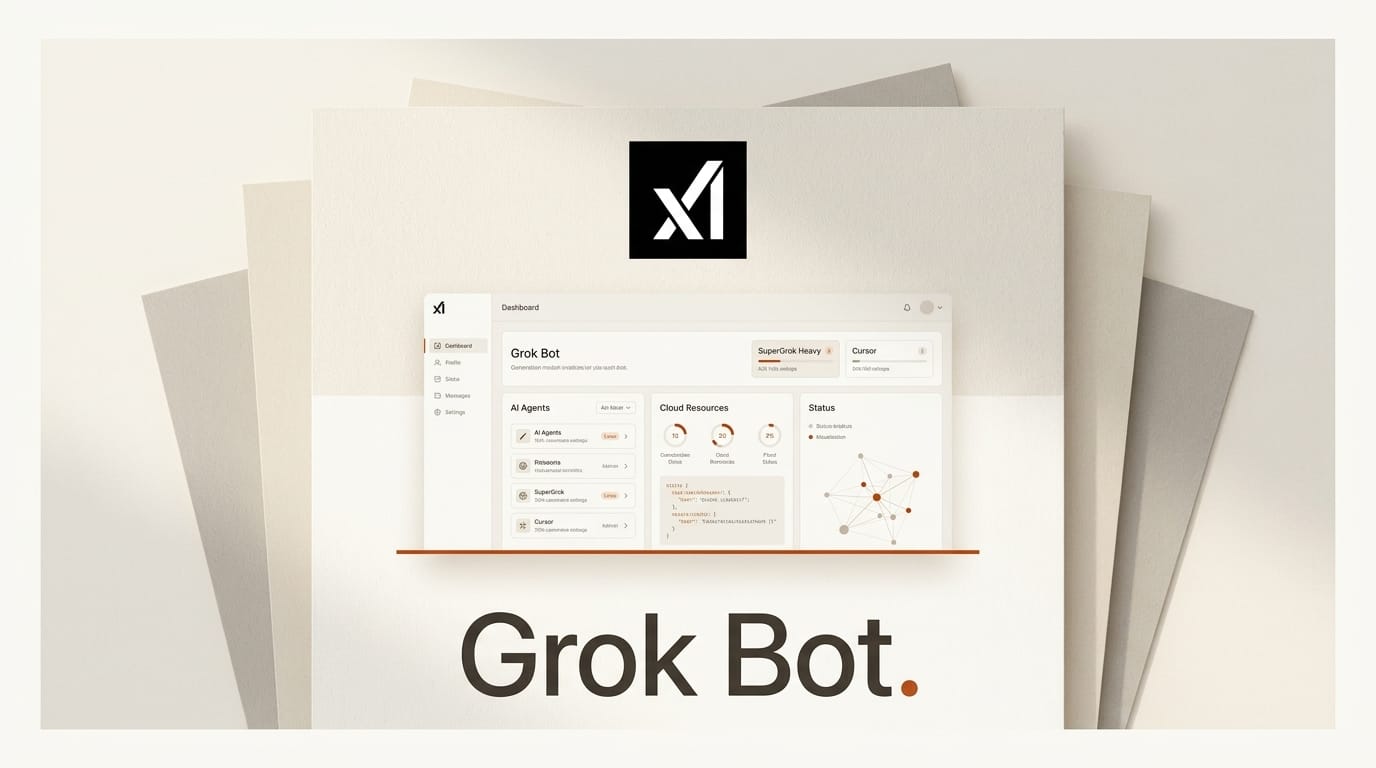
On August 11, 2026, xAI launched Grok Bot, a beta product that turns Grok into a team of always-on AI agents rather than a chat window you talk to. Each bot gets its own cloud computer, signs into your apps and websites the way you do, and keeps working after you close the tab. It is available first to SuperGrok Heavy, Cursor Ultra, and Cursor Teams Premium subscribers on desktop and iOS, with enterprise customers on a waitlist.
This is xAI's answer to the office-agent race that Anthropic opened with Claude Cowork in January 2026. Instead of another coding assistant, Grok Bot targets the general knowledge work most creators and small teams actually spend their day on: research, publishing operations, inbox triage, and repeatable multi-step tasks. Here is what it does, how it compares to the alternatives, and where it fits into a creator workflow.
What Grok Bot Actually Is
Grok Bot is a system of persistent agents that xAI describes as AI teammates. According to the official Grok Bot documentation, each named bot runs on a dedicated cloud computer with a browser, filesystem, and terminal, and it keeps memory, files, browser sessions, and preferences across turns. You do not build a workflow or wire up nodes. You message a bot like a colleague, it completes the task end to end, and it asks for approval when it hits something that needs a human decision.
The headline capability is delegation without configuration. A bot can sign into your existing tools, work across apps and inboxes, and follow a task through to completion. xAI cites internal examples such as a sales bot that updates a CRM from call transcripts, an operations bot that onboards employees and processes Gmail invoices, and an engineering bot that reproduces bugs and files tickets. The company reports two to three times efficiency gains from internal staff testing, though no independent benchmarks are available yet, so treat that number as a vendor claim.

Grok Bot vs Claude Cowork vs OpenClaw
Grok Bot enters a field with two very different competitors: Anthropic's hosted Claude Cowork and the community-run, self-hosted OpenClaw. The split comes down to where the agent runs, what it costs, and how much control you keep.
| Feature | Grok Bot | Claude Cowork | OpenClaw |
|---|---|---|---|
| Maker | xAI | Anthropic | Community foundation (501c3) |
| Launched | Aug 11, 2026 (beta) | Jan 12, 2026 | 2026 (open source) |
| Where it runs | xAI cloud computer | Anthropic cloud plus desktop | Self-hosted on your hardware |
| Model | Grok | Claude | Model-agnostic (Claude, GPT, Gemini, local) |
| Access | SuperGrok Heavy, Cursor Ultra, Cursor Teams Premium | Max plan ($100/mo) | Free, MIT license |
| Platforms | Desktop, iOS | Desktop, web, mobile | 20-plus messaging apps |
| Multi-agent | Parallel bots share one computer | Background tasks | Single agent per instance |
| Best for | Delegated office operations | Autonomous knowledge work | Privacy and tinkering |
Claude Cowork got here first and has scale to show for it: Anthropic's data from 1.2 million sessions found that more than 90 percent of Cowork usage is not coding but business operations and content creation, and TechCrunch framed the trend as the coding-agent wars spilling into the rest of the office. OpenClaw takes the opposite path: it is MIT-licensed, runs on your own machine, is model-agnostic, and went from zero to roughly 250,000 GitHub stars in about 60 days. Grok Bot sits between them, hosted and polished like Cowork but built around many bots working in parallel.
How Grok Bot Works: One Persistent Cloud Computer
The architecture is the most interesting part. Rather than giving every bot an isolated sandbox, xAI puts all of a user's bots on one shared, user-scoped cloud computer. They can run in parallel, message each other, share context in threads or group chats, and pass ownership of a task between them. A coordinator bot can hand a subtask to a specialist bot and collect the result, which is closer to how a real team divides labor than a single agent looping on its own.
The second key feature is learning by watching. You ask a bot to follow along once through a multi-step or multi-system path, it persists that path as a routine, and it can re-run the routine on a schedule or on demand. Combined with persistent memory and saved browser sessions, that turns a one-time walkthrough into a reusable automation without any scripting. For anyone who has fought with brittle no-code automations, this is the pitch that matters. To understand the underlying assistant, the Grok chatbot background is a useful primer on the model powering the bots.
What This Enables for Creators
For a solo creator or a small studio, the appeal is offloading the operations layer that surrounds the actual creative work. A research bot can gather sources, pull quotes, and assemble a brief while you sleep. A publishing bot can take a finished draft, format it for your CMS, schedule social posts, and update a content calendar. An assets bot can rename, tag, and file exports into the right folders. Because the bots keep browser sessions and logins, they can operate inside the same tools you already use instead of forcing everything through an API.
The realistic way to try it: pick one repetitive, low-risk chore you do every week, walk a bot through it once, and let it save the routine. Keep approvals on for anything that sends email, spends money, or publishes externally. Because independent benchmarks do not exist yet and the product is in beta, do not hand it irreversible actions until you have watched it complete the same task cleanly a few times. Start with drafting and organizing, not one-click publishing.
How to Get Access
Grok Bot is in beta today on desktop and iOS for three subscription tiers: SuperGrok Heavy, Cursor Ultra, and Cursor Teams Premium. Enterprise customers can join a waitlist. xAI has not published standalone pricing for the bot beyond membership in those tiers, and API access, usage limits, and general availability are not yet documented. If you are not already on one of the eligible plans, the practical move is to wait for the enterprise or lower-tier rollout rather than upgrading solely for a beta.
The Bigger Picture
Grok Bot lands in a crowded month for office agents. Claude Cowork expanded to mobile and web in July 2026, OpenClaw became one of the most-starred projects on GitHub, and now xAI is shipping a parallel-agent take on the same idea. The common thread is that the frontier of AI assistants has moved from answering questions to doing multi-step work across your real tools. xAI has been pushing on several fronts at once, including its recent Grok Voice speech model, and Grok Bot is the agentic piece of that strategy.
Frequently Asked Questions
Is Grok Bot free?
No. Grok Bot is in beta and limited to SuperGrok Heavy, Cursor Ultra, and Cursor Teams Premium subscribers. There is no free tier at launch. For a free, self-hosted alternative, OpenClaw is MIT-licensed and runs on your own hardware.
What can Grok Bot actually do?
It completes multi-step tasks across your apps: signing into tools, updating a CRM from call notes, processing invoices, onboarding steps, reproducing bugs, and filing tickets. It asks for approval on decisions and can save a task as a reusable routine after watching you do it once.
How is Grok Bot different from Claude Cowork?
Both target general office work rather than pure coding, and both run tasks in the background. The main difference is architecture: Grok Bot puts multiple bots on one shared cloud computer so they can run in parallel and hand off work, while Claude Cowork centers on a single autonomous agent available across desktop, web, and mobile. The Grok platform underpins xAI's version.
Is my data safe on the Grok Bot cloud computer?
Bots run on xAI-hosted infrastructure and store logins, files, and browser sessions to work across apps, so you are trusting a third-party cloud with those credentials. If you need data to stay on your own machine, a self-hosted option like OpenClaw is the better fit. Keep approvals on for sensitive actions during the beta.
Can Grok Bot write and ship code?
It can handle engineering chores such as reproducing bugs and filing tickets, and it is available to Cursor Ultra and Cursor Teams Premium users. That said, xAI positions it as a general office agent, not a dedicated coding tool, so pair it with a purpose-built coding agent for heavy development.
How do I get access to Grok Bot?
Subscribe to SuperGrok Heavy, Cursor Ultra, or Cursor Teams Premium and use the desktop or iOS app. Enterprise teams can request access through the waitlist. Standalone pricing and general availability have not been announced.