Google's Gemma 4 E2B, the 2-billion-parameter edge model released on April 2, 2026, is proving more capable than its size suggests. Developers running the model locally through LM Studio and Spring AI are reporting reliable structured JSON output, multi-step tool calling, reasoning traces, and real code review that caught an actual Java bug. For creators building private, cost-free AI workflows, a 2B model that handles agentic tasks is a meaningful shift.
What Gemma 4 E2B Is
Gemma 4 is Google DeepMind's most capable open model family to date, and the E2B variant is built specifically for edge and mobile hardware. "Effective 2B" means the active parameter count during inference stays at roughly 2 billion, letting the model run on consumer laptops and phones without swapping memory.
The full Gemma 4 family spans four sizes: E2B (phones and IoT), E4B (mid-range edge), 26B MoE (consumer GPUs), and 31B Dense (workstations). All four share the same architecture improvements: 256K token context window, 140-language coverage, multimodal input support, and native function calling baked into the model's weights with six dedicated special tokens. The E2B is the smallest and most constrained, which makes the tool-calling results especially notable.
How Gemma 4 2B Handles Tool Calling

Most small models struggle to generate reliable structured function calls. They hallucinate parameter names, return invalid JSON, or break mid-schema. Gemma 4's architecture addresses this directly: Google fine-tuned the entire family to generate structured outputs and invoke function calls based on system instructions, using six dedicated tokens to signal tool declarations, function calls, and responses.
According to Google's function calling documentation, the workflow follows four stages:
- Define tools with JSON Schema or raw Python functions (Gemma auto-generates schemas from type hints and docstrings)
- Model generates structured function call objects instead of plain text
- Developer parses and executes the calls against real systems
- Model processes the results and produces a natural language response
The same architecture applies to structured JSON output: constrained decoding forces outputs to match a provided schema with correct keys, types, and required fields. For pipelines that need predictable data shapes, this means you get reliable parsing instead of regex hacks.
The Spring AI + LM Studio Setup
The workflow that community developers are demonstrating uses two tools together. LM Studio runs the Gemma 4 E2B model locally, exposing an OpenAI-compatible API endpoint on localhost. Spring AI, the Java/Spring Boot framework for AI integration, connects to that endpoint and handles tool registration, conversation history, and response parsing.
The combination means Java backend developers can build AI agent features without sending data to external APIs. The entire pipeline runs on the developer's machine. LM Studio handles model serving and hardware acceleration; Spring AI handles the application-layer orchestration.
For Python-based workflows, the same local model approach works through Ollama's API. Ollama with Gemma 4 follows the same pattern: local inference, OpenAI-compatible endpoints, and tool registration at the framework level. The underlying model behavior is identical regardless of the serving layer.
Reasoning Traces
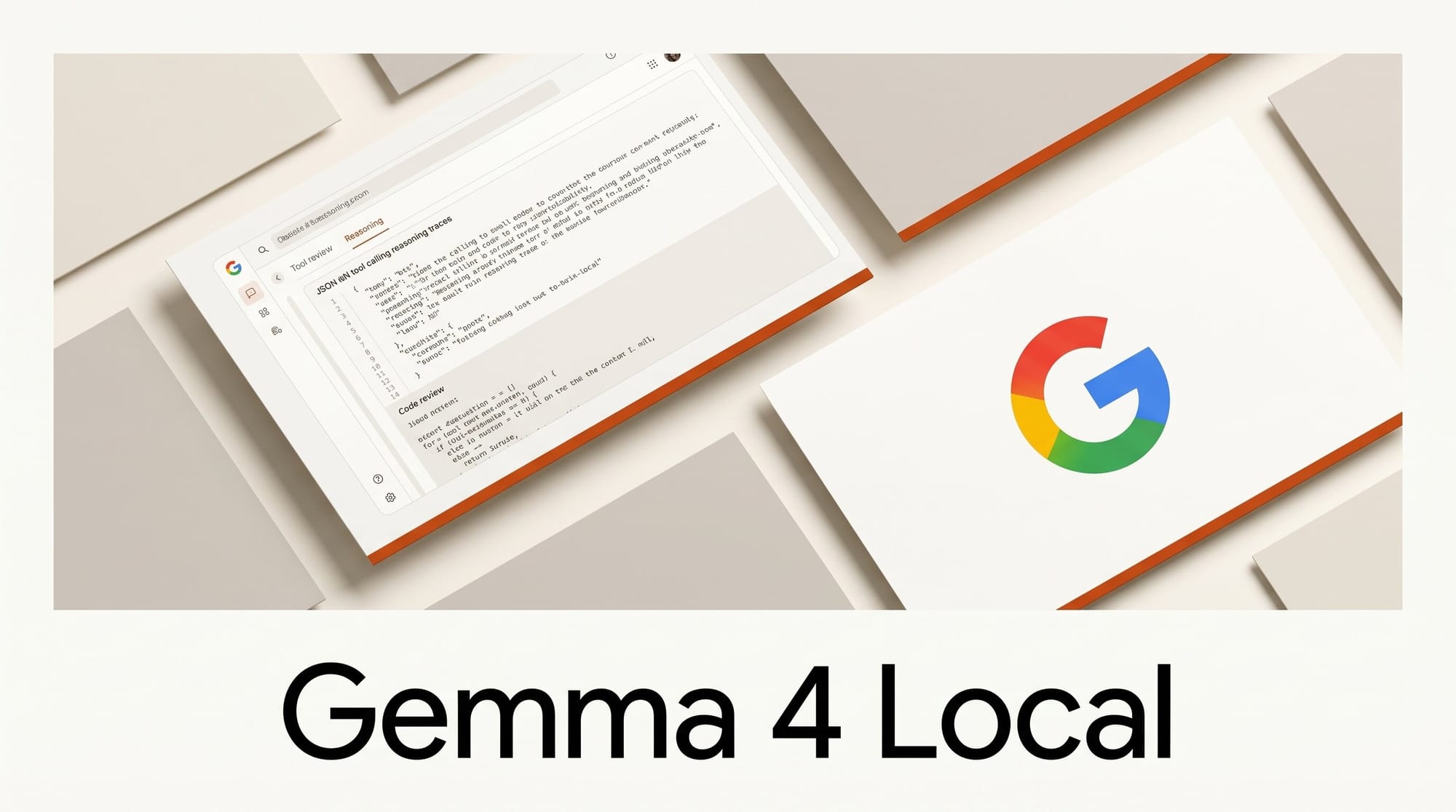
Gemma 4 supports configurable thinking modes across all model sizes, including E2B. When enabled, the model produces a chain-of-thought reasoning block before committing to a final answer. On the 31B model, these traces can run to 4,000+ tokens. On the 2B model the depth is shorter, but community testing shows the model consistently using multi-step reasoning before generating tool calls, which improves accuracy on complex requests.
For agentic workflows, visible reasoning is practically useful: you can inspect why the model called a particular tool, catch errors before execution, and build better debugging tooling. A model that silently generates wrong function calls is harder to fix than one that shows its work.
Code Review: The Java Bug
The standout result from community testing is Gemma 4 E2B correctly identifying a real Java bug during a code review task run through the Spring AI integration. The model was given code with a logic error, asked to review it, and flagged the actual defect rather than generating plausible-but-wrong feedback.
This matters because code review is a high-stakes workflow where hallucinated confidence is actively harmful. A model that invents non-existent bugs or misses real ones costs developer time. A 2B model running locally that reliably finds real defects becomes a practical tool for teams that cannot or will not send proprietary code to cloud APIs.
For creators building developer tools, this opens an interesting possibility: code review agents that run entirely on-device, at zero API cost, without sharing source code. The Framedex approach to local AI processing applies the same logic to video indexing; the pattern generalizes to any workflow where data privacy and cost matter.
Comparison: Gemma 4 2B vs Other Small Local Models for Tool Calling

| Model | Params | Native Tool Calling | Structured JSON | Reasoning Traces | Local via LM Studio |
|---|---|---|---|---|---|
| Gemma 4 E2B | 2B | Yes (native) | Yes (constrained) | Yes (configurable) | Yes |
| Qwen 3.5 1.7B | 1.7B | Yes | Yes | Yes | Yes |
| Llama 4 Scout (MoE) | ~17B active | Yes | Yes | Limited | Requires high VRAM |
| Phi-4 Mini | 3.8B | Partial | Partial | No | Yes |
| Mistral 7B v0.3 | 7B | Yes | Yes | No | Yes |
Gemma 4 E2B is the smallest model in this class that combines all three capabilities natively, without fine-tuning. Qwen 3.5 1.7B is a close alternative for pure tool-calling tasks and is even smaller. The key differentiator for Gemma 4 is the reasoning trace support at 2B scale, which Qwen does support but Phi-4 Mini does not.
What Creators Can Build With This

The practical applications for this capability set break into three categories:
Private code assistants. Code review, refactoring suggestions, and documentation generation that never leaves the developer's machine. Useful for teams under NDA or working in regulated industries.
Structured data extraction. Parse documents, emails, or logs into JSON schemas without cloud API costs. A 2B model running on a laptop can process thousands of documents per hour at zero marginal cost.
Local workflow automation. Connect Gemma 4 to local tools (file system, databases, APIs) via Spring AI or Ollama-based frameworks to build agents that run without internet access. Think of it as a private Claude Code but on a 2B model, with the trade-off being lower capability on complex tasks.
For a reference point on what lightweight local agents look like in production, the Zerostack approach to minimal coding agents shows how constrained, purpose-built agents outperform general models on specific tasks.
Frequently Asked Questions
Can Gemma 4 E2B actually run on a laptop without a GPU?
Yes, with quantization. LM Studio supports Q4 and Q8 quantized versions of Gemma 4 E2B that run on CPU-only machines, though inference will be slower. A modern laptop with 8GB RAM can run it. GPU acceleration via Metal (Mac) or CUDA (Nvidia) is recommended for usable speed on longer tasks.
Is the Apache 2.0 license truly permissive for commercial use?
Yes. Gemma 4's Apache 2.0 license allows commercial use, modification, and distribution. You can build and sell products built on Gemma 4 without royalties. Check Google's Gemma Terms of Service for any additional restrictions on specific use cases.
How does Spring AI connect to a local LM Studio model?
LM Studio exposes a local server at http://localhost:1234/v1 using OpenAI-compatible endpoints. Spring AI's OpenAI client can point to this base URL instead of the cloud API. You set the API key to any non-empty string (LM Studio does not validate it locally), configure your tools, and the rest of the Spring AI API works identically.
Does the E2B model support vision/image input for code review?
Yes. All Gemma 4 models, including E2B, support multimodal input: text, images, video, and audio. For code review specifically, you can send screenshots of code alongside text prompts. In practice, pasting code as text is more reliable and produces better structured outputs than image-based input.
What is the quality difference between Gemma 4 E2B and GPT-4o Mini for tool calling?
GPT-4o Mini is significantly stronger on complex multi-step tool chains and edge cases. Gemma 4 E2B's advantage is locality, cost, and privacy. For deterministic, well-defined tool schemas with limited branching, E2B performs competitively. For open-ended agentic tasks with many tools, cloud models still lead. The right choice depends on your privacy requirements and task complexity.
What hardware do you need to run the 26B or 31B Gemma 4 models with tool calling?
The 26B MoE model (3.8B active parameters during inference) runs on consumer GPUs with 8-16GB VRAM. The 31B Dense model needs 24GB+ VRAM at full precision, or 16GB with Q4 quantization. For tool-calling workflows where the 2B model is insufficient, the 26B MoE is the practical next step.
What to Do Next
If you want to test this setup today, the fastest path is downloading LM Studio, pulling the Gemma 4 E2B model from the LM Studio model library (search "gemma-4-e2b" in the Models tab), and starting the local server. From there, you can connect via any OpenAI-compatible client. For a complete local agent setup with Ollama, the Analytics Vidhya Gemma 4 tool calling guide covers the Python-side setup step by step.
Spring AI integration requires a Spring Boot project with the Spring AI dependency. Point the base URL to your LM Studio instance, define tools as Java methods with @Tool annotations, and the framework handles the rest. Google's official function calling documentation covers the exact token protocol if you want to understand what the model is doing under the hood.