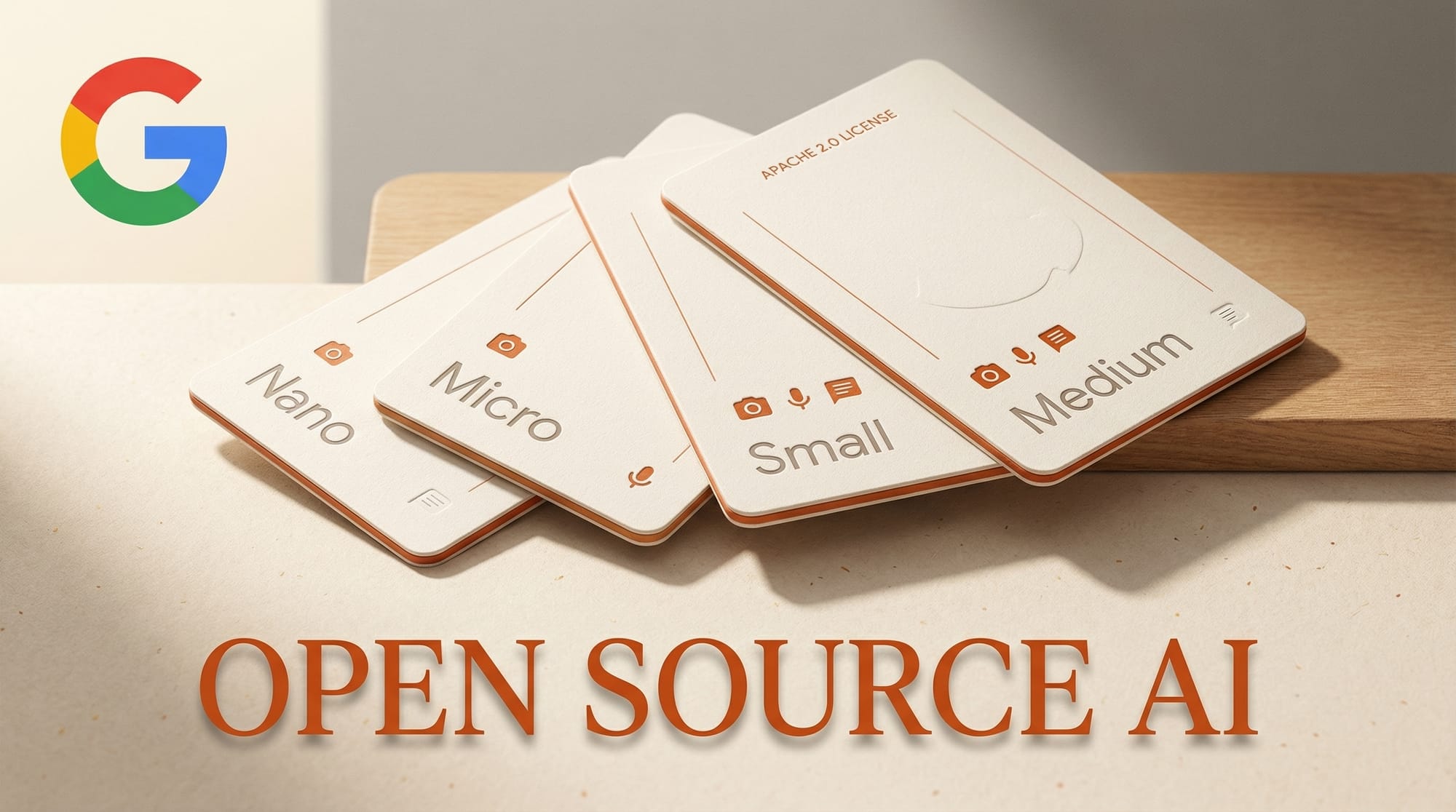
Google just released Gemma 4, a family of four open multimodal models that represent the biggest leap in open-source AI capability this year. The 31B dense model scores 89.2% on AIME 2026, quadrupling its predecessor's 20.8%. All four variants ship under Apache 2.0, process images and video natively, and include built-in function calling for agentic workflows. The smallest model fits on a smartphone. For creators, developers, and businesses building on open models, this release fundamentally changes what is possible without paying for API access.
Background
Google's Gemma series has been the company's answer to an uncomfortable question: how does a cloud-first business compete in the open-model market? The first Gemma launched in early 2024 as a capable but limited text-only model. Gemma 3 added vision and expanded to 27 billion parameters, but it still lagged behind Meta's Llama and Alibaba's Qwen series in multimodal breadth. More critically, Gemma shipped under a custom license with vague restrictions that made enterprise legal teams nervous.
Gemma 4 addresses every one of those gaps simultaneously. It is built on the same foundation as Google's Gemini 3 family, inheriting architecture innovations that were previously locked behind Google's API paywall. The release comes amid an increasingly aggressive open-model race, with Qwen, Mistral, and Meta all shipping competitive multimodal models in 2026.
Deep Analysis
The Apache 2.0 Gambit
The most consequential change in Gemma 4 is not a benchmark score. It is the license. Google abandoned its custom Gemma Use Policy in favor of a standard Apache 2.0 license, the same permissive terms used by Qwen, Mistral, and most of the open-weight ecosystem.
This matters because the old Gemma license included ambiguous "Harmful Use" restrictions that required legal interpretation. Enterprise teams building production applications often defaulted to Llama or Qwen rather than risk compliance issues. Apache 2.0 eliminates that friction entirely: no custom clauses, no redistribution restrictions, no commercial deployment limits.
The timing is strategic. Mistral just committed $830 million to sovereign AI infrastructure partly on the strength of its permissive licensing. Meta's Llama models continue to dominate enterprise adoption. By matching their licensing terms while shipping a more capable model, Google is making a direct play for the developer ecosystem it has been losing.
Four Models, One Architecture
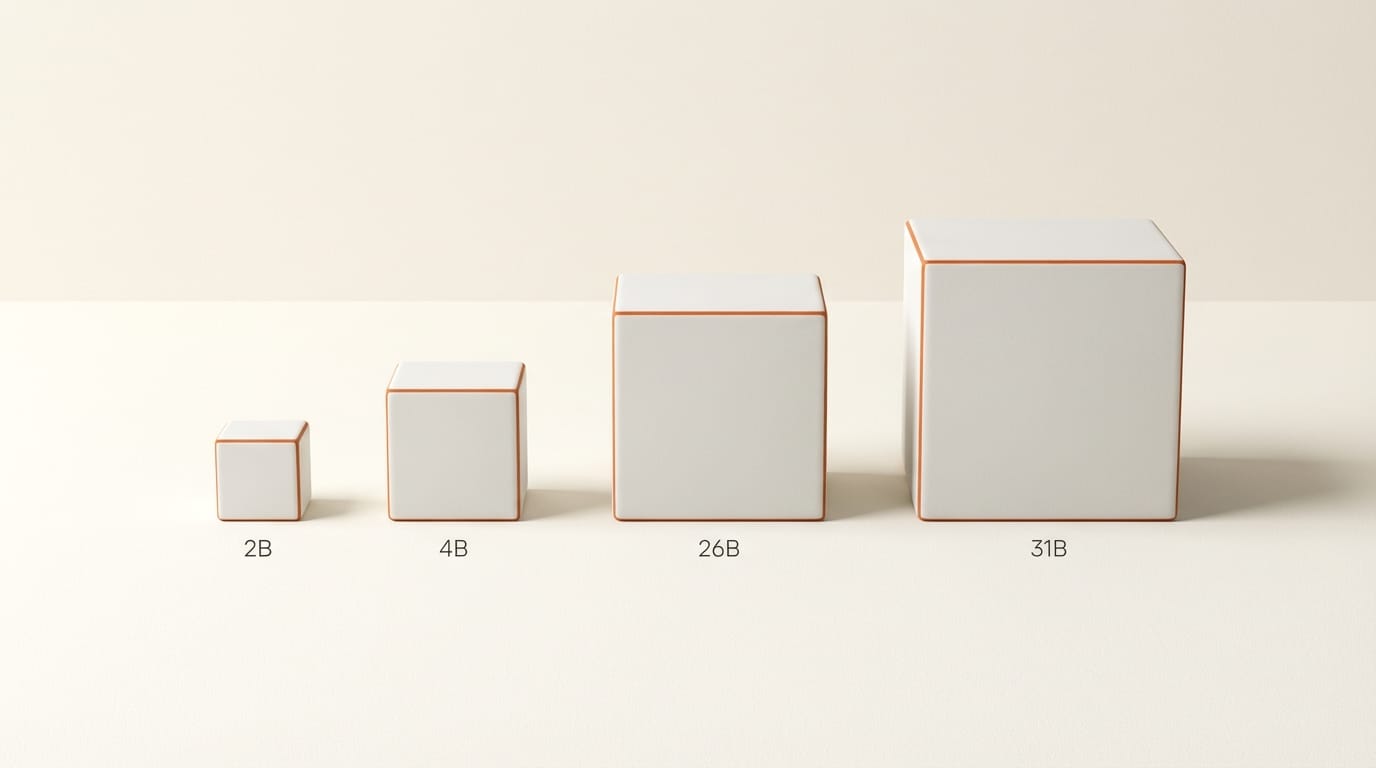
Gemma 4 ships as four distinct models, each targeting a different compute tier:
| Model | Parameters | Type | Context | Target |
|---|---|---|---|---|
| E2B | 2.3B effective | MoE | 128K | Smartphones, IoT |
| E4B | 4.5B effective | MoE | 128K | Edge devices, laptops |
| 26B A4B | 26B total, 4B active | MoE | 256K | Consumer GPUs |
| 31B | 31B dense | Dense | 256K | Workstations, servers |
The architectural innovations are significant. All four models use alternating local and global attention layers, with sliding windows of 512 tokens (small models) or 1024 tokens (large models) paired with full-context global layers. This hybrid approach enables the 256K context window on the larger models without the quadratic memory scaling that makes long-context inference expensive.
A new Per-Layer Embeddings (PLE) system feeds a dedicated residual signal into every decoder layer, combining token-identity and context-aware components. The result is greater specialization per layer at modest parameter cost. For the MoE models, a shared KV cache across the final layers further reduces memory requirements during generation.
Every model processes images and video natively with variable resolution support, using a configurable visual token budget (70 to 1,120 tokens) that lets developers trade detail for speed. The E2B and E4B models add native audio input via a USM-style conformer encoder, making them true any-to-text models for edge deployment.
The Reasoning Leap

The benchmark numbers tell a story of a model family that has leapfrogged its own class. The 31B dense model scores 89.2% on AIME 2026, a rigorous mathematical reasoning test where Gemma 3 27B scored just 20.8%. That is not incremental improvement. It is a generational jump.
The gains extend across every category. LiveCodeBench v6 jumps from 29.1% to 80.0%. GPQA Diamond, which tests graduate-level scientific reasoning, rises from 42.4% to 84.3%. The agentic benchmark (tau2-bench) shows the most dramatic shift: from 6.6% to 86.4%, reflecting the new native function-calling and tool-use capabilities.
On LMArena's text leaderboard, the 31B model ranks #3 among all open models with a score of 1,452, up from Gemma 3's 1,365. The 26B MoE model is close behind at 1,441, despite activating only 4 billion parameters during inference. That efficiency ratio, achieving near-flagship performance with a fraction of the compute, is the real engineering achievement.
Extended thinking mode, activated via a simple token flag, allows all models to reason step-by-step before answering. This configurable approach means developers can toggle between fast responses and deep reasoning without swapping models or endpoints.
Edge AI Gets Practical
The E2B and E4B models deserve separate attention. At 2.3 billion and 4.5 billion effective parameters respectively, they are small enough to run on a smartphone, yet they process text, images, video, and audio natively. The E4B scores 42.5% on AIME 2026 and 52.0% on LiveCodeBench, numbers that would have been competitive for a full-sized model just two years ago.
NVIDIA has optimized all four models for RTX GPUs, DGX Spark, and Jetson Orin edge modules. With Q4_K_M quantization through llama.cpp, the models run efficiently across NVIDIA's hardware stack from data center to desktop. Apple Silicon users get MLX support with TurboQuant compression that cuts memory use by 4x.
The practical implication for creative professionals is significant. A photographer could run E4B locally on a laptop to analyze, tag, and describe images without sending data to any cloud service. A video editor could use it to generate descriptions, extract key moments, or transcribe voiceovers entirely offline. The models are available through Ollama with a single command, removing the friction that historically kept local AI models out of creative workflows.
Impact on Creators
Gemma 4 shifts the economics of AI-assisted creative work in three ways. First, the multimodal capability across all model sizes means creators no longer need separate models for text, vision, and audio tasks. A single local model can handle image analysis, video understanding, transcription, and text generation. Second, the Apache 2.0 license removes the legal ambiguity that prevented commercial use of Gemma in production tools and plugins. Third, the edge models make privacy-first workflows viable for the first time at this quality level.
For tool builders, the native function calling and agentic capabilities (86.4% on tau2-bench) mean Gemma 4 can drive complex multi-step workflows: analyze an image, search a database, format output, and call external APIs, all within a single model inference chain. This is the foundation for the next generation of open-source creative AI tools that do not depend on cloud APIs.
Key Takeaways
- Gemma 4 ships four models (2.3B to 31B) under Apache 2.0, all processing text, images, and video natively
- The 31B model scores 89.2% on AIME 2026, quadrupling Gemma 3's 20.8%, and ranks #3 on LMArena's open text leaderboard
- Native function calling and extended thinking make it the first open model family purpose-built for agentic workflows
- Edge models (E2B, E4B) add audio understanding and run on smartphones, enabled by MoE architecture and shared KV cache
- The license switch from custom Gemma terms to standard Apache 2.0 removes the biggest barrier to enterprise and commercial adoption
What to Watch
The real test for Gemma 4 is adoption velocity. Meta's Llama ecosystem has a massive head start in tooling, fine-tuning recipes, and community infrastructure. Google is countering with day-one support across Hugging Face, Ollama, llama.cpp, MLX, Unsloth Studio, and NVIDIA's RTX stack, but ecosystem momentum takes months to build.
Watch for creative tool integrations. If plugins for Blender, DaVinci Resolve, or ComfyUI start shipping with Gemma 4 as the default local model, it will signal a real shift in how creators interact with AI. The multimodal-everywhere architecture and permissive license make it the strongest candidate for that role today. The question is whether Google can sustain the update cadence that Qwen and Meta have established, or whether Gemma 4 becomes another strong release that fades as competitors iterate faster.