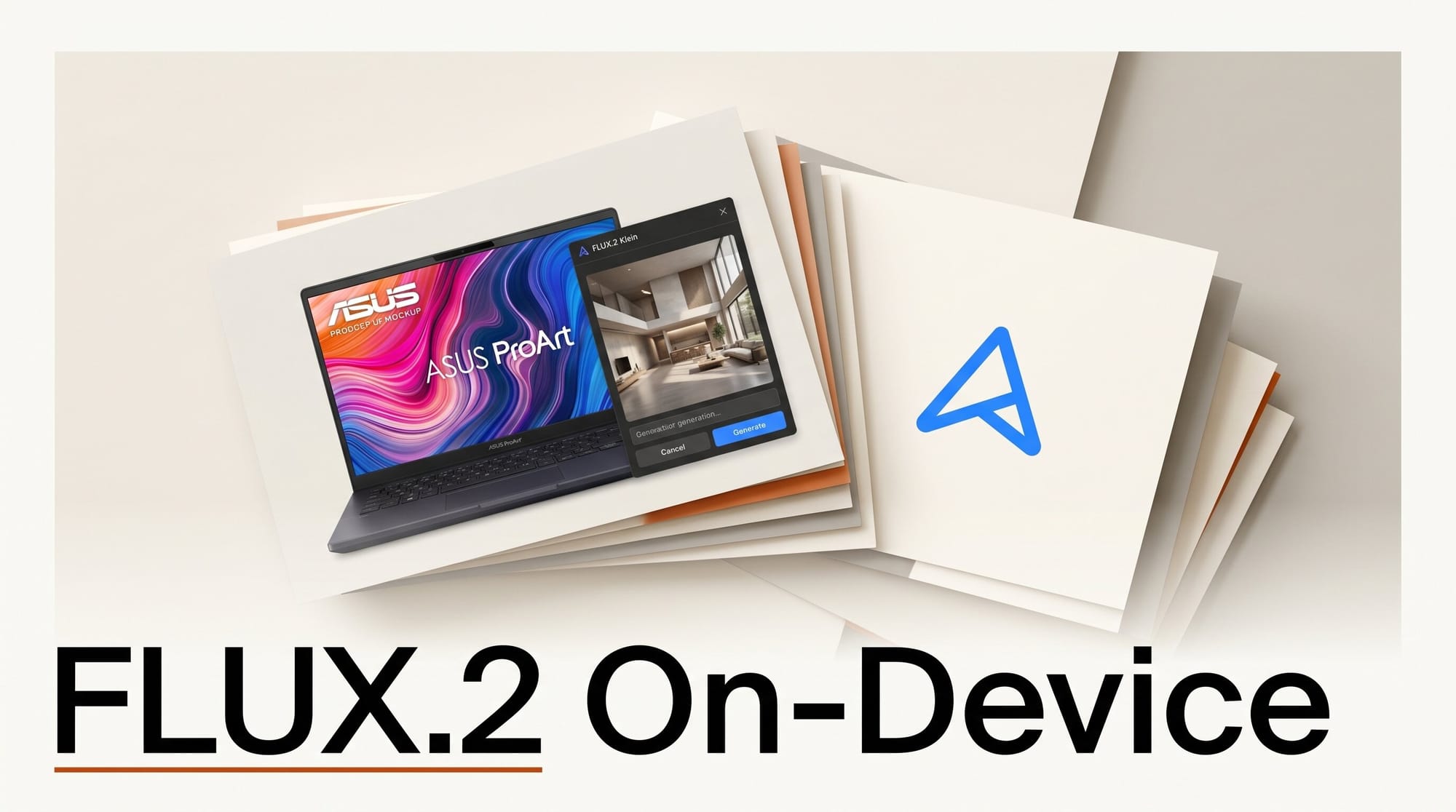
Black Forest Labs announced on June 4, 2026 that FLUX.2 [klein] now ships preloaded on the next-generation ASUS ProArt laptop lineup unveiled at Computex 2026, marking the first time a FLUX model has been bundled directly into consumer creator hardware. The 4B model lives inside ASUS's MuseTree creative app and runs entirely on the laptop's NVIDIA RTX GPU, with no internet, API key, or cloud round-trip in the loop.
Try it: Run FLUX locally inside your next image session
If you are not buying a new ProArt laptop, you can still test the same model today. Pull the FLUX.2-klein-4B FP8 weights from Hugging Face into ComfyUI on any 8 GB-VRAM RTX laptop or desktop, drop it into a text-to-image workflow, and benchmark generation time against your current Midjourney or Nano Banana cloud round-trip. The point of this drop is the latency floor: BFL claims sub-5 second generations while Photoshop and Premiere are open in the background. If your storyboarding loop currently waits 10 to 30 seconds per cloud call, swapping to klein-4B for first-pass iteration and reserving the cloud FLUX.2 Pro endpoint for hero shots is a one-day workflow change.
Why it matters
On-device image generation removes three creator pain points at once: per-image API cost, network latency, and NDA-sensitive material leaving the machine. FLUX.2 [klein] is the same lineage already shipped in third-party desktop apps like Fizgig, but the ASUS deal puts it in the install image of a new shelf of laptops aimed at retouchers, concept artists, and pre-vis crews. Bundling a foundation model with the hardware is the same playbook NVIDIA is running with its RTX Spark superchip creator PC, and it signals that 2026 is the year on-device image inference becomes table stakes for premium creator hardware.
Key details
BFL stated the 4B [klein] variant targets an 8 GB VRAM floor, hits sub-5 second generations on that hardware, and is preloaded inside the ASUS ProArt MuseTree app on the new laptops shown at Computex 2026. The model card lists FP8 and NV-FP4 quantizations alongside the BF16 base, all under BFL's open-weights distribution. There is also a [klein] 9B for users with 16 GB VRAM or above. Pricing for the laptops was not disclosed, and BFL is inviting other OEMs to apply for hardware-specific optimization through the same partner program. A companion announcement from ComfyUI shipped Ideogram 4.0 day-0 nodes in v0.24.0, which means creators on the same RTX hardware now have two open-weights text-to-image foundation models running locally in the same workflow.
What to do next
If you are spec'ing a new creator laptop this quarter, check whether the model includes a preloaded FLUX runtime before locking in a different brand. If you already have a 16 GB-class RTX laptop, install ComfyUI and pull the klein-4B FP8 weights this week to baseline local generation speed against your current cloud spend.