DeepSeek-V4-Flash, a 284-billion parameter open-weight model with 13B activated parameters and a 1-million-token context window, is the first locally runnable model capable enough to compete with frontier agentic coding tools. That capability gap closing matters beyond benchmarks: it makes LLM activation steering, a technique that has existed in research for years but required local access to apply, viable for the first time for production engineers and creators. Sean Goedecke's May 16 analysis lays out why the combination of DeepSeek-V4-Flash and antirez's DwarfStar 4 project represents a practical inflection point for the technique.
What is LLM Activation Steering

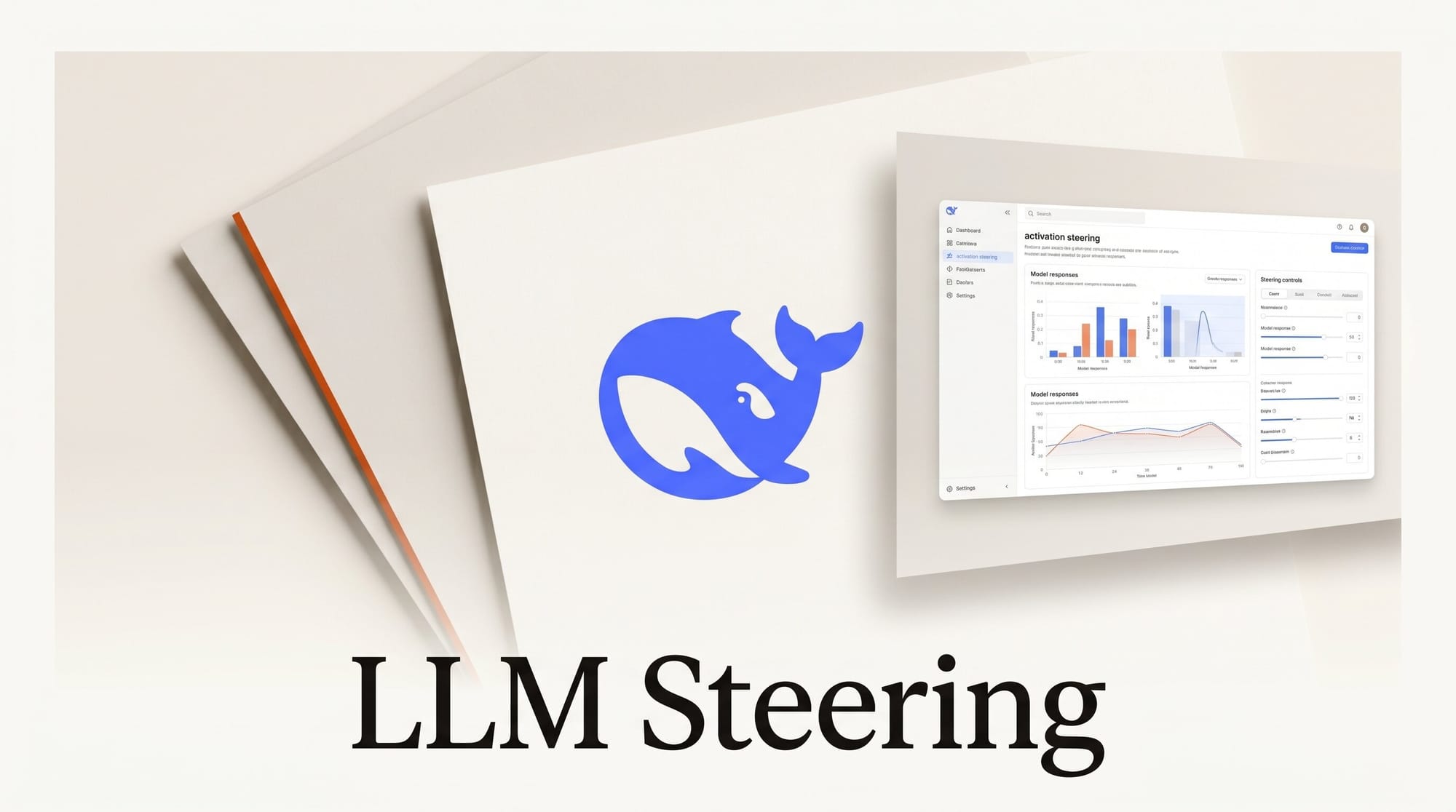
Steering manipulates a language model's internal activations mid-inference to guide its behavior without changing the prompt or retraining the model. The basic procedure involves running the same prompt twice with and without a target behavior, such as "respond tersely" or "maintain a formal tone," measuring the difference in internal activation states between the two runs, and extracting a steering vector representing that behavioral delta.
That vector is then applied to future inference passes by boosting the relevant activations. The model behaves as if the target trait were an intrinsic property of its generation rather than an instruction it may or may not follow. Anthropic's internal research extends this further with sparse autoencoders to identify subtler conceptual patterns, but the core version requires no special tooling beyond local model access and the ability to inspect activation layers.
The technique is not new. Academic papers on it date back to 2023, and the most cited result, "Refusal in Language Models Is Mediated by a Single Direction," demonstrated that safety refusals in major models were controlled by a single identifiable activation vector. What has been missing is a local model good enough to make real use of it.
Why DeepSeek-V4-Flash Changes the Equation
Steering requires local model access. API-based models expose nothing but the output token stream; there is no way to read or modify intermediate activations through a REST endpoint. Until recently, the models good enough for agentic coding work were exclusively available via API. Running a competitive model locally meant accepting serious capability compromises.
DeepSeek-V4-Flash changes that. The model uses a Mixture-of-Experts architecture where only 13B of 284B total parameters are active per token, making local inference on consumer hardware tractable. The full model weights are on Hugging Face under DeepSeek's open-weight license. Antirez, creator of Redis, has built DwarfStar 4 (ds4), a local inference engine for DeepSeek-V4-Flash on Metal and CUDA that integrates steering as a first-class feature, following the single-direction refusal paper directly.
The project launched eight days before Goedecke's piece and already includes working activation steering, described as "rudimentary" but functional. For creators and engineers who want to experiment with the technique on a competitive model, it is the first practical entry point that does not require writing custom inference code from scratch.
Steering vs Prompting vs Fine-Tuning

| Method | Requires Local Access | Persistent Effect | Removes Trained Refusals | Setup Complexity |
|---|---|---|---|---|
| Prompting | No | Per-session only | No | Low |
| Activation Steering | Yes | Per-vector (persistent while loaded) | Yes | Medium |
| Fine-tuning / LoRA | Yes (for training) | Yes (baked into weights) | Yes | High |
| System prompt | No | Per-session only | No | Very low |
Goedecke's central skepticism is that prompting accomplishes most of what steering promises for simpler behavioral adjustments. If you want the model to respond tersely, telling it to respond tersely in the system prompt works. Steering adds real value in one specific scenario that prompting cannot address: removing trained-in refusals. A refusal that is mediated by a single activation direction can be neutralized by a steering vector that suppresses it. No prompt phrasing achieves the same result because the refusal fires before the output layer processes the instruction.
Practical Applications for Creators

The use cases worth pursuing with steering vectors on DeepSeek-V4-Flash fall into two categories: behavioral consistency and constraint removal.
Behavioral consistency means encoding a persistent style or persona at the activation level rather than relying on a prompt that the model may drift away from over a long session. A custom writing assistant that stays in a particular voice, a code review bot that maintains a specific level of strictness, or a dialogue generator locked to a character's established speech patterns can all be implemented this way. The effect is more robust than a system prompt because it operates at a lower level of the model's processing.
Constraint removal means neutralizing specific trained refusals for legitimate research or commercial applications where the default safety calibration is too conservative. Character dialogue for mature fiction, medical information tools, security research assistants, and content moderation classifiers are common examples. Fine-tuning accomplishes the same goal but requires far more compute and dataset preparation. A steering vector can be extracted and applied in hours rather than days.
Goedecke notes a third potential category, complex conceptual steering like "more intelligent responses" or "deeper understanding of this codebase," but is skeptical that this works in practice. Concepts that require representing the entire codebase or abstract qualities like intelligence likely need full retraining rather than activation-level nudges. Creators should treat steering as a precision tool for specific, identifiable behavioral traits rather than a general capability enhancer.
How to Start with Steering Vectors on DeepSeek-V4-Flash
- Get the model running locally. DwarfStar 4 (github.com/antirez/ds4) supports both Metal (Apple Silicon) and CUDA (NVIDIA). Clone the repo and follow the setup instructions. Hardware requirements depend on quantization level; 16 GB VRAM handles smaller quantized versions.
- Identify the behavior you want to steer. Steering works best on specific, identifiable traits. "Less verbose" or "no refusals on medical questions" are tractable targets. "More creative" or "smarter" are not; they do not correspond to clean activation patterns.
- Extract a steering vector. Run the same prompt with and without the target behavior. Record the activation states at one or more intermediate layers. Subtract the baseline activation from the target activation. Normalize the resulting vector.
- Apply and test the vector. Load the vector into ds4's steering interface. Run test prompts to measure behavioral change. Scale the vector strength up or down; too strong produces incoherent outputs, too weak has no effect. Finding the right scale for each vector requires empirical testing.
- Save the vector for reuse. A working vector can be saved and reapplied across sessions. Build a small library of vectors for each behavioral mode your application needs.
For API-based access to DeepSeek-V4-Flash without running the full model locally, Together AI hosts the model. Note that API access does not expose activation layers, so steering is not possible via the API. The API is useful for evaluating output quality and cost before committing to local infrastructure.
Creator Outcome
The window that DeepSeek-V4-Flash opens is narrow but significant. Creators building custom AI tools on top of open-weight models now have a local option that matches API-tier capability, which makes activation steering a viable technique for production use cases for the first time. The immediate payoff is constraint removal for applications where default safety calibration is misaligned with legitimate use. The longer-term payoff is persistent persona and style encoding that survives long sessions without prompt drift. DwarfStar 4 provides the starting point; the extraction and application tooling will evolve quickly as the open-source community builds on it.
The official DeepSeek V4 release notes cover the full technical specification, context window details, and API pricing for teams that want cloud access alongside or instead of local deployment.
Frequently Asked Questions
What hardware do I need to run DeepSeek-V4-Flash locally for steering experiments?
DwarfStar 4 supports both Apple Silicon (Metal) and NVIDIA (CUDA). The 284B MoE architecture activates only 13B parameters per token, which makes inference significantly more efficient than dense models of comparable scale. A machine with 16-24 GB VRAM running a quantized version is a reasonable starting point. Full precision inference requires substantially more memory. Antirez's documentation in the ds4 repository covers specific hardware requirements for different configurations.
Is activation steering the same as fine-tuning?
No. Fine-tuning modifies the model's actual weights through training on new data. Activation steering modifies the internal state during inference at runtime without changing any weights. Steering effects last only as long as the vector is applied; removing the vector returns the model to baseline behavior instantly. Fine-tuning is permanent and requires retraining to undo.
Can steering vectors be transferred between models?
Generally no. Steering vectors are extracted from a specific model's internal architecture at specific layers. A vector extracted from DeepSeek-V4-Flash layer 24 will not apply meaningfully to a different model with different architecture or even to a different quantized version of the same model. Each model requires its own vector extraction process.
Does steering work on models accessed via API?
No. API access exposes only the output token stream. Steering requires reading and modifying intermediate activation states, which is only possible with direct local model access. This is precisely why DeepSeek-V4-Flash being available as local weights matters for this technique.
What are the risks of using steering to remove safety refusals?
Removing safety constraints via steering carries the same responsibilities as any other method of constraint removal. The technique is not inherently harmful; it is a tool that legitimate researchers, developers, and creators use for specific applications. The risk is misuse, and the responsibility sits with the deployer. Applications targeting medical information, adult content, or security research should have appropriate access controls and legal review regardless of how the model behavior is modified.
How does DwarfStar 4 compare to running DeepSeek-V4-Flash through Ollama or LMStudio?
Ollama and LMStudio provide convenient serving interfaces but do not expose activation layers for steering. DwarfStar 4 is specifically designed to support steering as a first-class feature, following the single-direction refusal research. For creators who only need inference without steering, Ollama or LMStudio are simpler options. For steering experiments, ds4 is currently the primary open-source option for this model.