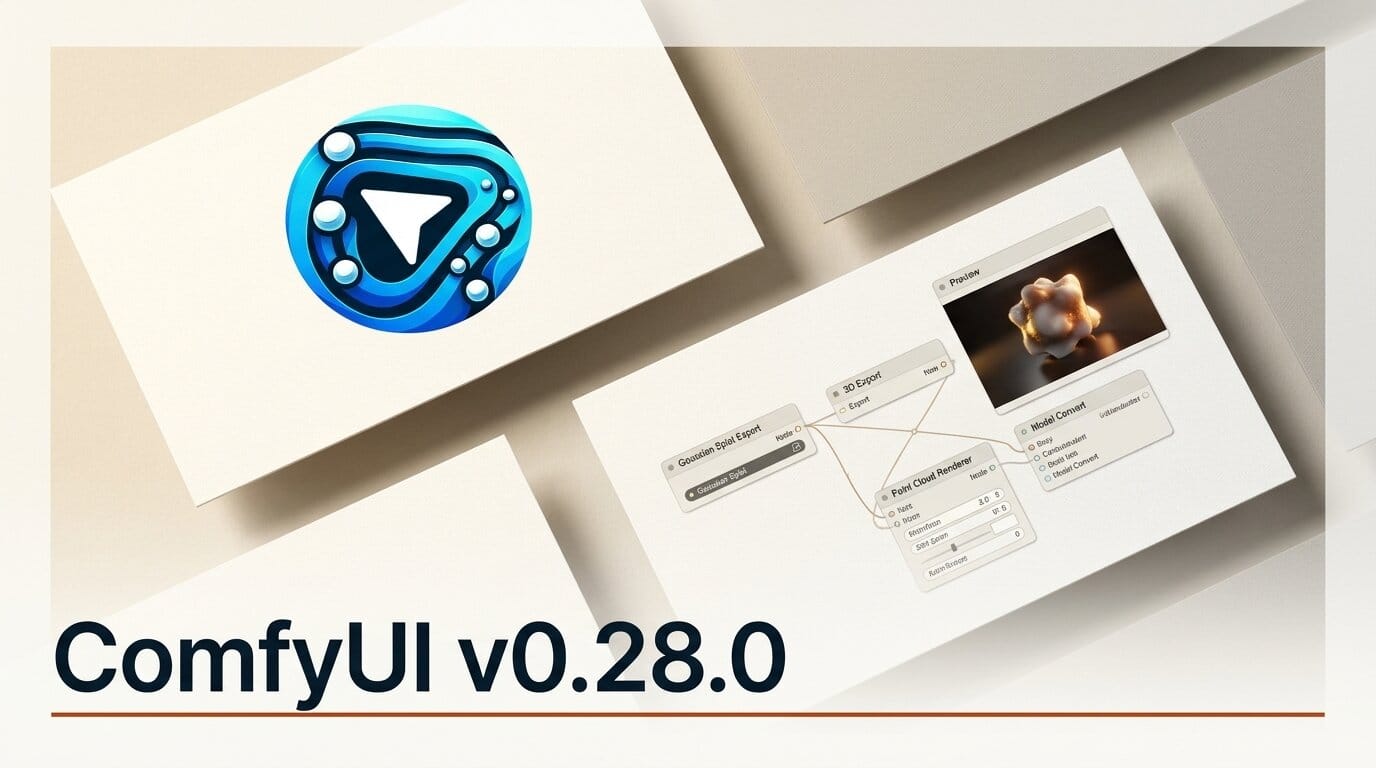
ComfyUI shipped version 0.28.0 on July 15, 2026, and it is one of the most creator-facing core releases in months. The headline change is native 3D and Gaussian splat export straight from a graph, alongside new text-on-image and text-on-video nodes, native SeedVR2 upscaling, and a batch of new open-model support. Nothing here is a plugin you have to hunt for on a registry: these are built-in nodes that appear the moment you update.
For anyone who runs image, video, or 3D pipelines locally, this release quietly closes several gaps that used to force a trip out of ComfyUI and into a separate tool. You can now finish a generation and write a .ply splat, a point cloud, a burned-in caption, or a structured .json without leaving the canvas. The full list is in the v0.28.0 release notes, but the short version is that ComfyUI is turning into a genuine export hub, not just a generator.
What Shipped in v0.28.0
This is a bundled release: several unrelated capabilities land at once, which is exactly why it is worth more than a one-line changelog mention. Here is how the new built-in nodes break down.
| Node | What it does | Who it helps |
|---|---|---|
| Save 3D (Advanced) | Exports meshes with finer control over format and geometry options | 3D and game creators |
| Save Splat | Writes a Gaussian splat file from a 3D graph | Splat and virtual production artists |
| Save Point Cloud | Exports a point cloud for downstream 3D work | Photogrammetry and scanning workflows |
| Text Overlay | Burns text onto images and video frames inside the graph | Social and short-form video editors |
| SaveText | Writes strings to .txt, .md, or .json | Prompt engineers, dataset builders |
| Create Bounding Boxes | Generates boxes from a bboxes input for masking and detection | Compositing and control workflows |
The plumbing changes matter too. The core project dropped its PyTorch 2.4 requirement, enabled GQA attention on all backends, added a --models-directory launch argument so you can point ComfyUI at a shared model folder, and fixed an int8 regression that had been hurting owners of older GTX 16xx cards. The ComfyUI repository tracks each of these as individual pull requests if you want to read the implementation.
The New 3D and Gaussian Splat Export Nodes
The most consequential additions are the three export nodes: Save 3D (Advanced), Save Splat, and Save Point Cloud. Until now, getting a usable 3D asset out of ComfyUI meant screen-grabbing a preview or wiring in a third-party custom node whose format support was inconsistent. Native export changes the economics of a local 3D pipeline.
Gaussian splatting is the technique behind much of the recent surge in fast, photoreal 3D scenes, and a splat file is what you feed into web viewers, game engines, and virtual production tools. If you want the background on the method, the Gaussian splatting overview is a good primer. The point is that ComfyUI can now write that format directly, so a graph that generates or reconstructs a scene can hand off a splat without a manual conversion step.
Save Point Cloud fills the adjacent gap for photogrammetry and scanning-style workflows, and the restored Text node plus Create Bounding Boxes give you the string and mask primitives that these 3D and compositing graphs usually need alongside the geometry.
A Quick Workflow: Splat Out of ComfyUI
Here is the practical shape of a splat export once you are on v0.28.0. Exact node wiring depends on your generation or reconstruction graph, but the finishing steps are now first-class.
1. Update ComfyUI. Pull the latest and confirm the frontend is on v1.45.21 or later, then restart so the new core nodes register.
2. Build or load your 3D graph. Use your existing scene reconstruction or 3D generation nodes to produce geometry in the graph.
3. Add Save Splat. Connect the 3D output into the Save Splat node and set an output path. ComfyUI writes the splat file to your output directory.
4. Add Save Point Cloud or Save 3D (Advanced) in parallel. Branch the same geometry into a second export node if you want a point cloud or a mesh in the same run.
5. Verify in a viewer. Drop the splat into a web splat viewer or your engine of choice to confirm the export before you scale the graph up.
New Model Support: SeedVR2, PixelDiT, and More
v0.28.0 also broadens what you can run. Native SeedVR2 image and video upscaling is now built in, which means restoration and detail recovery no longer require a bolt-on node. The release adds PixelDiT PID 1.5 model compatibility, convrot int4 support with Turing optimizations for lower-VRAM cards, and a thinking toggle so you can disable extended reasoning on Seedream nodes when you want speed over deliberation.
On the partner side, the release brings sync.so sync-3 lip-sync and talking-image support into the node graph, and promotes the previously preview-only Gemini Image models to release status. Taken together, these updates keep more of the modern image, video, and audio-visual stack inside a single local runtime instead of scattered across separate apps.
Why It Matters for Creators
The through-line of this release is consolidation. ComfyUI has always been strong at generation, but the last mile, getting a finished asset into the format a downstream tool actually wants, kept pushing creators into other software. Native 3D, splat, point cloud, text overlay, and structured-text export shrink that last mile to a node.
If you already run a ComfyUI-based video or 3D stack, this is a clean upgrade with immediate payoff, in the same spirit as open pipelines like the ones behind Velorn's ComfyUI video editor. The dropped PyTorch 2.4 requirement and the int8 fix for older GPUs also mean the update reaches more hardware, not less.
Frequently asked questions
What is new in ComfyUI v0.28.0?
The July 15, 2026 release adds native 3D, Gaussian splat, and point cloud export nodes, a Text Overlay node for images and video, SaveText for .txt, .md, and .json, Create Bounding Boxes, native SeedVR2 upscaling, PixelDiT PID 1.5 support, sync.so sync-3 lip-sync, and promotes Gemini Image to release status.
How do I export a Gaussian splat from ComfyUI?
Update to v0.28.0, build or load a 3D graph, and connect its geometry output into the new Save Splat node with an output path. ComfyUI writes the splat file directly to your output folder, with no external conversion step.
What is SeedVR2 in ComfyUI?
SeedVR2 is an image and video upscaling and restoration model. v0.28.0 adds native support, so you can run detail recovery inside the graph rather than through a separate custom node.
Does v0.28.0 still support older GPUs?
Yes. The release fixes an int8 regression on GTX 16xx cards and adds convrot int4 support with Turing optimizations, which improves compatibility for lower-VRAM and older hardware.
How do I update ComfyUI to v0.28.0?
Pull the latest version through your usual update path and restart. Confirm the frontend is on v1.45.21 or later, and the new core nodes will appear in the node menu automatically.
Related deep dives