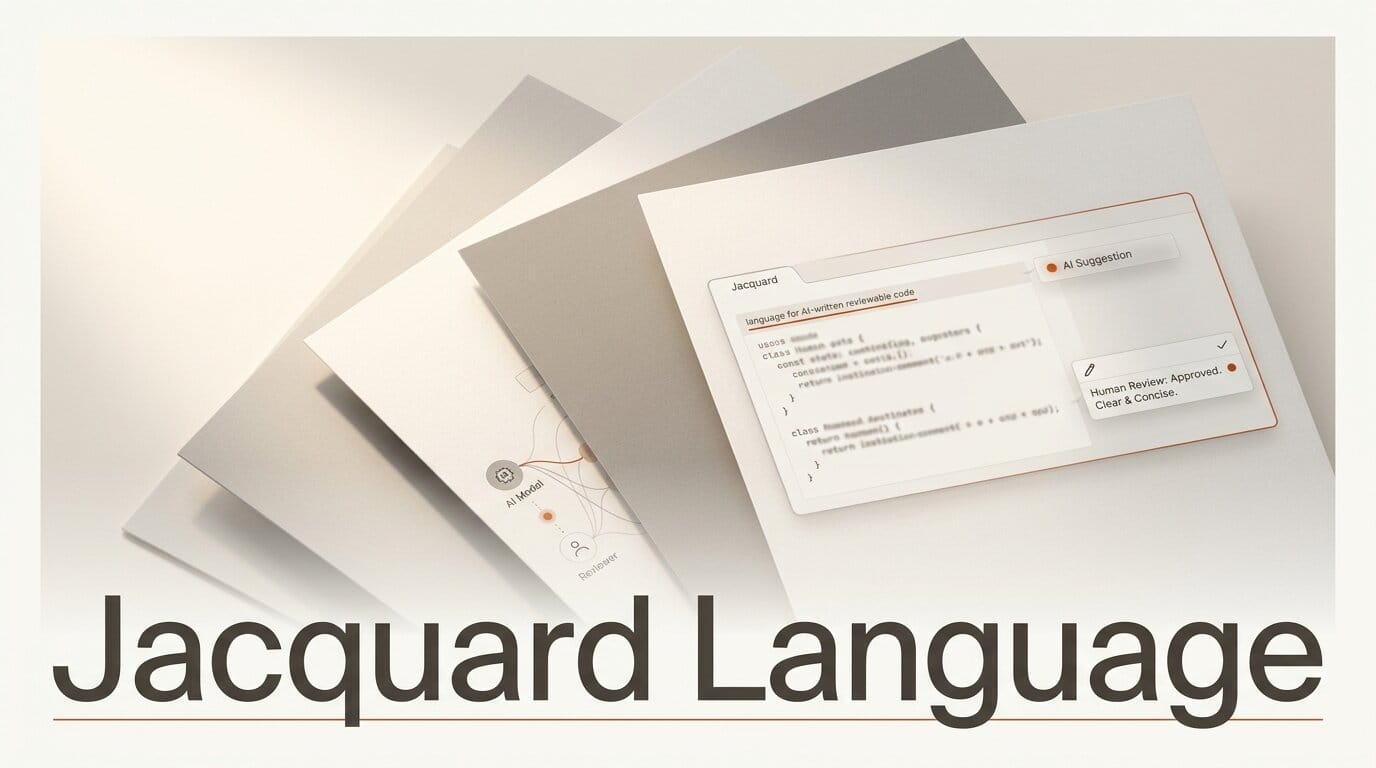
As coding agents write more of the code humans ship, reviewing that code is becoming the hard part. Jacquard, a new open-source language from research group FriendMachine, takes a different swing at the problem: it is a programming language designed for a world where most code is written by machine-learning models and reviewed by people. The version 0.1 release candidate went public this week.
What Happened
Jacquard makes the things a reviewer cares about visible in the language itself. Every function declares its external effects in its signature, so a function that touches the network reads as (text) ->{net} text, and the runtime refuses to let it reach the filesystem or network unless you explicitly grant permission. Instead of reading every line to answer "what can this code touch," the reviewer reads the signature. The project's introduction frames the goal plainly: when machines write the code, the language should tell humans what it can do and how confident it is.
What This Enables
The design targets the exact failure mode of AI-generated code review: plausible-looking code that quietly does something it should not. Because Jacquard gives code a content-addressed identity based on resolved structure, renames and formatting changes do not trigger recompiles or retesting, so a diff full of cosmetic churn from an agent does not bury the one change that matters. Its handler system also lets the same program run against the real network, a scripted fake, or a recording of last week's traffic, which replaces a lot of mocking when you want to test what an agent wrote against a controlled world.
Why It Matters for Creators
Anyone building with coding agents today lives in the review loop, and most languages were not designed for it. Jacquard is a research prototype, not a production language, but it is a concrete proposal for making agent-written code auditable by construction rather than by vigilance. The discussion on Hacker News centered on whether capability-visible, effect-typed languages are the right foundation for the agent era, a question every team wiring AI into its pipeline will eventually face.
Key Details
Status: Version 0.1 release candidate, works end to end, labeled a research prototype.
Toolchain: OCaml checker and interpreter, a C-emitting native AOT backend via jac build, a standard library written in Jacquard, and a test framework called Warp.
License: Apache 2.0, with an exception letting programs you write carry any license, including proprietary.
Maker: FriendMachine research project (GitHub user jbwinters).
What to Do Next
If you build agent coding pipelines, read the introduction and skim the language spec to see whether effect-visible signatures fit how you review. It is too early to adopt Jacquard for real work, but the ideas around capability security and structural code identity are worth borrowing even inside the languages you already use.