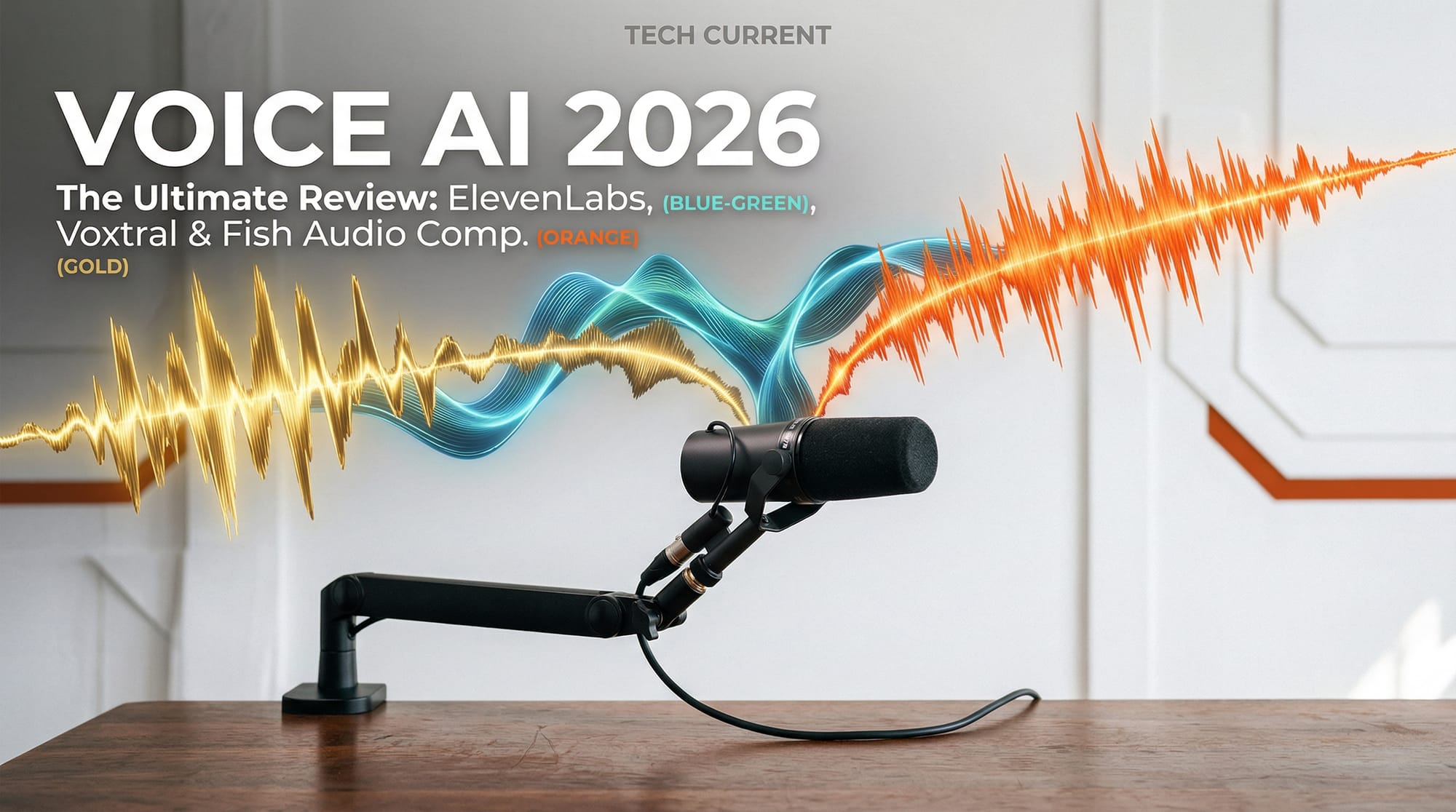
The AI voice cloning market will reach $4.06 billion in 2026, growing at 23.9% annually. Three platforms define the competitive landscape: ElevenLabs, now valued at $11 billion with $330 million in annual recurring revenue; Voxtral TTS, Mistral's open-weights model that matches ElevenLabs v3 quality in human evaluations; and Fish Audio S2, a fully open-source system trained on 10 million hours of audio. This analysis compares all three on quality, cost, latency, and practical deployment scenarios to help creators and developers choose the right tool for their voice AI workflows.
For the broader landscape, see our complete producer guide to AI music and audio in 2026.
The Three Approaches to Voice Cloning
Voice cloning in 2026 falls into three distinct categories, each with different trade-offs between quality, cost, and control. The commercial API model offers the highest convenience but locks users into per-character pricing. Open-weights models provide the model itself for self-hosting while restricting commercial redistribution. Full open-source releases give complete freedom but require technical expertise to deploy.
ElevenLabs represents the commercial API approach. Developers send text and receive audio, paying per character with no infrastructure to manage. Voxtral TTS from Mistral AI takes the open-weights path, releasing a 4-billion-parameter model on Hugging Face under a CC BY NC 4.0 license. Fish Audio S2 goes furthest, open-sourcing model weights, fine-tuning code, and a production-ready inference stack.
This three-way split mirrors what happened in large language models between 2023 and 2025. Commercial APIs dominated first, then open-weights models closed the quality gap, and now fully open alternatives are viable for production use. Voice cloning is following the same trajectory, compressed into roughly 18 months.
ElevenLabs: The Commercial Benchmark
ElevenLabs crossed $330 million in annual recurring revenue in late 2025, reaching that milestone from $200 million in just five months. The company raised $500 million in its Series D round in February 2026, led by Sequoia Capital. That growth was driven primarily by enterprise adoption from companies including Deutsche Telekom, Revolut, and the Ukrainian government.
The platform currently offers multiple TTS models. Eleven v3, released in early 2026, is the flagship quality model. It produces speech with natural sighs, whispers, laughs, and emotional reactions. The trade-off is higher latency, making v3 unsuitable for real-time conversational applications. For those use cases, ElevenLabs recommends v2.5 Turbo or Flash, which process audio roughly four times faster than the Multilingual models.
Pricing and Model Tiers
ElevenLabs API pricing starts at $0.06 per 1,000 characters for Flash and Turbo models, rising to $0.12 per 1,000 characters for Multilingual v2 and v3. Consumer plans range from free (10,000 credits per month) to Business ($1,320 per month with millions of credits). The Pro plan at $99 per month with 500,000 credits remains the most popular tier for individual creators.
Voice Cloning Features
ElevenLabs offers two cloning tiers. Instant Voice Cloning, available on the Starter plan ($5 per month), creates a basic voice copy from a short audio sample. Professional Voice Cloning, available on Creator plans and above ($11 per month), analyzes longer recordings and produces higher-accuracy voices with better emotional range and consistency. The professional tier requires at least 30 minutes of clean audio for optimal results.
Strengths and Limitations
ElevenLabs remains the quality leader for English speech synthesis, particularly for emotional expressiveness and consistency across long-form content. The platform supports 32 languages and offers the broadest ecosystem of integrations. The main limitation is cost: at scale, per-character pricing adds up quickly. A 10,000-word blog post converted to audio costs roughly $0.72 on Flash or $1.44 on v3. For production voice agents handling thousands of conversations daily, monthly bills can reach five figures.
Voxtral TTS: Open Weights from Mistral
Voxtral TTS launched on March 26, 2026, as Mistral AI's first speech model. At 4 billion parameters total (3.4 billion transformer backbone, 390 million acoustic transformer, 300 million neural codec), it was built on the Ministral 3B architecture. The model is lightweight enough to run on consumer hardware while delivering quality that matches commercial alternatives in blind listening tests.
Performance Against ElevenLabs
Mistral's human evaluation data tells a compelling story. Voxtral TTS achieved a 68.4% win rate against ElevenLabs Flash v2.5 in multilingual voice cloning tests. Against ElevenLabs v3, the flagship quality model, Voxtral performed at parity while supporting emotion-steering capabilities. These results come from Mistral's own evaluations, and independent benchmarks are still emerging, but early third-party tests from the open-source community have largely confirmed the findings. Our own Voxtral TTS analysis covered the initial reception in detail.
Voice Cloning and Language Support
Voxtral TTS can clone a voice from as little as 3 seconds of reference audio, capturing accent, inflections, intonation, and even casual vocal fillers like "ums" and "ahs." The model supports 9 languages: English, French, German, Spanish, Dutch, Portuguese, Italian, Hindi, and Arabic. Cross-lingual voice cloning works across all supported languages, meaning a voice cloned from English audio can generate natural-sounding French or German speech.
Latency and Deployment
The model achieves a time-to-first-audio of roughly 70 milliseconds for a typical input (10-second voice sample, 500 characters of text), with a real-time factor of approximately 9.7x. Via the Mistral API, pricing is $0.016 per 1,000 characters, making it 73% cheaper than ElevenLabs Flash and 87% cheaper than ElevenLabs v3.
Self-Hosting Considerations
The open-weights release on Hugging Face under CC BY NC 4.0 means anyone can download and run Voxtral TTS locally. The non-commercial license restricts revenue-generating applications unless a separate commercial license is obtained from Mistral. For researchers, hobbyists, and internal tools, self-hosting eliminates per-character costs entirely. The 4-billion-parameter model fits comfortably on a single GPU with 16GB or more of VRAM, making it accessible on consumer hardware like the NVIDIA RTX 4090.
Fish Audio S2: Full Open Source
Fish Audio open-sourced S2 on March 9, 2026, releasing not just model weights but the complete system: fine-tuning code, streaming inference stack, and production deployment tooling. The model uses a Dual-Autoregressive (Dual-AR) architecture with 4.4 billion parameters along the time axis and 400 million along the depth axis. It was trained on over 10 million hours of audio data covering approximately 50 languages.
Architecture and Performance
The Dual-AR design is the key innovation. A "Slow AR" component predicts semantic codebooks along the time axis while a "Fast AR" generates residual codebooks at each step. This approach achieves a real-time factor of 0.195 on a single NVIDIA H200 GPU, with time-to-first-audio of approximately 100 milliseconds and throughput exceeding 3,000 acoustic tokens per second.
On the Audio Turing Test, S2 achieved a posterior mean of 0.515, outperforming Seed-TTS (0.417) by 24% and MiniMax-Speech (0.387) by 33%. On EmergentTTS-Eval, S2 reached an 81.88% win rate. These benchmarks place Fish Audio S2 among the top voice synthesis systems regardless of whether they are commercial or open-source.
Voice Cloning and Control
S2 supports fine-grained prosody and emotion control through natural language tags like [whisper], [excited], and [angry]. The model captures timbre, speaking style, and emotional tendencies from reference audio without additional fine-tuning. Multi-speaker support allows uploading reference audio containing multiple speakers, with the model processing each speaker's features via speaker ID tokens. A single generation can include multiple speakers switching naturally.
The voice cloning implementation uses a prefix-caching system that achieves an average cache hit rate of 86.4% (over 90% at peak) when reusing voices across requests. This makes repeated use of the same cloned voice significantly faster than the initial clone.
Pricing and Community
Fish Audio's API pricing is $15 per million UTF-8 bytes, which translates to roughly 180,000 English words or about 12 hours of speech. For self-hosting, the model is fully open-source under the Apache 2.0 license, meaning commercial use is permitted without restriction. The platform also hosts over 2 million community-created voices that are freely accessible.
Head-to-Head Comparison
| Feature | ElevenLabs | Voxtral TTS | Fish Audio S2 |
|---|---|---|---|
| Model Size | Proprietary | 4B parameters | 4.4B + 400M parameters |
| Languages | 32 | 9 | ~50 |
| API Cost (per 1K chars) | $0.06 - $0.12 | $0.016 | ~$0.015 |
| Min Clone Audio | ~10 seconds | 3 seconds | ~5 seconds |
| Time-to-First-Audio | ~200ms (Flash) | ~70ms | ~100ms |
| Self-Hosting | No | Yes (non-commercial) | Yes (Apache 2.0) |
| Emotion Control | v3 native | Emotion steering | Tag-based [whisper], [excited] |
| License | Proprietary SaaS | CC BY NC 4.0 | Apache 2.0 |
| Fine-tuning | Professional tier | Not available | Full code released |
| Community Voices | Yes (marketplace) | No | 2M+ voices |
Quality vs. Cost Analysis
The cost equation shifts dramatically based on scale. For a creator producing fewer than 100,000 characters of audio per month (roughly 15 hours of speech), ElevenLabs' Pro plan at $99 per month delivers the best value per quality ratio. The convenience of zero infrastructure management and the polish of v3 output justify the premium.
At medium scale (500,000 to 2 million characters per month), the Voxtral TTS API becomes compelling. At $0.016 per 1,000 characters, 2 million characters cost $32 compared to $120-$240 on ElevenLabs. The quality difference at this point is minimal for most use cases, particularly for non-English content where Voxtral's multilingual performance is strong.
At high scale (over 5 million characters per month), self-hosting Fish Audio S2 provides the best economics. A dedicated GPU server running S2 costs roughly $200-$400 per month depending on the cloud provider, with unlimited generation. At ElevenLabs API rates, the same volume would cost $300-$600 per month on Flash alone. The break-even point for self-hosting is typically around 3-4 million characters per month.
Hidden Costs of Self-Hosting
Self-hosting is not free even when the model is open-source. Infrastructure costs include GPU compute, storage, bandwidth, and monitoring. Engineering time for deployment, maintenance, and scaling adds further expense. For teams without ML infrastructure experience, the total cost of ownership can exceed API pricing for the first 6-12 months. The real savings emerge only at sustained high volume with a team capable of managing GPU infrastructure.
The Open-Source Voice AI Gap
In early 2025, the gap between commercial voice AI and open-source alternatives was wide. ElevenLabs' Multilingual v2 was clearly superior to any freely available model in naturalness, consistency, and emotional range. That gap has narrowed significantly in the 12 months since.
Fish Audio S2's Audio Turing Test score of 0.515 places it at near-human level for naturalness. Voxtral's 68.4% win rate against ElevenLabs Flash v2.5 shows open-weights models competing directly with commercial mid-tier offerings. Against v3, the quality flagship, Voxtral reaches parity on most metrics.
The remaining gaps are in edge cases. ElevenLabs v3 still handles long-form narration with the most consistent quality, maintaining character voice across 30+ minutes of continuous speech. For whispering, laughing, and extreme emotional registers, the commercial model has more training data and finer control. For standard conversational and narration use cases, the practical difference is shrinking toward imperceptible.
The OmniVoice project, which covers 600 languages with open-source TTS, shows the breadth of open-source voice AI is expanding rapidly even beyond these three platforms.
Who Should Use What
Choose ElevenLabs If:
- You need the absolute highest quality for English narration, audiobooks, or premium content
- Your monthly volume stays under 500,000 characters
- You need 32+ languages with consistent quality
- Zero infrastructure management is a priority
- You need Professional Voice Cloning with dedicated voice training
Choose Voxtral TTS If:
- You work primarily in European languages (French, German, Spanish, Italian, Dutch, Portuguese)
- You want near-v3 quality at 87% lower API cost
- You plan to self-host for non-commercial research or internal tools
- 3-second voice cloning with minimal reference audio matters
- You need emotion steering without manual prosody tags
Choose Fish Audio S2 If:
- You need a commercially licensable open-source model (Apache 2.0)
- Your volume exceeds 3-4 million characters per month, making self-hosting economical
- You need fine-grained emotion and prosody control via natural language tags
- Multi-speaker generation or custom fine-tuning is required
- You want access to 2 million+ community voices
What to Watch
Microsoft MAI-Voice-1, announced on April 2, 2026, generates 60 seconds of expressive audio in under one second on a single GPU. At $22 per million characters via Azure Speech, it sits between the open-source and premium commercial tiers. Microsoft's integration with Copilot and the Azure ecosystem could make it the default choice for enterprise customers already on Azure.
Hume AI continues developing emotion-aware voice models that detect and respond to listener sentiment in real time. Real-time voice-to-voice systems, where speech input is processed and responded to without a text intermediary, represent the next frontier. ElevenLabs, Voxtral, and Fish Audio are all moving toward this capability.
The Mistral Voxtral TTS launch and Fish Audio S2 release happened within weeks of each other in March 2026. This compression of release timelines suggests the next generation of open-source voice models will arrive by late 2026, potentially closing the remaining quality gaps entirely.
Methodology
This comparison draws on publicly available data from each platform's official documentation, published benchmarks, and pricing pages as of April 2026. ElevenLabs metrics come from their product documentation and blog posts. Voxtral TTS performance data references Mistral's published human evaluation results. Fish Audio S2 benchmarks cite their technical report published on Hugging Face. Pricing data was verified directly from each platform's pricing pages on April 5, 2026. Latency measurements reflect published benchmarks under standard test conditions; real-world performance varies with hardware, network, and input length. Market size data comes from The Business Research Company's 2026 Voice Cloning Global Market Report.
Frequently Asked Questions
Which AI voice cloning tool has the best quality in 2026?
ElevenLabs v3 remains the quality leader for English speech synthesis, particularly for long-form narration and emotional expressiveness. However, Voxtral TTS performs at parity with v3 in human evaluation tests for multilingual voice cloning, and Fish Audio S2 scored 0.515 on the Audio Turing Test, placing it at near-human naturalness. For most conversational and narration use cases, all three produce professional-grade output.
Can I self-host AI voice cloning for free?
Fish Audio S2 is fully open-source under Apache 2.0, allowing free commercial self-hosting. Voxtral TTS open weights can be self-hosted for non-commercial use under CC BY NC 4.0. Both require GPU hardware (16GB+ VRAM recommended). ElevenLabs is API-only with no self-hosting option. The "free" aspect covers only the software license; you still need GPU compute infrastructure.
How much reference audio do I need to clone a voice?
Voxtral TTS requires as little as 3 seconds of reference audio. Fish Audio S2 works well with 5-10 seconds. ElevenLabs Instant Cloning needs roughly 10 seconds for basic results, while Professional Voice Cloning recommends 30+ minutes for optimal accuracy. Generally, more reference audio produces better results across all platforms, with diminishing returns after about 60 seconds for instant cloning methods.