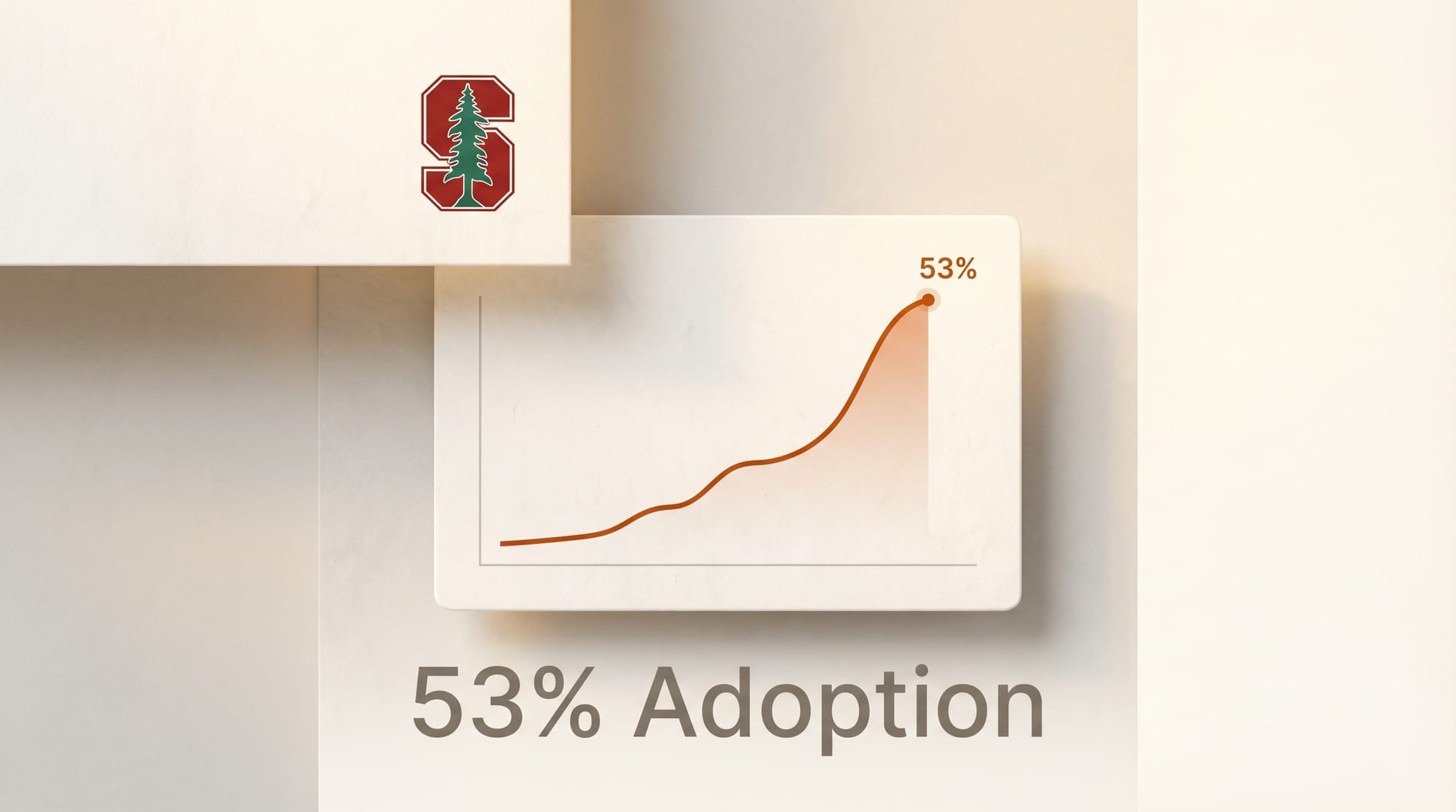
Stanford HAI's ninth annual AI Index Report reveals that generative AI reached 53% global adoption in three years, the fastest technology adoption curve in modern history, while the creative AI sector sits at the intersection of a transparency crisis, an environmental reckoning, and a geopolitical competition that will reshape which tools creators can access and trust.
Background
The AI Index Report has tracked artificial intelligence progress since 2017. Published by Stanford's Institute for Human-Centered Artificial Intelligence, it aggregates data from academic publications, patent filings, industry investment, government policy, and public surveys to produce the most comprehensive annual snapshot of where AI stands globally.
The 2026 edition, released April 13, arrives at a critical inflection point. Generative AI tools moved from novelty to mainstream faster than the personal computer, faster than the internet, and faster than smartphones. The report quantifies what many creative professionals have felt anecdotally: the world changed between 2023 and 2026, and the data now proves it.
Deep Analysis
The 53% Threshold: What Mass Adoption Means for Creative Work

The headline number is stark: 53% of the global population now uses generative AI regularly. For context, personal computers took roughly a decade to reach similar penetration. The internet took seven years. Generative AI did it in three.
But the adoption map reveals significant disparities. Singapore leads at 61%, followed by the UAE at 54%. The United States, despite being home to most frontier AI companies, ranks just 24th at 28.3%. Countries projected to exceed 80% adoption include China, Malaysia, Thailand, Indonesia, and Singapore.
For creators, mass adoption means two things. First, the audience for AI-assisted creative work is now the majority, not the fringe. Clients, collaborators, and competitors all have baseline familiarity with generative tools. Second, the value proposition shifts from "I use AI" to "I use AI better." The estimated consumer surplus from generative AI tools in the U.S. alone hit $172 billion annually, with per-user value tripling between 2025 and 2026. That growing value comes from better prompting, workflow integration, and creative judgment, not just access.
The Transparency Crisis and What It Means for Training Data

The report flags a troubling trend for anyone who cares about creative IP. Of the 95 most notable AI models released in 2025, 80 launched without disclosing their training code. Leading companies including Google, Anthropic, and OpenAI have stopped sharing dataset sizes and training duration entirely.
This opacity matters directly for creative professionals. Image generators, video synthesis tools, and music models all train on creative works. When a company refuses to disclose what data went into training, creators cannot verify whether their work was used, cannot negotiate compensation, and cannot make informed decisions about which tools to support or avoid.
The transparency decline also correlates with a power shift. Over 90% of notable frontier models now originate from private companies rather than academia. In 2020, that split was closer to 50-50. As AI development concentrates in corporate hands, the incentive to disclose training methodologies decreases while the incentive to protect competitive advantages increases.
For creators choosing between tools, this means relying increasingly on companies' self-reported policies rather than verifiable technical disclosures. Platforms like our video generation benchmark become more important as independent verification fills the gap that corporate transparency used to occupy.
The China-US Race and the Open Source Variable

The geopolitical findings carry direct implications for which creative AI tools will be available and at what cost. The report concludes that China has "nearly erased" the U.S. performance gap on major benchmarks. Chinese and American models now trade places at the top of leaderboards regularly.
The competition plays out differently by metric. The U.S. maintains advantages in capital investment and chip development. China leads in patents, publications, and robotics. Both countries now have 44 state-backed supercomputing clusters contributing to AI development.
For creators, this competition is a net positive. Chinese companies like ByteDance, Alibaba, and Tencent have released capable open-source video generation models that run locally, partly as a strategy to compete with U.S. closed platforms. Tools like Wan2.7, Qwen, and Seedance 2.0 give creators free or low-cost alternatives to subscription-based Western services.
Corporate AI investment hit $581.7 billion in 2025, a 130% year-over-year increase. Private investment alone reached $344.7 billion, up 127.5%. A significant portion flows into generative media, the category that includes image, video, audio, and 3D generation tools. The scale of this investment ensures continued rapid improvement in creative AI capabilities regardless of which country's models lead at any given moment.
Environmental Costs and the Creator's Footprint
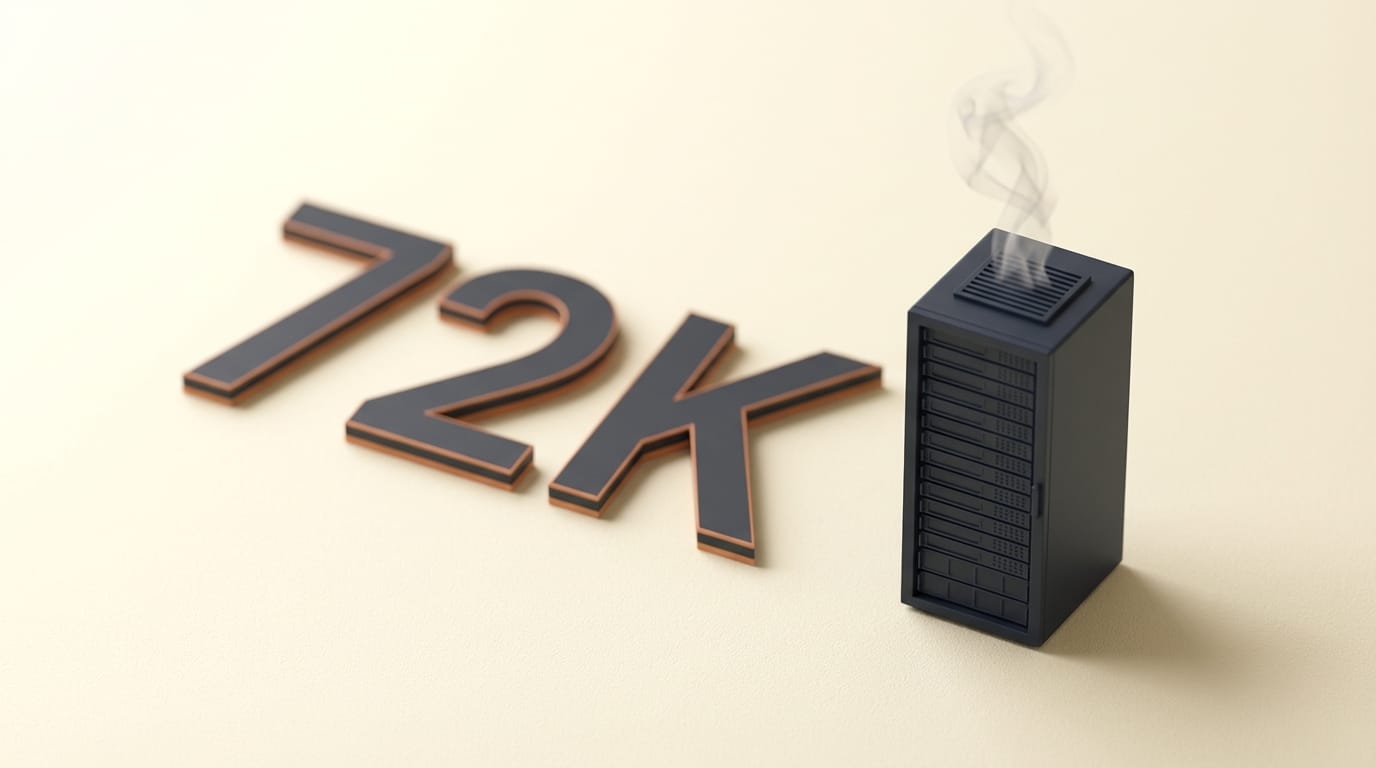
The report introduces environmental data that the creative AI community has largely ignored. Training xAI's Grok 4 model is estimated to have produced 72,000 tons of CO2. Inference for GPT-4o consumes enough water to supply 12 million people.
These numbers contextualize every image generation, every video synthesis, and every audio creation that runs through cloud-based AI. While individual creative tasks represent a tiny fraction of total compute, the aggregate demand from millions of creators using these tools daily adds up.
The environmental data strengthens the case for local AI processing. Models that run on consumer GPUs, like those available through ComfyUI, shift compute from data centers to existing hardware. Open-source models that can be quantized and optimized for local inference offer both cost savings and reduced environmental overhead per generation.
Public sentiment reflects this tension. The report found that 59% of people believe AI provides more benefits than drawbacks, but 52% simultaneously say AI makes them nervous. Among AI experts, 73% are optimistic about job impacts, compared to just 23% of the general public. Only 31% of U.S. citizens trust their government to regulate AI properly.
Impact on Creators
The Stanford AI Index 2026 paints a picture of an industry that is growing faster than its guardrails. For creative professionals, the practical takeaways are concrete:
Skill differentiation matters more than tool access. With 53% global adoption, having AI tools is no longer a competitive advantage. Knowing how to use them effectively, combining them into production workflows, and exercising creative judgment on outputs is what separates professionals from casual users.
Training data transparency is getting worse, not better. Creators who care about IP provenance need to actively choose tools from companies with clear data policies, or use open-source alternatives where training data is documented.
The best tools will increasingly come from everywhere. The U.S.-China competition and the 44-nation supercomputing race mean creative AI innovation is truly global. Locking into one ecosystem means missing capabilities emerging from the other side of the world.
Key Takeaways
- Generative AI reached 53% global adoption in three years, faster than any prior consumer technology. The U.S. ranks 24th at 28.3%.
- Corporate AI investment hit $581.7 billion in 2025, a 130% year-over-year increase, with private investment at $344.7 billion.
- Model transparency is declining: 80 of 95 notable models shipped without training code, and leading companies stopped disclosing dataset sizes.
- China and the U.S. are now "neck-and-neck" on AI benchmarks, with Chinese open-source models creating viable alternatives for creators.
- Environmental costs are significant: one frontier model training run can produce 72,000 tons of CO2, strengthening the case for local AI processing.
What to Watch
The next 12 months will reveal whether the transparency decline triggers regulatory action. The EU's AI Act enforcement begins in earnest in 2026, and the report's data on undisclosed training sets could become evidence in ongoing copyright litigation. Watch for whether the 53% adoption figure accelerates demand for creator-friendly AI policies, or whether the economic momentum makes reform harder.
The China-U.S. parity finding may also shift corporate strategy. If Chinese open-source models continue matching or exceeding closed Western alternatives, subscription-based platforms will face pricing pressure that benefits creators directly.
This analysis was produced by Creative AI News, covering AI tools for image, video, audio, and 3D creators.