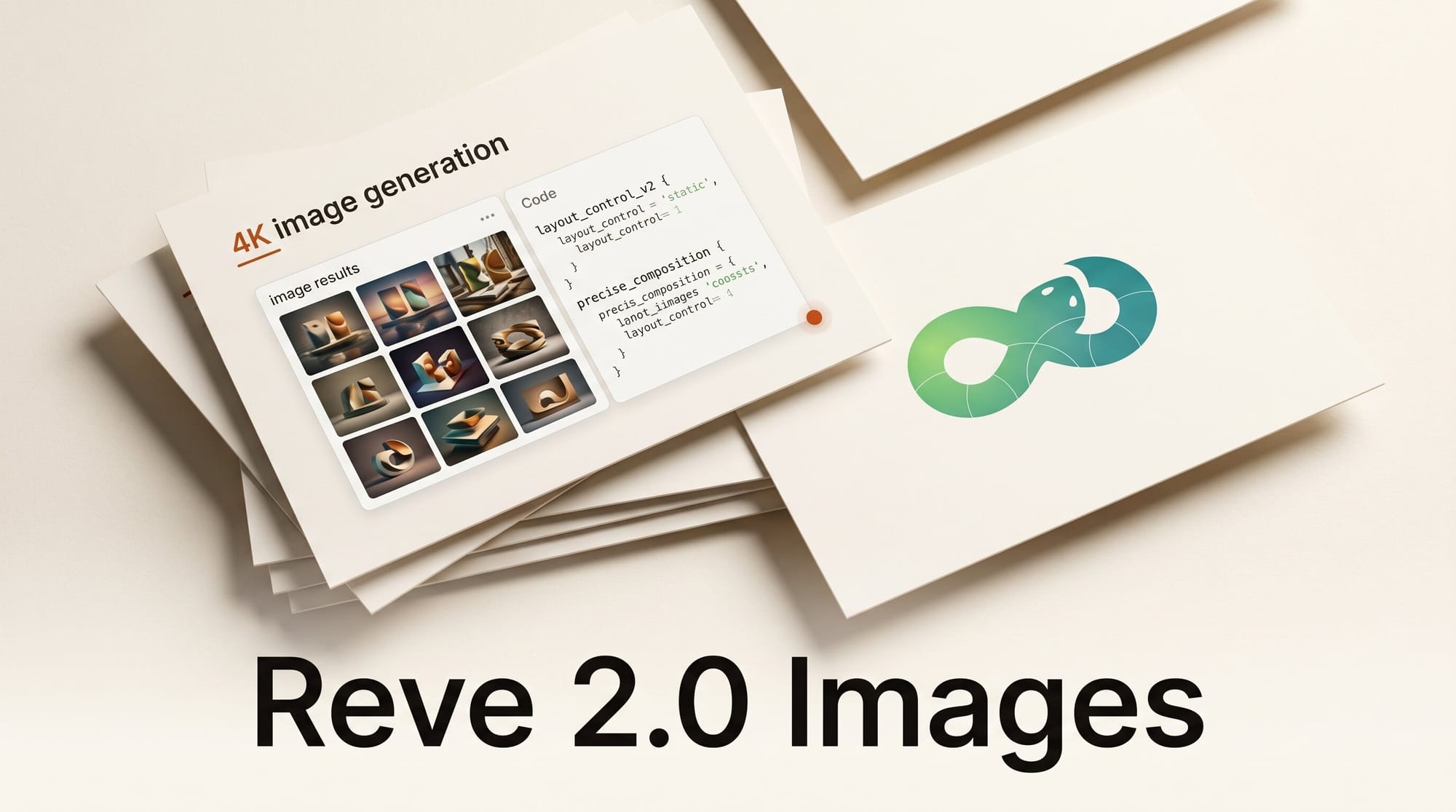
Reve launched Reve 2.0 on June 3, a 4K native image model that replaces freeform text prompts with a structured layout primitive where every element has an explicit location, size, and local description. The model debuted at #2 on the Text-to-Image Arena leaderboard with a 1280 score, +125 Elo over Reve v1.5, sitting above MAI-Image-2.5, Nano Banana 2, and GPT-Image-1.5 High Fidelity, and behind only OpenAI's GPT Image 2.
What this enables for designers and brand creators
The headline use case is graphic design with reliable typography and composition. Standard text-to-image models still treat layout as a side effect of the caption, which is why text rendering, brand guideline adherence, and multi-element layouts have remained brittle. Reve 2.0 inverts that: you write or import a layout document, the model treats it as a constraint, and the diffusion stack renders to it. The Reve team's own ablation, covered in Latent Space's writeup, shows CLIP similarity climbing from 0.865 with no layout regions to 0.929 with 50 regions, which translates directly to fewer regen cycles for poster, ad, and packaging work. Because the layout is code, AI agents can read and modify it, so the editing loop fits into agent-driven design tools the same way a Figma component tree does.
Why it matters
Layout-based image generation is the same architectural bet Ideogram 4.0 shipped open weights for last month, and Reve 2.0's Arena performance suggests the layout approach now scales to flagship quality. The competitive read, per a Startup Fortune analysis, is that a Palo Alto startup trained on 10x fewer GPUs than its hyperscaler competitors just landed #2 on a leaderboard whose top tier otherwise belongs to OpenAI, Google, Microsoft, and Adobe. That signals the image generation moat is still about data quality and architecture, not just compute scale.
Key details
Reve 2.0 generates at true 4K x 4K resolution, 16 megapixels native, using what the team calls a Large Layout Model: a unified architecture trained on billions of images with dense human annotations, combined with continued pretraining of open-source Qwen language models for spatial reasoning. The model supports lossless iterative editing, meaning regenerations from the same layout do not accumulate artifacts the way text-prompt rerolls do. Reve 2.0 is available via the web app and a public API at app.reve.com, with subscriptions targeting creators and professional design teams. Public pricing tiers have not yet been disclosed at launch.
What to do next
Run a layout-based prompt for the next brand asset on your queue, ideally one with required text or strict composition rules where Midjourney and GPT-Image-2 have been costing you regen cycles. Compare the first-pass output and total iteration count to your current workflow before deciding whether to swap in production. Bookmark the Arena leaderboard for the next pricing announcement, since API economics will dictate whether Reve 2.0 displaces existing tools or supplements them.