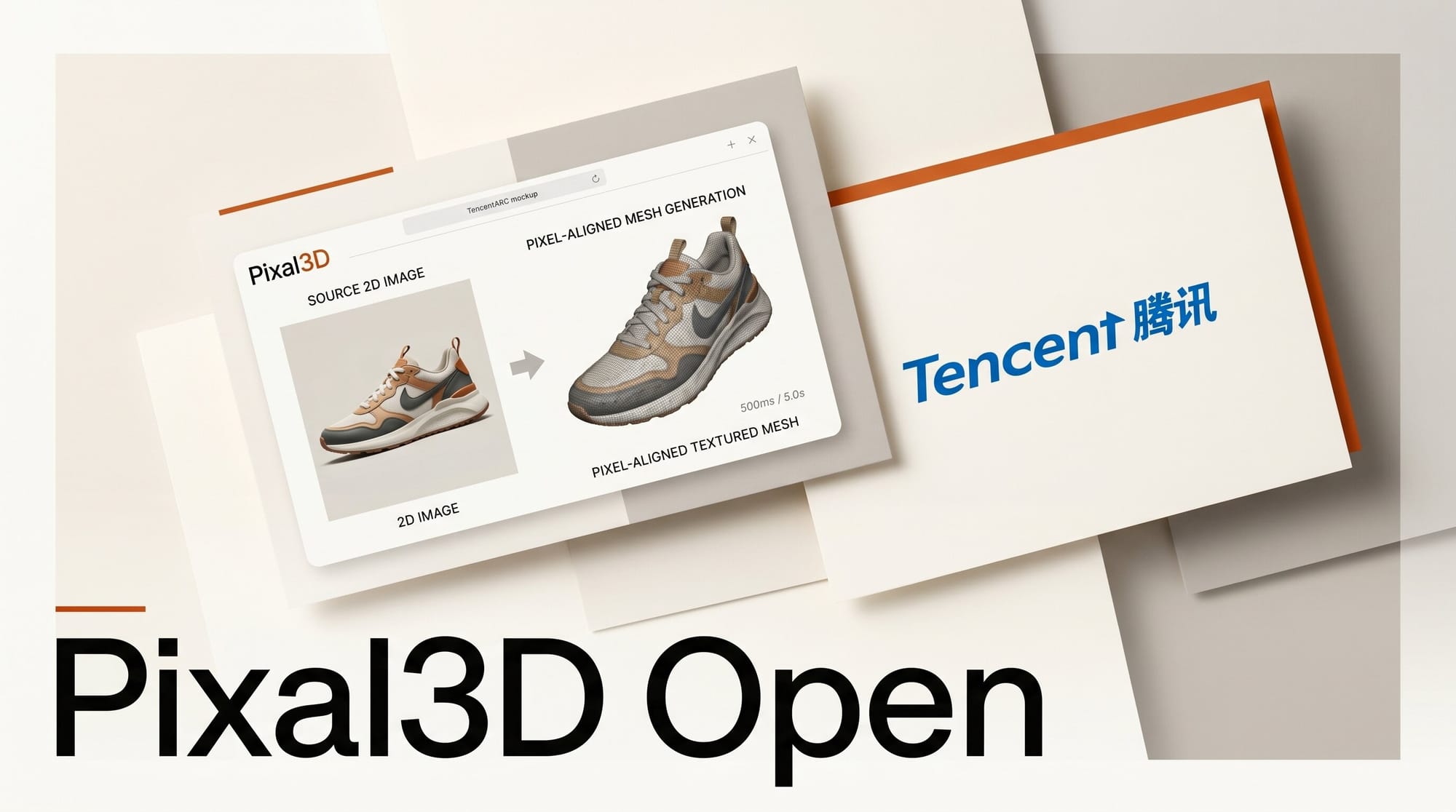
Tencent ARC Lab, working with Tsinghua and Victoria University of Wellington, has open-sourced Pixal3D, an image-to-3D model that produces textured GLB meshes from a single picture and lands as an accepted SIGGRAPH 2026 paper. Code, weights, and an interactive demo went live on Hugging Face on May 21, with the paper posted to arXiv on May 11. Pixal3D leans on a pixel back-projection scheme that lifts 2D image features straight into a 3D feature volume, which the authors argue closes the pixel-level faithfulness gap that has dogged prior image-to-3D pipelines.
Try it: Generate a 3D asset from a single photo in under an hour
Pixal3D ships under an MIT license, so creators can plug it directly into commercial pipelines. The fastest path is the hosted Hugging Face demo: upload a product photo or concept render, pick the 1024 or 1536 resolution mode, and download a GLB mesh with PBR textures. For local runs, clone the GitHub repo, install dependencies, and call inference.py with the image path. A low-VRAM flag is included for 12 GB cards. The mesh imports cleanly into Blender, Unreal Engine, or any GLB-aware viewer.
Why it matters
The open image-to-3D space has been dominated by Microsoft TRELLIS and Tencent Hunyuan3D, both strong but uneven on fine detail and texture alignment. Pixal3D positions itself against the latest TRELLIS 2 and HY3D V3.1 builds with side-by-side comparison renders on its project page, and the SIGGRAPH acceptance signals that the pixel-aligned approach holds up under peer review. For game artists, ad designers, and product visualisers who have been waiting for a single-image route to production-quality assets, the bar just moved.
Key details
The system uses a three-stage cascade: a sparse structure pass, a shape refinement pass, and a texture pass, each at progressively higher resolution. Outputs are GLB meshes with PBR textures suitable for game engines. The project page documents extensions to multi-view input and object-separated scene synthesis, which opens the door to staged compositions rather than single hero assets. Full implementation details are in the arXiv preprint.
What to do next
Run the hosted demo with a reference image from your current project to see whether the geometry and texture quality meet your bar. If it does, pull the GitHub repo for local control over resolution, view count, and the low-VRAM mode. Pair the GLB output with a quick cleanup pass in Blender for production handoff.