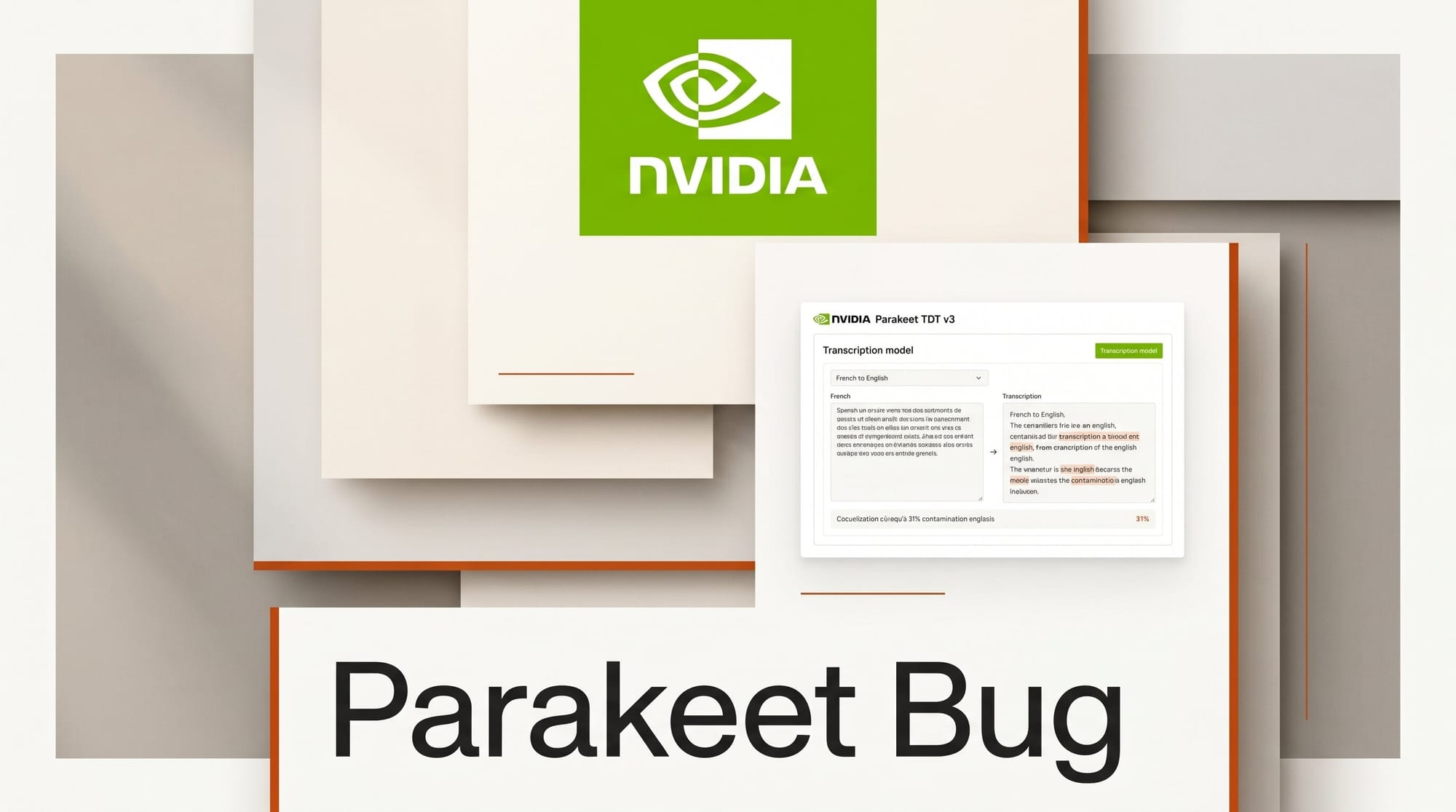
A new analysis published May 19, 2026 shows that Parakeet TDT 0.6B v3, NVIDIA's fast speech transcription model, silently translates French audio into English rather than transcribing it. On spontaneous interview recordings, the model introduced English words into 31.3% of utterances, producing output that is grammatically coherent but linguistically wrong. The model does not flag the language shift. It returns clean text with no error or warning.
What Happened
The finding comes from the Thoth app team. Thoth is a Mac-based meeting recorder that offers Parakeet TDT v3 as a fast English transcription option. A developer running French archival recordings through the app noticed the output was fluent English rather than French. When a speaker in a 1981 INA documentary said French phrases, Parakeet returned English equivalents such as "At different representations in the history."
The root cause is architectural. Parakeet TDT v3 has no language identification mechanism. Whisper handles multilingual input through language-conditioning tokens that explicitly signal which language to transcribe. Parakeet has no equivalent mechanism. When the model encounters phonemes it cannot reliably map to English, it defaults to English words that sound similar to what it heard. The result is automatic translation, not a transcription failure the model knows about.
Testing across different French content types revealed how much the source material affects severity. Scripted French with clear enunciation produced 0% English intrusion. A 40-minute spontaneous interview with informal speech and regional vocabulary produced 31.3% English intrusion. The more natural and unscripted the speech, the worse the drift.
Why It Matters for Audio Creators
This is a practical risk for anyone who uses Parakeet for speed and runs non-English content through it without checking the output. Podcast producers, archival researchers, interview transcribers, and localization teams are all in scope. The problem is silent by design: the model returns clean, well-formed text with no language-shift flag, so a creator might accept the output without noticing the language changed.
Parakeet TDT v3 remains fast and accurate for English-only workflows where Whisper Large V3 Turbo is the common alternative. Parakeet is significantly faster than Whisper for English. The problem is isolated to non-English input. If your audio is English, nothing changes.
Key Details
- Model: Parakeet TDT 0.6B v3 by NVIDIA
- Affected content: All non-English audio; most visible on French
- Intrusion rate: 0% on scripted French, 31.3% on spontaneous 40-minute interviews
- Output character: Grammatically correct English, not garbled text, making detection harder
- Thoth's response: Added a warning before Parakeet is used on non-English content, recommending Whisper Large V3 Turbo instead
- English-only performance: Parakeet remains accurate and faster than Whisper for English transcription
Creator Outcome: What to Do With Your Audio Workflow
If your workflow is English-only, no action is needed. Parakeet TDT v3 works as documented for English.
If your workflow includes any non-English audio, switch to Whisper Large V3 Turbo for those files. Whisper handles language identification through explicit language tokens. You can force a specific transcription language from the Whisper CLI using the --language flag, which also suppresses automatic translation mode.
For batch archival or research workflows, run a five-minute spot-check on each non-English source before committing to a full transcription run. Catching a language-shifted output on a short sample costs less than re-processing hours of content. For AI voice tools that handle multiple languages in a single session, see also how Darwin-TTS approaches emotion and language output through weight merging rather than relying on language conditioning alone.