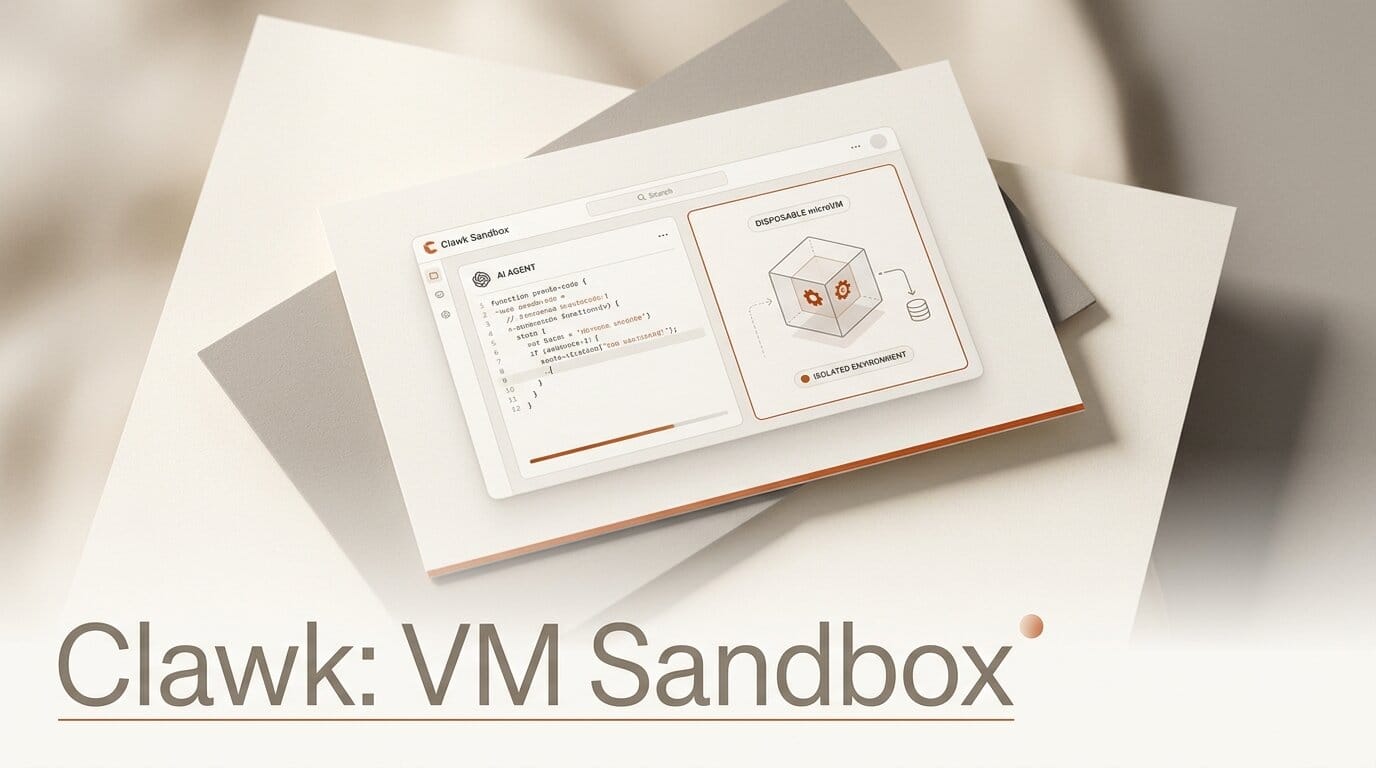
Clawk, an open-source tool that hands an AI coding agent its own disposable Linux virtual machine instead of your laptop, shipped version 0.2.0 on July 13, 2026 under the Apache 2.0 license. Its one-line pitch is blunt: give a coding agent its own disposable Linux machine, not yours. Rather than running Claude Code or Codex directly on your host, Clawk boots a lightweight microVM, mounts your repository inside it, and lets the agent operate with full autonomy while your filesystem, SSH keys, and network stay behind a hard boundary. The Show HN launch drew close to 100 comments within hours, landing in the middle of a week when agent file-access scares dominated developer forums.
Background
For most of 2026, the way builders ran coding agents forced an uncomfortable choice. You could babysit every action, approving each file write and shell command, which defeats the point of an autonomous agent. Or you could grant broad permissions and hope the model never runs a destructive command, leaks a secret, or wanders outside the repo it was told to touch. As agents graduated from autocomplete to multi-step workers that edit files, run tests, and open pull requests, that trade-off got sharper, not softer.
A wave of tooling has tried to close the gap from inside the agent's environment. Permission-gating layers such as Kastra's coding-agent guardrails intercept what an agent is allowed to do before it does it, and Anthropic shipped its own managed agents with self-hosted sandboxes. Clawk takes a different position on the same problem. Instead of policing intent, it assumes the agent will eventually do something you did not sanction, and makes sure the damage is confined to a machine you can throw away.
Deep Analysis
Isolation That Sits Below the Agent
Clawk's core claim is architectural: the boundary lives below the guest, where even root inside the VM cannot move it. On Apple silicon Macs running macOS 14 or later, the sandbox is a full Linux virtual machine on Apple's Virtualization.framework. On Linux, the same role is filled by Firecracker microVMs, the same lightweight virtualization that powers AWS Lambda, though Clawk's Linux support is still experimental. Each sandbox runs its own Linux kernel rather than a shared one, so an entire class of container-escape bugs has nowhere to land.
Networking is where the design gets interesting. All traffic passes through a userspace TCP/IP stack running inside the Clawk daemon, outside the guest entirely. Outbound connections are denied by default, and the allow-list is DNS-aware, so permitting example.com keeps working as its IP addresses rotate. Every denied connection is logged. Because the filter sits beneath the VM, an agent running as root cannot rewrite the rules that contain it. The root filesystem is just as flexible: any OCI image can serve as the base, which Clawk pulls without a Docker daemon, flattens, and writes directly to an ext4 disk.
Guardrails Gate Intent, Isolation Contains Damage
It is tempting to file Clawk next to the guardrail tools, but they solve different halves of the problem, and the strongest setups will run both. A guardrail layer reasons about intent: it can block a destructive delete, refuse a network call, or require approval before the agent touches a sensitive path. That is precise, and it is also brittle, because it depends on enumerating every dangerous action in advance. Isolation makes no attempt to understand intent. It assumes something will slip past the policy and caps the blast radius at a disposable VM.
The practical reading is defense in depth. Guardrails reduce how often the agent tries something harmful, and isolation determines what happens when one of those attempts succeeds anyway. For a creator handing an agent a real task on a real codebase, the combination is what makes walking away from the keyboard defensible. Neither layer alone gets you there: guardrails can be talked around, and a bare sandbox with broad mounts still exposes whatever you put inside it.
The Autonomy Unlock
The payoff Clawk is chasing is unattended autonomy. Because the host is protected by construction, you can finally let an agent run in full auto mode instead of approving each command, since the worst case is a wiped throwaway machine rather than a compromised laptop. The workflow is designed to stay out of the way: your repository is mounted in, the agent's conversation history persists back to the host, and you can snapshot a running VM to disk to free its RAM, then resume it later or destroy it outright without losing work.
That model scales past a single agent. Each per-sandbox disk is a copy-on-write clone, using APFS clonefile on macOS, so spinning up another VM is cheap. A ticket mode creates a sandbox with a git worktree per repository on a fresh branch, and a single command opens cross-linked pull requests, which maps cleanly onto running several agents at once. Builders already scaling out cheap coding subagents gain a way to keep each one contained instead of trusting all of them with the same broad access.
Where the Model Still Leaks
Clawk is candid about what it does not solve, and creators should read the fine print before walking away from a running agent. Whatever you mount into the VM is exposed to the agent, and any secret you push in is visible to it. Isolation protects the host, not the credentials you deliberately hand over. SSH-agent forwarding is a good example of the balance the tool strikes: git operations work inside the VM without your private keys ever entering it, but the forwarded agent socket is still reachable while the sandbox runs.
There are platform limits, too. The primary target is Apple silicon on macOS 14 or later, with no Windows and no Intel Mac support, and the Linux path through Firecracker is explicitly experimental with noted gaps. The whole model rests on the underlying hypervisor: Clawk states plainly that it depends on Virtualization.framework and KVM isolation and does not add defenses beyond them. A flaw in that layer is a flaw in Clawk.
Impact on Creators
The audience here is wider than backend engineers. The people building apps, websites, and content pipelines with AI are exactly the ones who want an agent to grind through a task unsupervised, and they are also the ones least equipped to recover a trashed development machine mid-project. A disposable VM turns a scary permission grant into a reversible one, which lowers the bar to actually using autonomous mode rather than leaving it switched off out of caution.
It also changes how experimentation feels. Trying an unfamiliar agent, an untrusted tool server, or a risky refactor stops being a gamble against your primary environment. You boot a fresh sandbox, point the agent at the task, watch the denial log on the first run to confirm the allow-list matches what your build actually needs, and tear the whole thing down afterward. For creators who treat their laptop as an irreplaceable studio, that separation is the difference between adopting agent autonomy and avoiding it.

Key Takeaways
- Clawk gives an AI coding agent its own disposable Linux microVM, so the host filesystem, keys, and network stay isolated even when the agent runs with full autonomy.
- The boundary sits below the guest: a separate Linux kernel per sandbox, plus a userspace, DNS-aware, deny-by-default network stack that root inside the VM cannot override.
- Isolation and guardrails are complementary. Guardrails reduce harmful attempts, and a throwaway VM caps the damage when one slips through.
- Copy-on-write clones, snapshots, and a git-worktree ticket mode make it cheap to run and to fan out across parallel agents.
- It protects the host, not what you mount or the secrets you inject, and it inherits the security of Virtualization.framework or KVM underneath.
What to Watch
The open question is whether OS-level isolation becomes a default expectation for autonomous coding agents rather than an add-on. Clawk is Apache 2.0 and only version 0.2.0, early enough that its Linux story and broader platform support are unfinished, but the shape of the idea is likely to outlast this particular tool. Watch whether the agent vendors themselves fold disposable sandboxing into their clients, the way Anthropic has moved toward managed sandboxes, and whether the microVM approach converges with the guardrail layer into a single stack rather than two tools bolted together. If unattended agents are going to do real work on real codebases, the interesting fight of the next several months is over who owns the containment layer, and how invisible it can become.