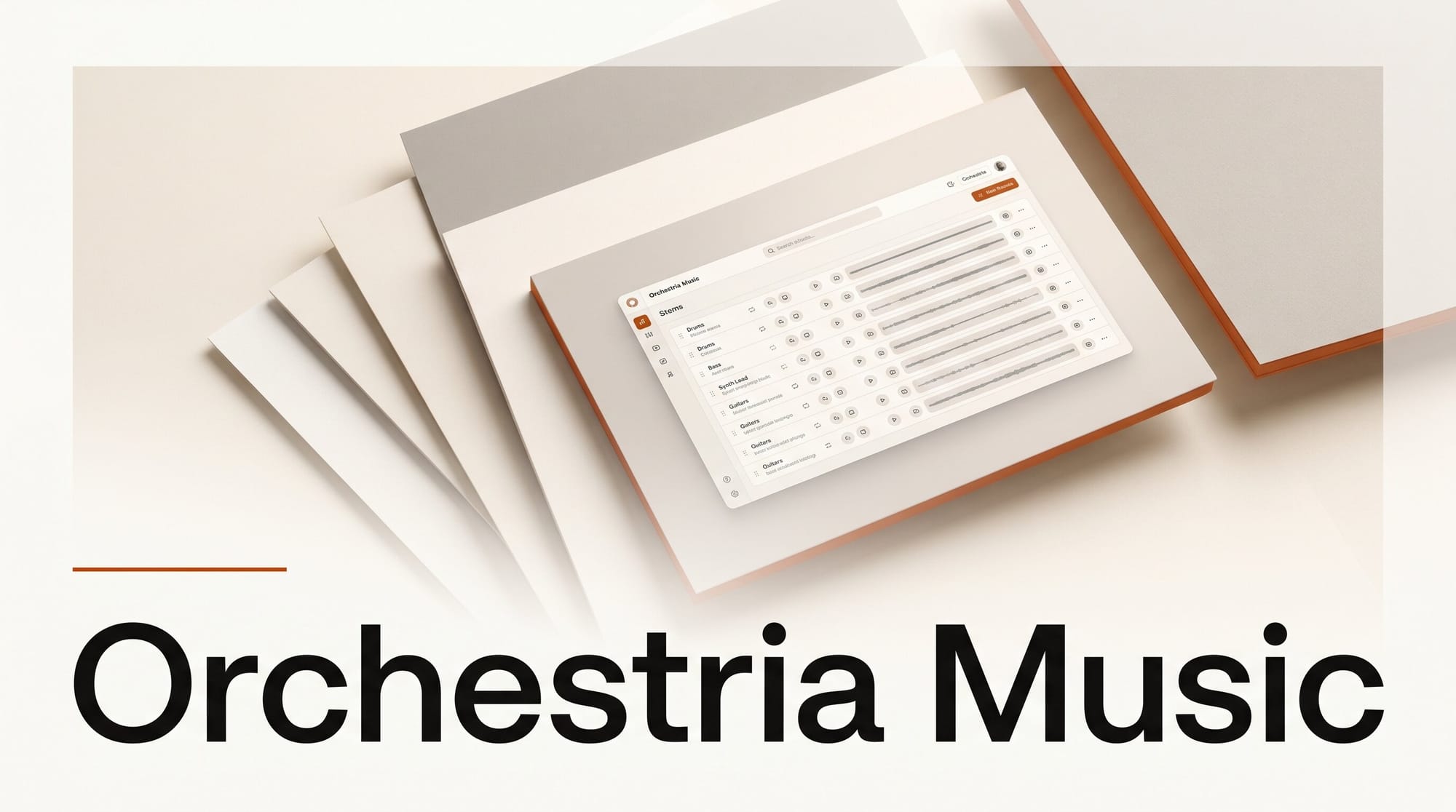
Orchestria launched on Product Hunt on May 25, 2026 as an AI music engine built around a multi-agent stack (drummer, bassist, melodist, critic, mixer) that compose in real time and surface every part as a separately editable stem. Unlike the locked stereo files that most generative music tools output, Orchestria lets you regenerate or tweak a single instrument with a natural-language prompt without re-rolling the whole track, with 24-bit WAV exports on paid tiers.
Try It This Week
Sign up on the Orchestria web app and start with the Free tier (five songs per month, session-only playback) to see whether the agent flow fits your writing style. Prompt with a vibe, a BPM, and a mood ("90 BPM low-fi hip-hop, dusty Rhodes, ghosted snare") and let the agents propose a structure. If the bassline is wrong, you do not re-roll the song; you tell the bassist to walk lower in the verse, and only that stem changes. Pro at $8 per month unlocks 60 songs, cloud storage, WAV download, and the commercial-use license; Maestro at $25 per month adds a Studio Mode with piano-roll editing, mixer, and MIDI export for DAW handoff. A 2-day free trial covers both paid tiers, so a full project test fits inside a weekend.
What Happened
Co-founders Batu Akdoğan and Oğuz Baran Aktaş launched Orchestria publicly today on Product Hunt after a private build cycle. The product is built around what they call the Batu Signature Protocols, a constraint layer that enforces scale and genre integrity across the agents so the stems mix cleanly rather than drifting into competing keys or feels. Rendering runs on headless VST3/AU instruments in the cloud over WebSocket streaming, which is closer to a DAW pipeline than a typical text-to-audio diffusion model and explains the per-stem fidelity.
Why It Matters for Creators
The two biggest complaints about Suno-style end-to-end generators are bounced mixes you cannot dissect and ambiguous commercial-use terms. Stem-level outputs solve the first; the explicit "users own the music for commercial use" language on the paid tiers (subject to final ToS at launch) takes a swing at the second. For producers who already work in Ableton, Logic, or Reaper, MIDI export on the Maestro tier means an AI sketch can land in your session as proper tracks, not a baked WAV you have to reverse-engineer. We covered the broader 2026 stem-tooling shift in our StemDeck stem-separation post; Orchestria is the generative side of the same trend.
Key Details
Three tiers: Free ($0, 5 songs, no download), Pro ($8/mo billed yearly, 60 songs, WAV, commercial rights, agentic edits), Maestro ($25/mo billed yearly, 200 songs, Studio Mode, MIDI). The agents listed on the landing page are Drummer, Bassist, Melodist, Critic, and Mixer, working in parallel rather than in a linear pipeline. The underlying model is not publicly disclosed. Compared to ElevenLabs Music with its WMG label-clearance angle, Orchestria is an indie launch and the licensing language is platform-side, not label-side.
What to Do Next
If you write briefs for clients or score short-form video, run a side-by-side: one project in Suno or ElevenLabs Music for the locked-mix baseline, one in Orchestria for the editable-stem version, and time how long it takes to land on a usable cue. The 2-day Pro trial is enough to settle whether the conducting metaphor saves real time or just adds prompt-engineering overhead. Watch the Maestro tier specifically; MIDI export is the feature that decides whether AI music belongs in your DAW session or just on your finished-render shelf.