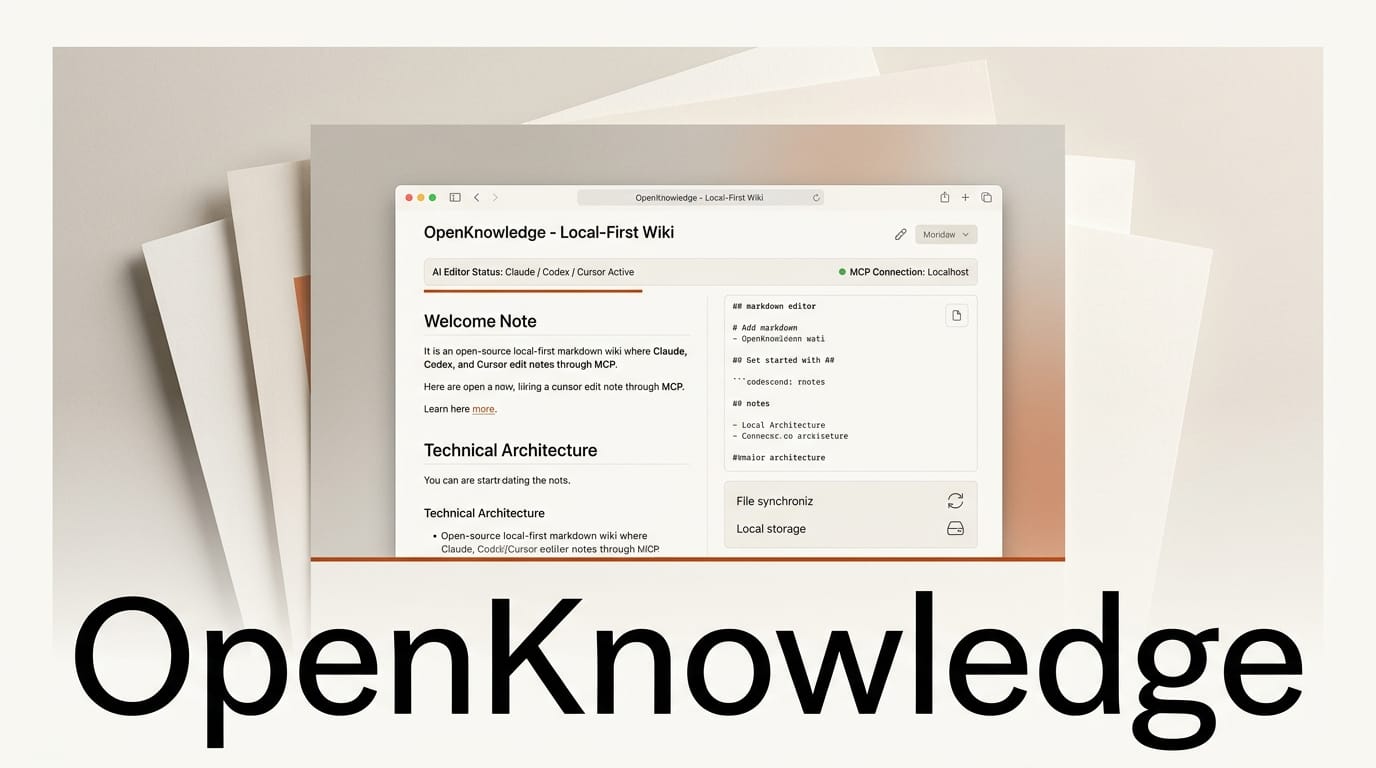
On June 25, 2026, the team at Inkeep shipped version 0.18.0 of OpenKnowledge, an open-source, local-first markdown editor and LLM wiki built for people who work alongside AI agents. It bills itself as an AI-first alternative to Obsidian and Notion: a clean WYSIWYG writing space that stores plain markdown files on your own machine, with Claude, Codex, and Cursor able to read and edit those notes directly.
What Happened
OpenKnowledge hit its v0.18.0 release on June 25, packaged as a native macOS desktop app plus a web and CLI build that runs on Linux, Windows, and Intel Macs. The project is licensed under GPL-3.0 and built almost entirely in TypeScript, using Bun as its runtime inside a Turbo monorepo. The full source and release notes are public on the project's GitHub releases page, and the Show HN post drew steady early interest from developers looking for a note system that treats AI as a first-class editor rather than a bolt-on chat panel.
Why It Matters
Most note apps that added AI did so by docking a sidebar chat next to your documents. OpenKnowledge flips that: Claude, Codex, and Cursor can collaboratively edit the same markdown files you are working in, and an agentic search lets a model traverse your entire knowledge base before answering. For creators and builders, that turns a personal wiki into a working context store an agent can actually reason over. It echoes the local-first, AI-native direction we covered in UCP-Local, an offline RAG layer for Claude Desktop and Cursor.
Key Details
The editor offers full WYSIWYG markdown, so you write in something that feels like Google Docs or Notion while the file on disk stays clean markdown. It ships native Model Context Protocol integration plus agentic search, so any MCP-aware harness can query your notes. Git and GitHub power team sharing and auto-sync, meaning a shared wiki is just a repository with history, branches, and pull requests. Because storage is local-first, your knowledge base is a folder of files you own, not a row in someone else's database.
What to Do Next
If you live in Claude or Cursor, clone the repo or grab the macOS build and point your harness at it through MCP, then test whether agentic search over your own notes beats pasting context by hand. Teams should try the GitHub sync flow to see how a markdown wiki behaves under version control, an approach that pairs naturally with tools like Oak, the version-control layer we profiled in version control built for AI agents. Since it is GPL-3.0 and accepts public pull requests, it is also a low-risk way to shape an AI-first knowledge tool before the pattern hardens.