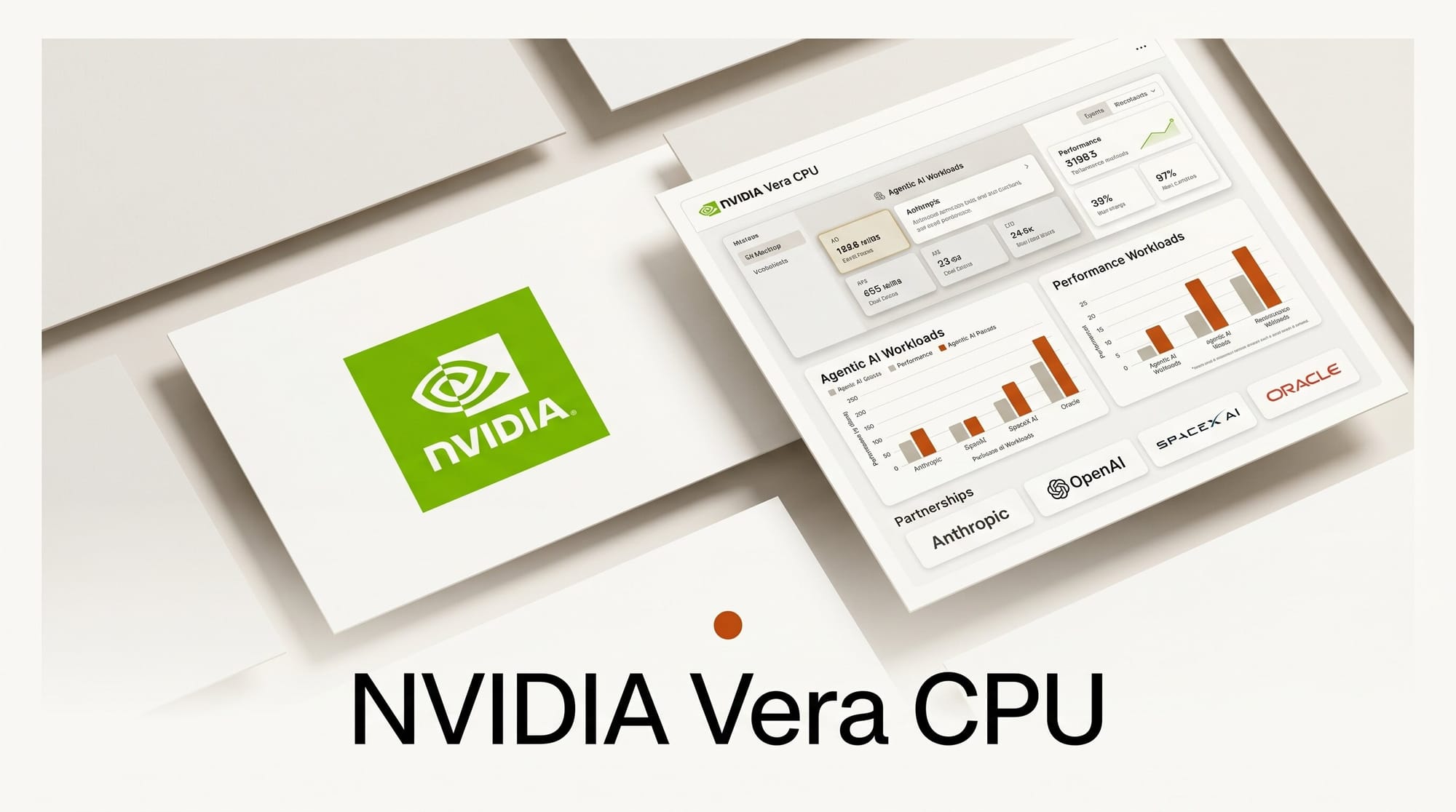
NVIDIA delivered the first Vera CPU systems on May 18, 2026, with VP of Hyperscale and HPC Ian Buck hand-carrying them to Anthropic in San Francisco, OpenAI in Mission Bay, SpaceXAI in Palo Alto, and Oracle Cloud Infrastructure in Santa Clara. The chip is NVIDIA's first CPU purpose-built for agentic AI, and the labs that just took delivery run Claude, ChatGPT, Grok, and a large share of public model inference.
What This Means for Creators
You will not buy Vera, but you will feel it. The chip's headline numbers are 88 custom Olympus cores, 1.2 TB/s memory bandwidth, and a claimed 50% per-core performance jump under full load, all targeted at the orchestration layer that runs tool-calling, long-context state, and agent sandboxing. Translation for creators: the tasks that feel sluggish in Claude Code, ChatGPT agents, and Grok Build right now (long tool chains, big file context, multi-step agents) sit exactly on Vera's strength curve. Watch your favorite agent product over the next quarter for latency drops and longer practical context windows.
Why It Matters
This is a posture shift for NVIDIA more than a chip launch. The company has lived in GPUs for the last decade. Vera is a deliberate move into CPU silicon at the inference-orchestration layer, where AMD and incumbent x86 vendors have owned share. Combined with rising GPU cloud prices, the read is that NVIDIA wants to capture the entire agent-server bill, not just the GPU portion. For Anthropic and OpenAI, getting first-customer status is a hedge against compute supply concentration.
Key Details
Oracle disclosed it will "deploy hundreds of thousands of NVIDIA Vera CPUs beginning in 2026" at hyperscale, the first cloud provider to commit at that volume. That gives Vera a public path to general developer access through Oracle Cloud, distinct from the closed deliveries to the four labs. Initial workloads named in the announcement: orchestration, tool-calling, reinforcement-learning training loops, data analytics, agent sandboxing, and long-context state management.
No retail pricing, no broader-OEM timeline, and no benchmark comparisons against the latest Cerebras inference silicon have been published. The first independent third-party numbers will come from whichever lab publishes a latency-improvement blog post first.
What to Do Next
If you run agent-heavy workflows in Claude Code, ChatGPT Codex, or Grok Build, log baseline times for your most painful multi-tool runs this week so you can measure when Vera-backed inference rolls in. If you build on Oracle Cloud, start tracking when OCI exposes Vera-backed instances. And if you write about AI infrastructure, the Anthropic-SpaceXAI-OpenAI-Oracle quartet is the customer list to watch for the next year of compute storylines.