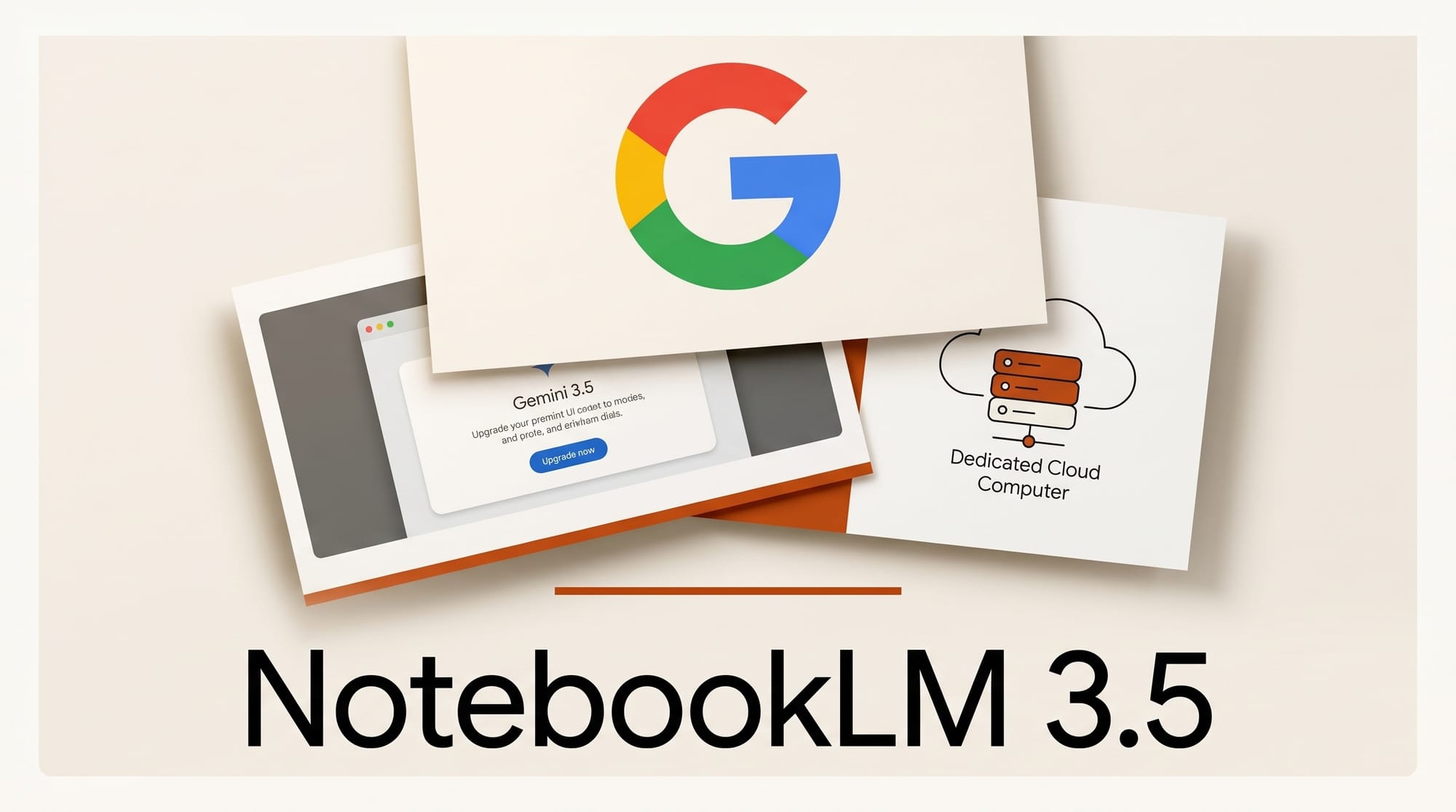
Google rolled out a major upgrade to NotebookLM on June 8, swapping in Gemini 3.5 as the underlying model and giving every notebook a secure cloud computer that can write and run code across more than 100 curated skills. Each session can now build a source library, execute its own analysis, and hand back downloadable outputs in PDF, spreadsheet, or slide-deck format. The rollout begins globally on the web for Google AI Ultra subscribers and Workspace customers with AI Expanded access.
Try it: turn a research stack into a finished deliverable in one session
The headline change is that NotebookLM is no longer a read-only research surface. It is now an agentic research environment that can act on the sources you upload. Three workflow shifts creators can ship this week:
- Drop your sources into a notebook (PDFs, web pages, audio interviews) and ask for a finished report in a specific format. Per SiliconANGLE, the secure cloud computer can produce charts, spreadsheets, and slide decks from the underlying material without leaving the notebook surface.
- Use the code path to run quick computations against tabular sources: clean a CSV, build a chart, export the result. The 100-plus curated skills are designed for source-grounded analysis rather than free-form coding, so the output stays anchored to your uploaded material.
- Layer NotebookLM into your editorial pipeline as the "analysis step" between research and writing. Send raw sources in, get a structured brief with tables and an outline out, then hand to your usual writing tool.
Why it matters
NotebookLM has been Google's most creator-friendly research tool since Audio Overviews shipped. The Gemini 3.5 plus agentic upgrade closes the loop between "read this material" and "produce something with it" without forcing a switch to a separate IDE or a Code Interpreter session. For independent researchers, newsletter writers, and educators, the deliverable-out side of NotebookLM has been the missing piece. It is now in the box.
Key details
The new architecture pairs Gemini 3.5 with Antigravity, Google's agent-first IDE, so each notebook gets a sandboxed cloud computer for code execution. Outputs include PDFs, spreadsheets, and slide decks, with Google saying more formats are coming. The "100-plus curated skills" are pre-built capabilities the agent can reach for, ranging from charting to data cleaning. Initial availability is global on web only, gated to Google AI Ultra users and Workspace AI Expanded customers. Wider rollout is planned but not dated.
What to do next
If you are already on Google AI Ultra, open NotebookLM and look for the new agentic research toggle. If you write or teach, replace one weekly research-to-deliverable handoff with a NotebookLM session and compare the time saved against your current chain of ChatGPT plus a separate slide tool. If you build creator tools, note that the secure-cloud-computer pattern is now the Google answer to OpenAI Code Interpreter and Anthropic Computer Use, and the differentiator is the source-grounding requirement rather than open-web autonomy.