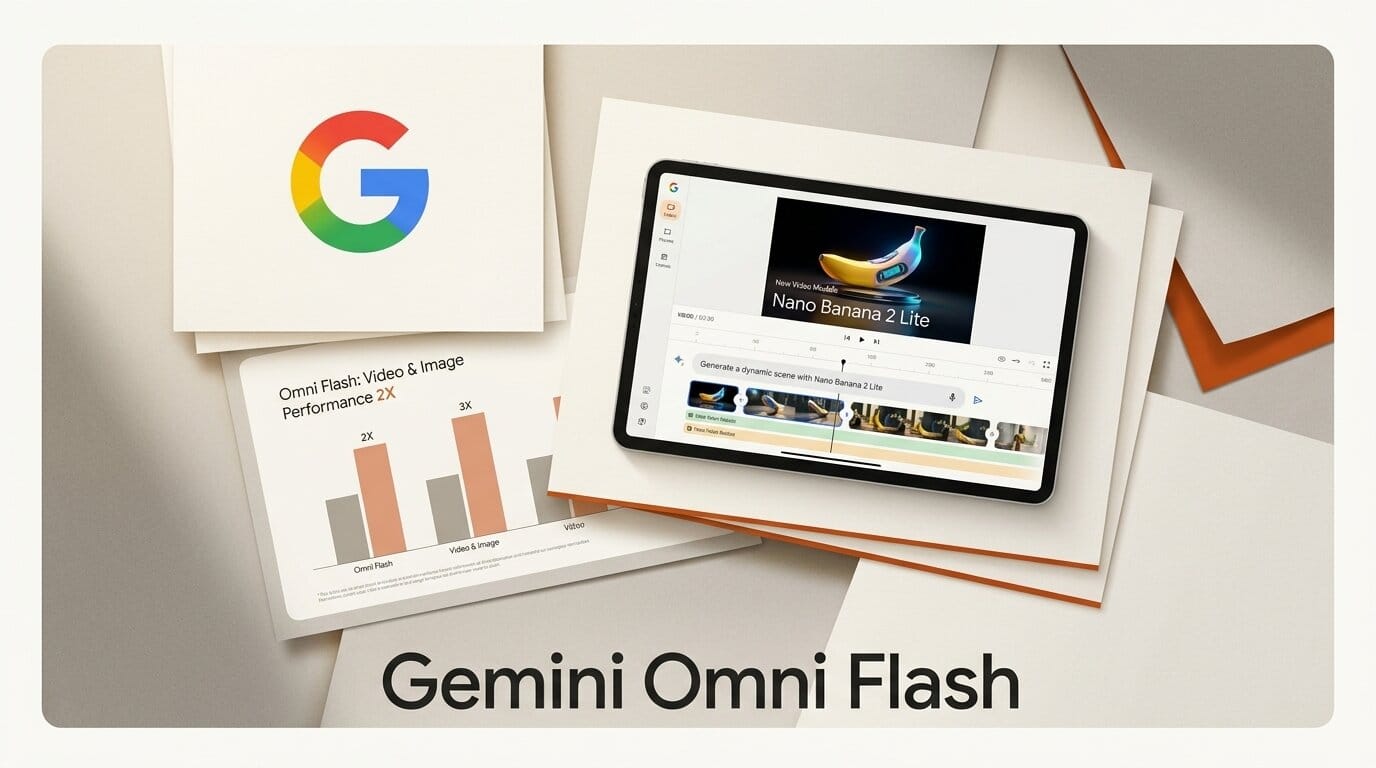
Google released two new generative models on June 30, 2026: Nano Banana 2 Lite, the fastest and cheapest member of its Nano Banana image family, and Gemini Omni Flash, a low-cost model for video generation and conversational editing. As detailed on the Google blog, Nano Banana 2 Lite returns a text-to-image result in about 4 seconds at $0.034 per 1,000 images, while Gemini Omni Flash generates video at $0.10 per second of output.
What Happened
The two models target creators who need speed and volume rather than maximum fidelity. Nano Banana 2 Lite sits below Nano Banana 2 and Nano Banana Pro in Google's lineup, trading some quality for a quicker, cheaper render. Google says it keeps reliable prompt adherence, character consistency, and legible in-image text, the features that made the earlier Nano Banana models popular. Both models are live now in Google AI Studio and the Gemini API, with Nano Banana 2 Lite also rolling into AI Mode in Search, the Gemini app, Google Photos, NotebookLM, and Google Ads.
Why It Matters
Price and latency are what decide whether a model fits inside a real workflow. At $0.034 per 1,000 images, Nano Banana 2 Lite makes batch generation, thumbnail variations, and storyboard frames cheap enough to run at scale. Gemini Omni Flash brings the same logic to video: at $0.10 per second you can iterate on short clips and edit them through natural language instead of a timeline. That conversational editing builds on the Gemini Omni video editing Google shipped to Android earlier this month. For a fuller picture of where the Nano Banana family sits against rivals, see our comparison of Nano Banana 2, FLUX.2, and Microsoft MAI. The Gemini Omni model page lists current limits, including 10-second clips.
Key Details
Nano Banana 2 Lite generates a 1K text-to-image output in roughly 4 seconds, costs $0.034 per 1,000 images, and supports the prompt adherence and text rendering of the larger Nano Banana models. Gemini Omni Flash produces 10-second video generations (longer durations are coming), supports multimodal referencing across images, text, and video, and synchronizes text and on-screen action, all at $0.10 per second of output. Google published a dedicated Nano Banana 2 Lite model page with the full specification. Both models carry SynthID watermarking on generated media.
What to Do Next
Open Google AI Studio and load Nano Banana 2 Lite to test it against your current image model on a real batch, then compare cost per usable frame. For video, try Gemini Omni Flash inside Google Flow, where it is in public preview, and run a conversational edit on a clip you already have. If you are building, the Gemini API exposes both models so you can wire them into an automated pipeline today.