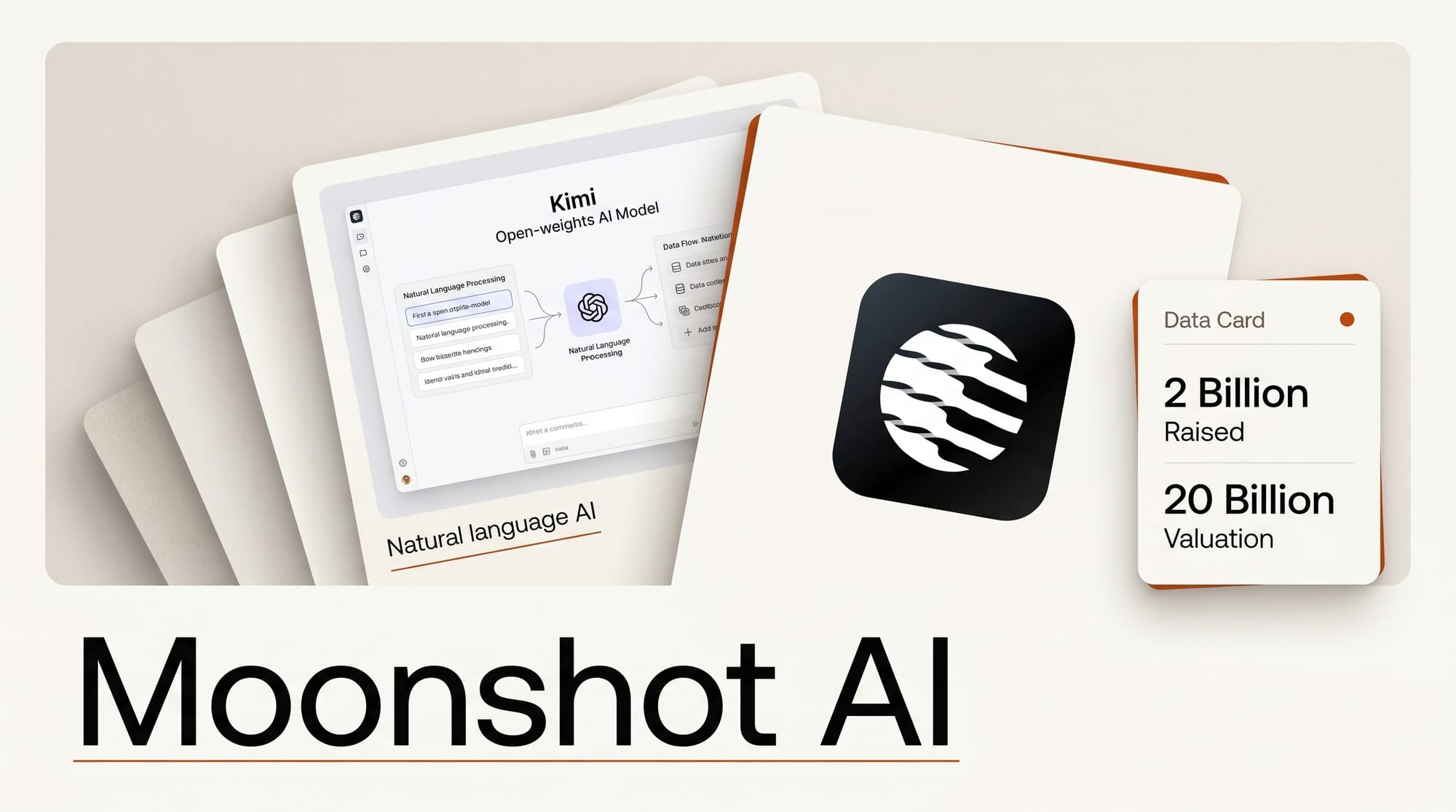
Moonshot AI, the Beijing lab behind the Kimi K2 family of open-weights models, closed a $2 billion round on May 7, 2026 at a valuation north of $20 billion, led by Meituan's Long-Z Investments with Tsinghua Capital, China Mobile, and CPE Yuanfeng joining. The headline number is interesting. The shape of the round is the story. Moonshot ships open-weights models, posted roughly $200 million ARR in April, and just secured the kind of capital usually reserved for closed-frontier labs. For creators using Kimi K2.6 in Cursor, Cline, or self-hosted pipelines, this round is a signal that the open-weights tier is consolidating around three or four well-funded labs rather than fragmenting into a long tail.
The backdrop matters. Anthropic raised at a $900 billion valuation last week. DeepSeek is reportedly in talks for its first outside round at a potential $45 billion valuation. Moonshot's $20 billion mark sits in between, but at roughly 100x ARR it lines up with the multiples closed-source labs trade at, not with the discounts open-weights shops have historically taken. Investors are paying a frontier-lab price for a lab that gives its weights away.
What Happened
The round was led by Meituan's venture arm Long-Z Investments. TechNode reports the deal closed at "more than $20 billion" with strategic participation from Tsinghua Capital (Yang Zhilin's alma mater Tsinghua University), China Mobile, and CPE Yuanfeng. Meituan, China's largest food-delivery and local-services platform, is now the anchor strategic on Moonshot's cap table, a notable pairing because Meituan operates one of the largest agentic-AI deployment surfaces in the country (couriers, restaurants, retail merchants, ad inventory).
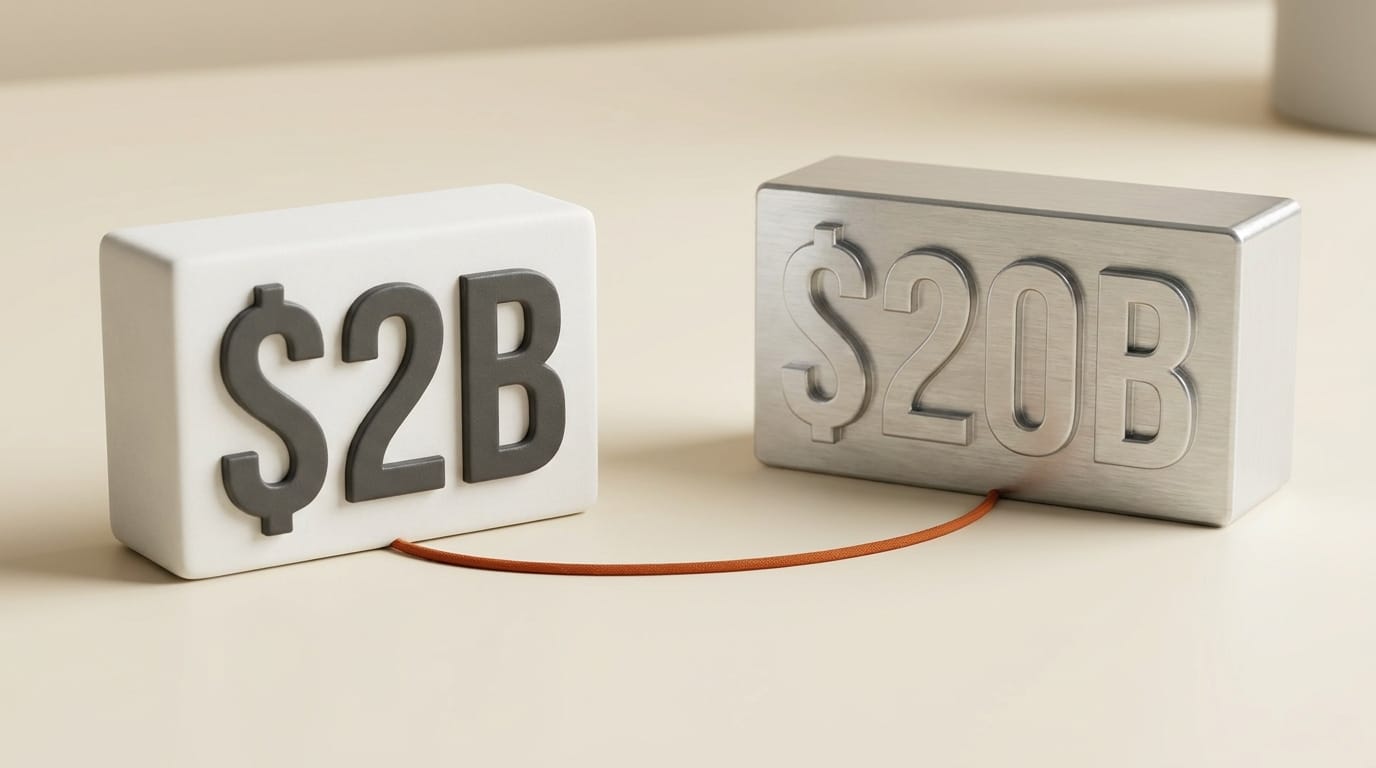
Moonshot's last round, in late 2024, valued the company at roughly $3.3 billion. The new mark is a 6x step-up in 18 months. Total funding raised over the past six months alone is reportedly $3.9 billion. Annualized revenue topped $200 million in April, driven by the Kimi consumer chatbot, Kimi Code (the IDE-integrated coding agent), and platform API revenue from platform.moonshot.ai.
The product side of the round is more important than the number. Moonshot ships all of its frontier weights to Hugging Face on the day they launch, including the recent Kimi K2.6 release: a roughly 1-trillion-parameter mixture-of-experts with 384 expert subnetworks, latent-space KV cache compression, and a tool-use SFT recipe that puts it within a single benchmark point of Claude Opus on coding evals. The Kimi-VL vision-language model, which extracts structured information from long-form video, is also fully open. The funding underwrites the next generation of these models on the same open-weights cadence, not a pivot to closed.
Why It Matters for Creators
Three things change for creators using AI tools day-to-day, and one thing does not.
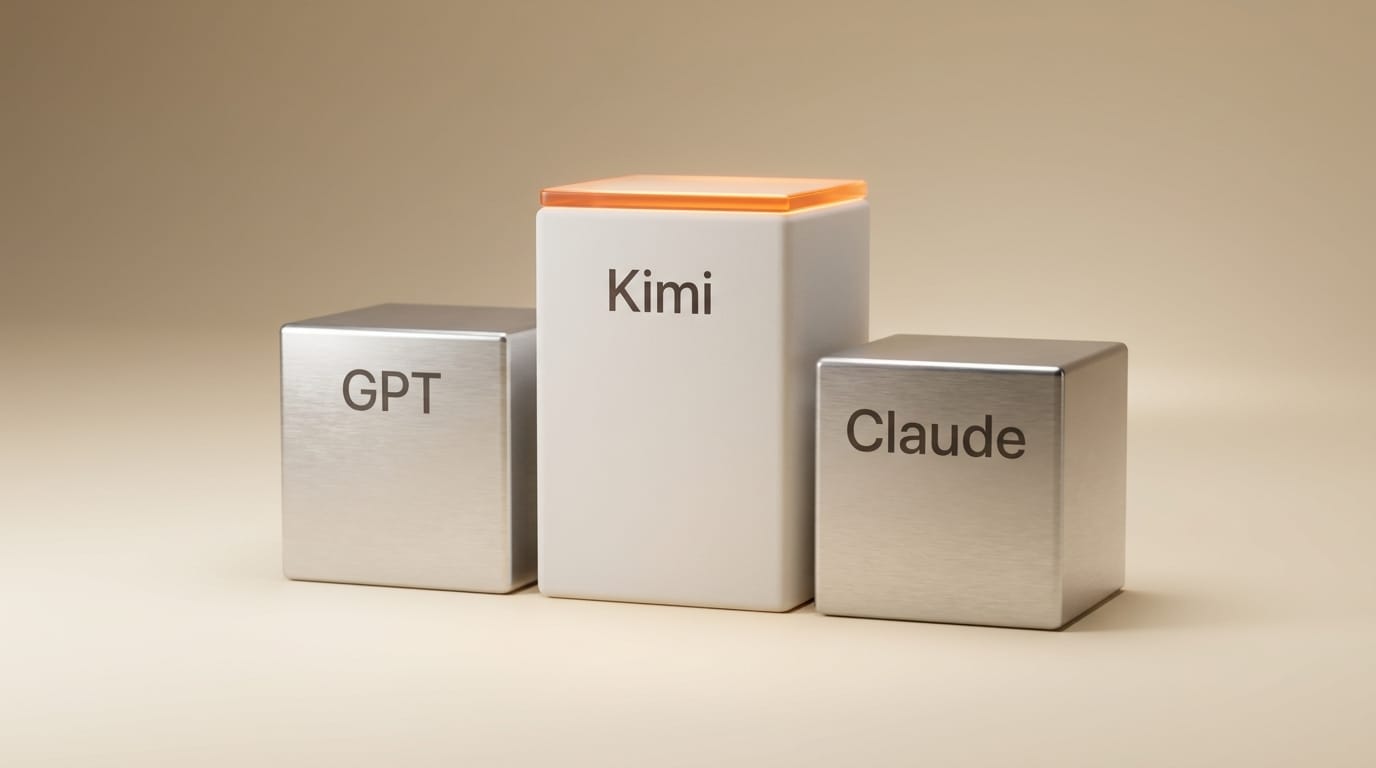
First, the open-weights tier is now well-capitalized enough to push back against pricing pressure from closed labs. Anthropic just raised Opus API prices to fund its capacity expansion. OpenAI's Pro tier sits at $200 a month. With Moonshot, DeepSeek, Qwen, and Z.ai (GLM) all funded into the multi-billion range and shipping open weights, creators have a credible substitute path: run Kimi K2.6 or DeepSeek V3.2 locally or on a low-cost GPU rental, get 90 to 95 percent of frontier coding quality, and pay a small fraction of closed-API rates. That backstop changes negotiation leverage even if you stay on closed APIs.
Second, the Meituan strategic angle previews where consumer-facing agent surfaces go next. Meituan operates millions of in-the-wild agent transactions per day across its delivery network. Joint product work between Moonshot and Meituan would give creators a real-world reference deployment for Kimi-powered agents at hyperscale, comparable to what Anthropic gets from Claude inside Cursor and Replit. Watch for Meituan-Moonshot APIs that expose merchant-side agent primitives.
Third, the open-weights commoditization thesis is now a financial bet, not just an ideological one. The AI Insider's writeup calls the round a wager that "intelligence will become a commodity, and value moves to applications and distribution." If that thesis cashes out, the durable creator businesses are the ones that build product on top of swappable model APIs (closed today, open tomorrow) and own the distribution.
What does not change: closed labs still hold the lead on multimodal frontier capabilities. Sora-class video, GPT Image 2-class image, and Veo 3-class motion remain the closed labs' moat for now. Open-weights is winning text, code, and increasingly vision-language extraction. It has not yet won creative video or audio.
How Moonshot Stacks Up
Here is how the round positions Moonshot relative to the other top-tier labs creators interact with most often.
| Lab | Latest valuation | Reported ARR | Open weights? | Flagship creator-facing model |
|---|---|---|---|---|
| OpenAI | $500B | $13B | No | GPT-5.5, GPT Image 2, Sora 2 |
| Anthropic | $900B | $44B+ | No | Claude Opus 4.7, Claude Code |
| xAI | $200B | ~$1.5B | Partial (Grok 1) | Grok Imagine, Grok Code |
| DeepSeek | ~$45B (rumored) | ~$300M | Yes | DeepSeek V4 Flash |
| Moonshot AI | $20B+ | $200M+ | Yes | Kimi K2.6, Kimi-VL |
| Z.ai (Zhipu) | ~$15B | ~$150M | Yes (GLM) | GLM-4.6, GLM-5V |
A few patterns are worth pulling out. The two top closed labs trade at roughly 38x and 20x ARR. The top three Chinese open-weights labs trade at 100x to 150x ARR. Investors are paying for the option value of those weights, not for current cash flow. Second, every Chinese open-weights lab now has a strategic backer with a national-scale distribution surface: Moonshot has Meituan, DeepSeek has High-Flyer plus state capital, Z.ai has Tencent and Alibaba ties. The "research-only" open-weights lab is not getting funded.
How to Use This in Your Stack
If you build with AI today, three concrete moves come out of this round.
Audit your provider concentration. If your creative pipeline routes 100 percent of LLM calls through one closed API, this round is a reminder to spike a parallel path. Run the same prompt through Kimi K2.6 on Moonshot's platform, on a Hugging Face inference endpoint, or self-hosted on an H100. Compare quality and latency on your actual use case, not on benchmarks. The number is rarely as bad as you expect, and the cost delta is often 10 to 20x.
Set up a local fallback. Kimi K2.6 quantized weights run on a single H100 (80GB) with reasonable throughput, and on consumer hardware (M-series Mac with 128GB) at lower throughput for batch jobs. Build a fallback config in your application that swaps the closed API for the open model when you hit a rate limit, a paywall, or a content filter that blocks legitimate creative work. Moonshot's GitHub has reference implementations.
Pay attention to Meituan integration milestones. If Meituan ships consumer-facing Kimi agents at scale (food ordering, ride-hailing, retail merchant tools), the agent design patterns that emerge will be more battle-tested than anything an enterprise API call has yet seen. Watch for case studies and reference architectures from Meituan's tech blog over the next two quarters.
Frequently Asked Questions
Is Kimi K2.6 actually competitive with Claude Opus or GPT-5.5 for creative work?
For text and code, yes, within a single-digit benchmark gap on most public evals. For multimodal creative work (image, video, audio generation), no. Kimi has Kimi-VL for vision input but does not currently ship a frontier image or video generator. If your work is text-heavy (writing, coding, research), the gap is small. If your work is image or video creation, you still need the closed labs or specialized open generators like Flux, Wan 2.5, or Stable Audio.
Does the Meituan investment affect Moonshot's open-weights commitment?
No public signals suggest a pivot. Moonshot has shipped every K2 generation as open weights on Hugging Face and confirmed the K2.6 release continues that pattern. Meituan's strategic interest is downstream agent deployment, not closed-source moat. The risk is dual-track: open community models plus a closed Meituan-tier optimized fork.
What is the difference between Moonshot AI and DeepSeek?
Both are Chinese open-weights labs at similar revenue scale, but they have different specialties. DeepSeek leans toward inference efficiency and reasoning (DeepSeek V4 Flash on a 128GB Mac via the antirez ds4 engine is a credible local frontier). Moonshot leans toward agent toolkits and longer context (Kimi K2.6 native tool calling, the Kimi Code IDE agent). For coding agents, Moonshot. For local reasoning, DeepSeek. For writing, both are within shouting distance of closed frontier.
How does the funding compare to recent Western rounds?
Moonshot at $20 billion is one-tenth of Anthropic's $200 billion round and one-twenty-fifth of OpenAI's $500 billion round. On an ARR multiple, however, Moonshot is more expensive (100x ARR) than Anthropic (about 20x ARR). Investors are paying for option value: if open-weights wins text and code, Moonshot becomes the default substrate.
Should I switch my pipeline to Kimi K2.6?
Don't migrate, dual-route. Add Kimi as a parallel provider in your stack so you can A/B test on real workloads, fall back to it when closed APIs hit rate limits, and switch entirely if pricing or policy at your closed provider changes. Tools like LiteLLM, OpenRouter, and Cline make multi-provider routing a config change, not a rewrite.
Is there a US-based hosting option for Kimi K2.6?
Yes. Together AI, Fireworks, OpenRouter, and Hyperbolic all host Kimi K2.6 with US-based inference. If data residency or geopolitical risk matters for your workflow, route through a US host rather than direct to platform.moonshot.ai. Costs are slightly higher than direct, but well below Claude Opus or GPT-5.5 rates.