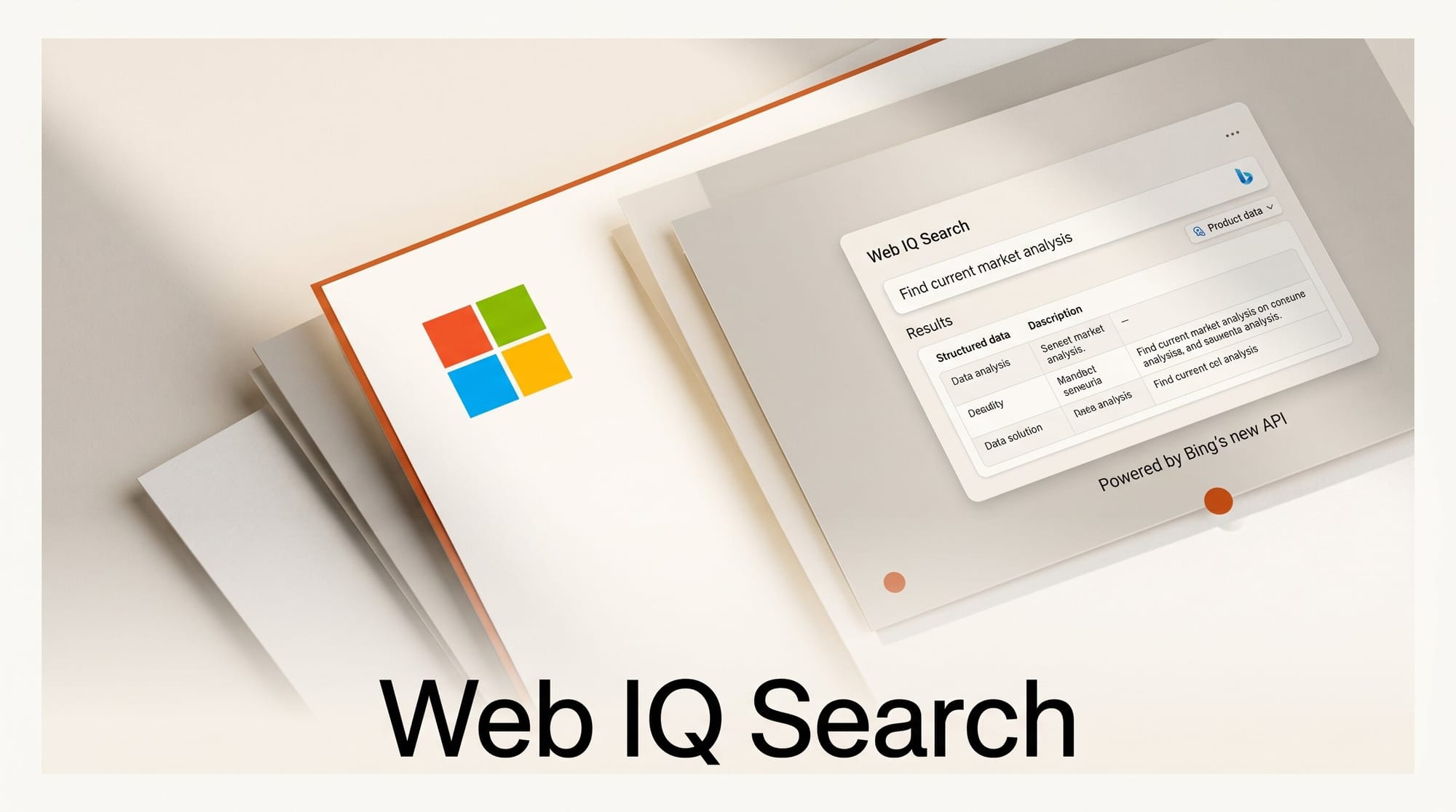
Microsoft launched Web IQ on June 2, 2026, a suite of search APIs built specifically for AI agents rather than human users. Powered by a re-architected version of the Bing global index, Web IQ already runs under the hood of both Microsoft Copilot and ChatGPT web responses.
What Is Web IQ?
Web IQ is what Microsoft describes as AI-native grounding APIs built for the agentic era. Where Bing was designed to surface ranked pages for human searchers, Web IQ is designed to help AI agents extract passage-level evidence from web content, news, images, and video, and feed that evidence directly into reasoning steps.
The key difference is how results are structured. Traditional search returns a list of links for humans to evaluate. Web IQ returns structured evidence chunks that an AI agent can immediately act on, without the overhead of loading full pages or parsing HTML.
Key Specs and Availability
- Latency: Sub-165ms at the 95th percentile
- Speed comparison: Approximately 2.5x faster than the next best alternative, according to Microsoft
- Result format: Passage-level evidence rather than full document links
- Current users: Microsoft Copilot and OpenAI ChatGPT both already running on Web IQ for web-grounded responses
- Availability: Cloud-hosted API with capacity expanding; interested developers can register via the announcement page
Why It Matters for AI Workflows
Web IQ is the infrastructure layer that determines what current web information AI tools can access when you ask them a question. As Search Engine Land noted, the system was built on the recognition that ranking is less important for agents compared to human searchers. Agents need accurate, dense evidence chunks rather than a ranked page of links.
For creators who build or use AI agent workflows, including tools like Copilot, ChatGPT with web search, or custom agent pipelines, this means the underlying search layer is now specifically optimized for how those tools retrieve information rather than retrofitted from human search infrastructure.
What to Do Next
If you build AI agents or workflows that rely on web grounding, Web IQ represents a more capable retrieval layer than general Bing Search API calls. Coverage from Search Engine Journal notes that pricing and full general availability timeline have not yet been announced, but Microsoft is taking interest registrations now. If your agents currently use the standard Bing Search API, monitoring the Web IQ waitlist is worthwhile.
For creators who are not building agents directly, the takeaway is that the quality of web-grounded AI responses in Copilot and ChatGPT improved with this infrastructure shift. Fresher, more precisely extracted web context means fewer outdated citations when you ask AI tools about current events or recent tools.