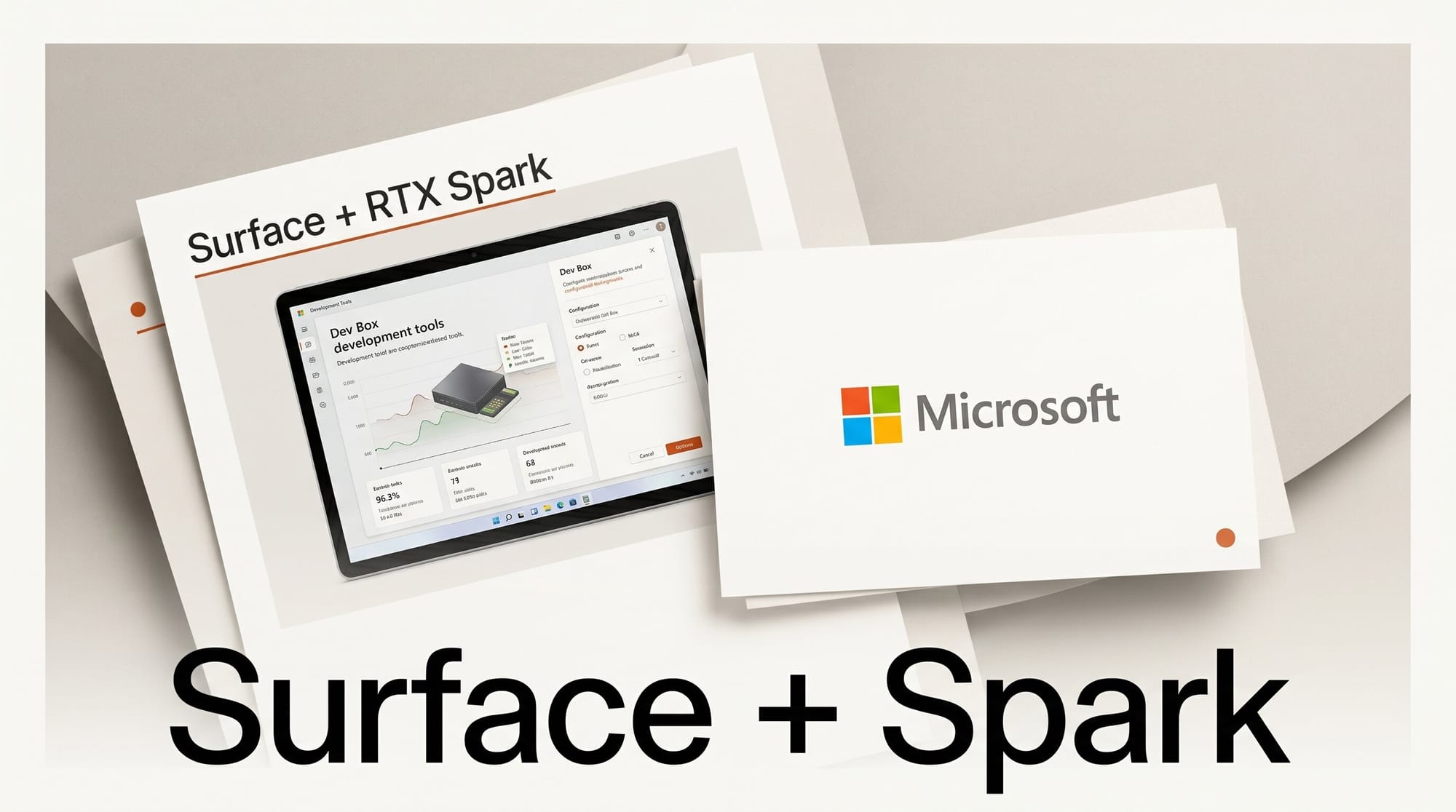
Microsoft announced the Surface RTX Spark Dev Box at Build 2026 on June 2, a compact developer PC powered by NVIDIA's RTX Spark superchip that runs AI models above 120 billion parameters entirely offline. The device arrives Fall 2026 exclusively on Microsoft.com in the US.
What Happened
Microsoft used its Build 2026 keynote to debut the Surface RTX Spark Dev Box, a stationary developer PC built around the same NVIDIA RTX Spark superchip announced at Computex on June 1. Where the laptop and slim-desktop SKUs target creators on the move, the Dev Box targets teams running sustained AI workloads: long training jobs, agentic pipelines, and local fine-tuning that would otherwise require cloud credits.
The device ships with Windows 11 Pro pre-configured for development, including VS Code, GitHub Copilot, Git, Python, Node.js, and WSL2 with native CUDA passthrough. An aluminum chassis doubles as the heatsink and a 100W thermal envelope supports multi-hour sustained compute without throttling.
Why It Matters
Cloud inference costs accumulate quickly when you iterate on prompts or pipelines dozens of times per day. The Dev Box trades a one-time hardware cost (price TBD; the competing NVIDIA DGX Spark starts at $3,999) for zero per-call costs and full data privacy. The 128GB unified memory means you can hold a 70B model in memory alongside active project context, something no current consumer GPU can match.
For AI-heavy creative workflows, those 128GB eliminate VRAM-split workarounds. Image generation pipelines running FLUX or Wan at full precision, local embedding search over large asset libraries, and real-time inference during video editing all fit inside a single address space.
Key Details
- Chip: NVIDIA RTX Spark (Blackwell GPU + Grace Arm CPU)
- Memory: 128GB unified
- AI performance: 1 petaFLOP FP4 inference
- Thermal: 100W sustained
- Software: Windows 11 Pro, VS Code, GitHub Copilot, WSL2 + CUDA
- Price: Not yet announced (competitor DGX Spark at $3,999)
- Availability: Fall 2026, Microsoft.com US only
What to Do Next
If you run inference-heavy workflows today, this is worth tracking. Three steps: (1) Measure what you currently spend on cloud inference per month to compare against an amortized hardware cost once pricing drops. (2) Audit whether your tools support ARM-native Windows or WSL2 (DaVinci Resolve, ComfyUI, and llama.cpp all have WSL2-compatible releases). (3) The Dev Box competes directly with AMD's Ryzen AI Halo PC and the NVIDIA DGX Spark; once pricing lands, compare total cost of ownership against your current monthly cloud spend to decide which makes sense for your workload.