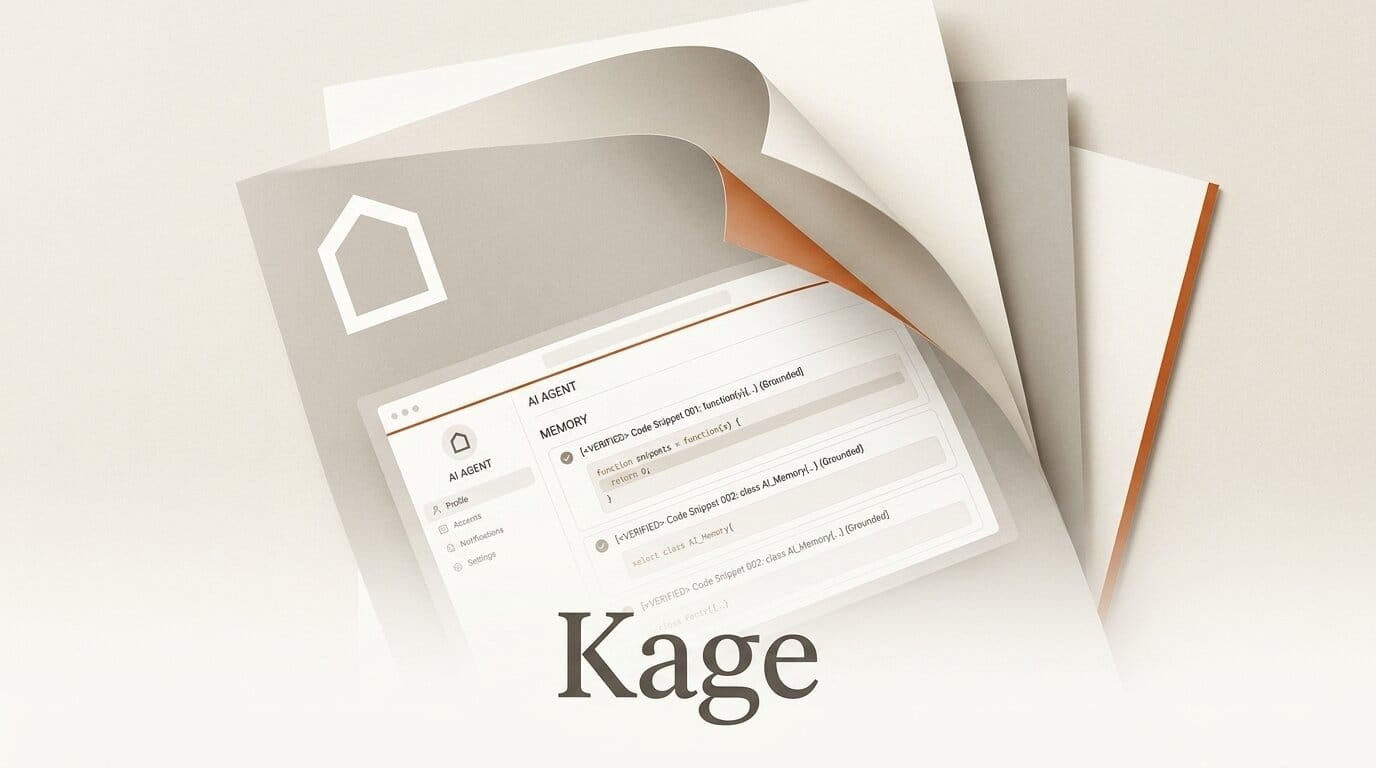
Kage, a new open-source verification layer for AI agent memory, launched this week with a single promise: stop your coding agent from recalling memories that are hallucinated or out of date. It is built directly on Google Cloud's Open Knowledge Format (OKF), the markdown-based agent memory standard Google shipped in June 2026, and adds the one thing OKF leaves out: proof that each remembered fact is still true.
What Happened
Kage shipped as a free, GPL-3.0 tool that installs in one command and works with any MCP-compatible agent. The full source lives in its public GitHub repository. Rather than invent its own storage format, Kage adopts OKF, which stores agent knowledge as a directory of markdown files inside your repo, then extends it with OKF-compliant x-kage-* fields that record where each memory came from in your code. Memories are committed to your own git history, so there is no proprietary database and no API key to manage.
Why It Matters
Agent memory is the current frontier for AI coding tools, and OKF gave the ecosystem a common file format almost overnight, as outlets like MarkTechPost documented at launch. But a shared format does not guarantee a shared truth. A memory that says "the auth service lives in services/login" is worse than useless once that folder is renamed, because the agent confidently acts on the stale fact. We covered the same problem from the wiki angle in our look at open-source AI wikis for Claude via MCP. Kage's answer is to refuse hallucinated citations on write and withhold stale ones on recall, so the agent only ever reads memory it can verify against the live codebase.
Key Details
Kage runs three checks on every memory it stores or serves:
- Verification. Every concept is checked against your real code, and hallucinated citations are rejected at write time.
- Freshness detection. When a code change invalidates a stored memory, Kage catches it and holds that memory back from recall until it is re-grounded.
- Code-grounding. Each memory anchors to specific symbols in your source, following the OKF concept-file model where one file equals one concept.
The project lists support for more than 15 clients, including Claude Code, Codex, Cursor, Windsurf, Gemini CLI, Cline, Goose, Aider, and Claude Desktop. The OKF foundation it builds on is published in Google's knowledge-catalog repository, so memories written by Kage stay readable by any other OKF-aware tool.
What to Do Next
If you run a coding agent and have ever watched it cite a file that no longer exists, Kage is worth a 10-minute trial. Install and wire it into your agent with one command:
npx -y @kage-core/kage-graph-mcp install copyThen scan an existing project to seed verified memory:
npx -y @kage-core/kage-graph-mcp scan --project .Because everything is markdown committed to git, you can review exactly what your agent "knows" in a normal pull request. Pair it with a reliable MCP setup, like the improvements in the recent Claude Code 2.1.195 rewind and MCP reliability update, and your agent's memory becomes something you can audit instead of trust on faith.