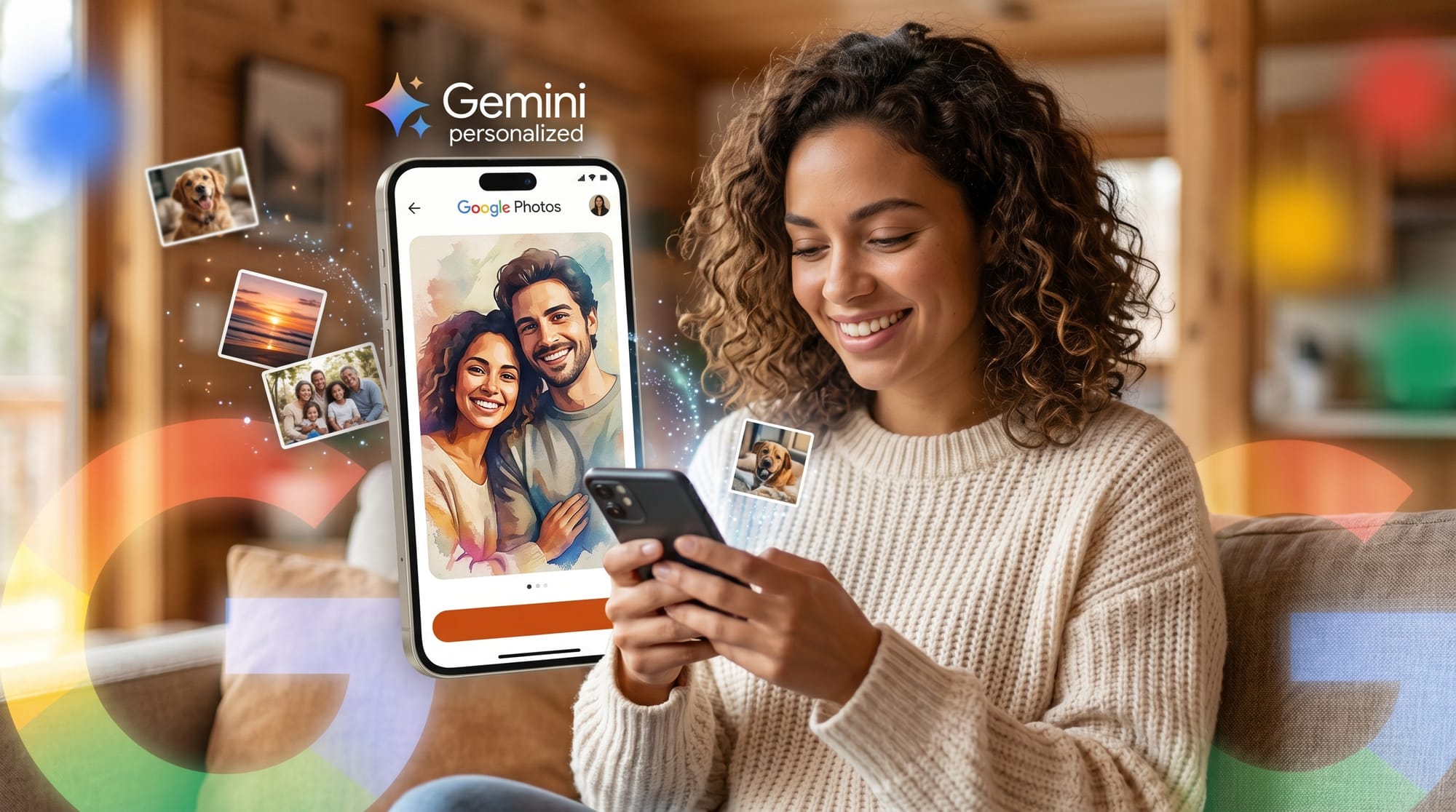
Google added Nano Banana 2-powered personalized image generation to the Gemini app on April 16, 2026, letting subscribers create images grounded in their own Google Photos library without writing detailed prompts.
For the broader landscape, see our complete guide to AI image generation in 2026.
The feature is part of Gemini's Personal Intelligence layer. When enabled, Gemini reads labeled groups, faces, and objects from your Google Photos archive and uses that context as input to Nano Banana 2. Ask for "a claymation version of me and my family on our last trip" and the model pulls location context and labeled faces from your library rather than requiring you to describe every detail.
What Changed
Standard AI image generation requires descriptive prompts: physical descriptions, clothing, settings, lighting, and style. Personal Intelligence removes most of that friction by substituting your actual photo library as context. The Gemini app uses Google Photos' existing organizational labels (people, pets, places) to inform generation, which means the work you have already done organizing your photos directly improves generation results.
Google states that private photo libraries are not used to train Nano Banana 2. Generation runs against your personal context without feeding your images into a shared training set.
Key Details
- Release date: April 16, 2026 (rolling out over the next few days)
- Model: Nano Banana 2
- Availability: U.S. subscribers on Google AI Plus, Pro, or Ultra plans
- Requires: Google Photos with labeled people, pets, or places for best results
- Privacy: Google states private photos are not used for model training
Why It Matters for Creators
The immediate use case is personal content: social media posts, gifts, holiday cards, and custom thumbnails featuring real people from your life. But the broader implication is that this model for personalized generation -- ground the AI in your actual existing media library rather than describing everything from scratch -- is likely to appear across other tools as the pattern gets established.
For professional creators, the more significant question is whether this approach extends to brand asset libraries, product photo catalogs, or character reference sheets. Google has not announced those use cases, but the underlying architecture (Photos-grounded generation via Personal Intelligence) supports them.
The feature is available now in the Gemini app for U.S. users on qualifying plans. Open the app, enable Personal Intelligence in settings, and connect your Google Photos account to get started.