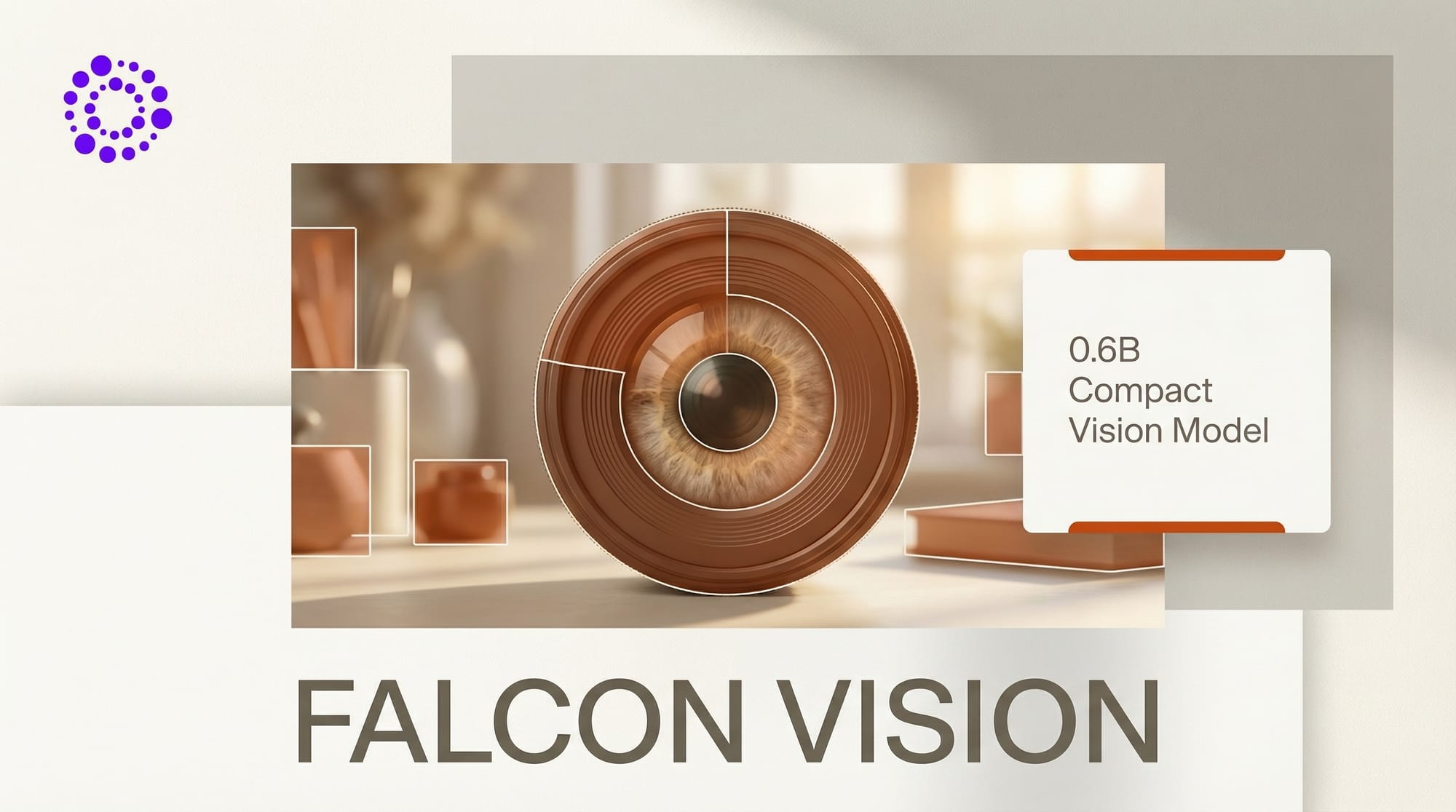
Technology Innovation Institute (TII) in Abu Dhabi has released Falcon Perception, a 0.6B parameter open-source vision model built for open-vocabulary grounding and segmentation from natural language prompts. Despite its compact size, the early-fusion Transformer outperforms Meta SAM 3 across six key benchmarks, delivering significant gains in spatial reasoning, dense scene handling, and OCR-guided tasks.
What Happened
Falcon Perception processes images and text together in a single unified sequence rather than treating them as separate inputs. The model introduces a Chain-of-Perception structured output pipeline that moves through coordinate detection, size estimation, and segmentation (coord -> size -> seg) to produce precise results from plain language descriptions.
The benchmark numbers against Meta SAM 3 are striking for a model this small:
- +5.7 Macro-F1 overall accuracy
- +9.2 on attribute recognition
- +13.4 on OCR-guided disambiguation
- +21.9 on spatial reasoning
- +15.8 on relational binding
- +14.2 on dense scene handling
Alongside Falcon Perception, TII also released Falcon OCR, a companion 0.3B parameter model focused on document understanding. Falcon OCR scores 80.3 on the olmOCR benchmark while running 3x faster than larger OCR models in its class.
Why It Matters for Creators
The practical value for creative professionals comes down to three capabilities that directly affect daily workflows.
Text-based object selection. Instead of manually drawing masks or clicking points, creators can describe what they want selected in plain language. "Select the red jacket on the person near the window" produces a precise segmentation mask. This changes how asset isolation works in compositing and editing pipelines.
Dense scene understanding. The +14.2 improvement on dense scenes means Falcon Perception handles cluttered compositions where other models struggle. Scenes with dozens of overlapping objects, common in product photography and architectural visualization, become manageable through text prompts alone.
OCR-guided disambiguation. When a scene contains text, the model can use that text to distinguish between similar objects. "Select the box labeled FRAGILE" works reliably, which opens up use cases in asset management and content organization that previously required manual tagging.
At 0.6B parameters, the model is small enough to run on consumer GPUs. This is not a cloud-only tool. Creators can integrate it into local workflows without API costs or latency concerns.
What to Do Next
The full model weights and code are available on GitHub under an open-source license. Pre-trained checkpoints are hosted on HuggingFace for quick setup.
For creators who want to test capabilities before committing to a local install, TII has published a live demo where you can upload images and try natural language segmentation directly in the browser.
If you work with masking, object selection, or asset pipelines, this is worth evaluating against your current tooling. The combination of small model size, strong benchmark performance, and open-source availability makes Falcon Perception one of the more practical vision model releases this year.