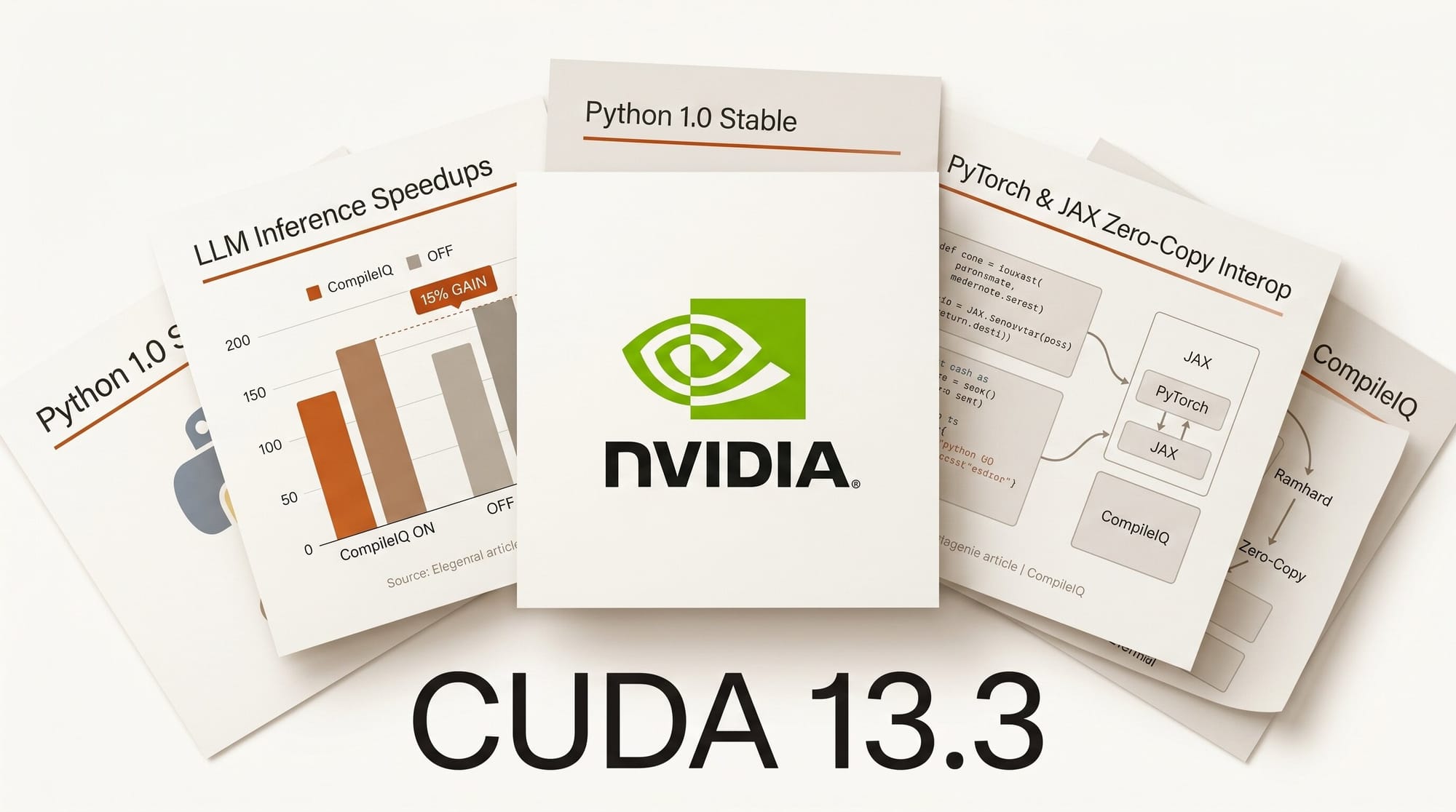
NVIDIA shipped CUDA 13.3 on May 26, 2026, marking the first stable 1.0 release of CUDA Python alongside a new compiler autotuning system called CompileIQ that delivers up to 15% speedups on GEMM and attention kernels, the two operations that consume more than 90% of LLM inference compute.
Try It: Drop CUDA Python Into Your Local AI Stack
If you run ComfyUI custom nodes, LoRA training scripts, llama.cpp builds, or any custom inference glue in Python, install the new cuda.core 1.0 package via pip and replace any hand-rolled ctypes bindings with the Pythonic API. The release ships three modules: cuda.core for runtime access (green contexts, IPC, process checkpointing), cuda.compute for algorithm primitives like upper_bound and lower_bound with Python lambdas as operators, and cuda.bindings for low-level C API calls. For Numba users, switching to the new MLIR backend is a single import change and cuts kernel launch latency by 2 to 3.5x, with bigger wins on kernels that take many scalar arguments.
Why It Matters
The CompileIQ auto-tuner is the headline number for creative AI workflows. GEMM and attention dominate the runtime cost of every diffusion sampler, every video generator, and every local LLM, so a 15% improvement on those kernels propagates through ComfyUI graphs, Stable Diffusion forks, and inference servers like llama.cpp and vLLM without any code change. The mmap() support is the other quiet win: it gives the CPU low-latency access to discrete GPU memory without needing the GDRCopy kernel module that most consumer GPU setups never install. The full CUDA Python documentation covers the API surface for both runtime and compute modules.
Key Details
CUDA Python 1.0 closes years of pre-release versions and finally guarantees API stability for tools that depend on direct CUDA access from Python. NVIDIA documents zero-copy tensor interoperability with PyTorch, JAX, and CuPy through cuda::to_device_mdspan, so creative AI inference frameworks can hand off arrays between runtimes without serialization overhead. CUDA Tile for C++ now supports Hopper (Compute Capability 9.0) for high-level tile-based kernel development, full C++23 lands in nvcc and nvrtc, and the complete toolkit is available in the CUDA Toolkit Archive alongside the rest of the 13.x line.
What to Do Next
If your creative AI pipeline pins an older CUDA Toolkit, test the 13.3 upgrade on a staging GPU first because driver compatibility shifts at every minor bump. ComfyUI and Forge users on Windows should wait for community wheels to rebuild before swapping. Local LLM creators using Gemma 4 2B in LM Studio or other quantized runtimes will pick up the CompileIQ gains automatically once they upgrade.