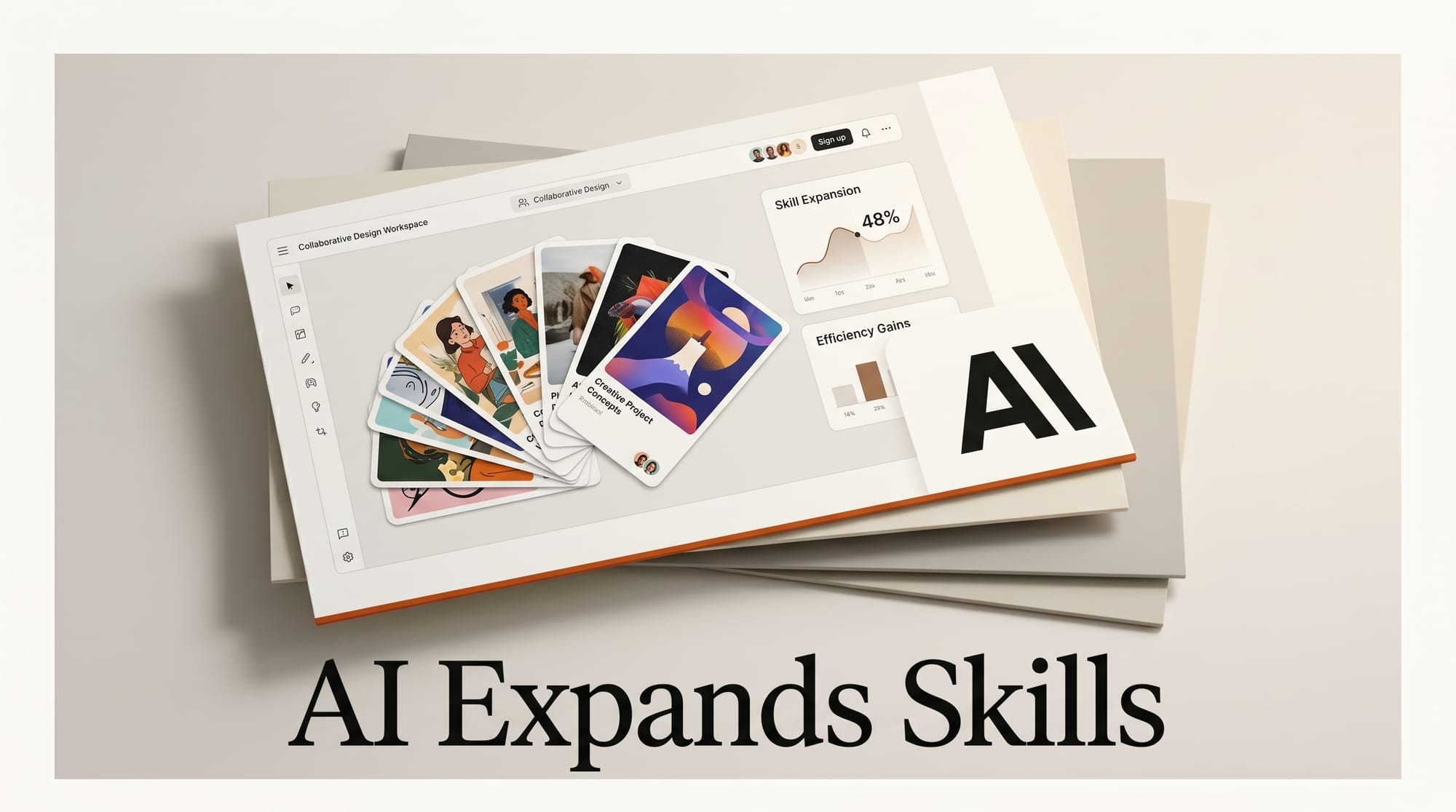
Anthropic surveyed 81,000 Claude users in April 2026 and found that AI is expanding what people can do more than how fast they do it. Among respondents who described productivity effects, 48% cited expanded scope as the top benefit, while 40% pointed to speed. The data comes from the Anthropic Economic Index, a new monthly study linking consumer economic perspectives with quantified Claude usage patterns, published April 22.
What Happened
Anthropic launched its Economic Index Survey on April 22, 2026, with an initial report covering 81,000 voluntary respondents drawn from personal Claude.ai accounts. Researchers Maxim Massenkoff and Saffron Huang conducted the analysis. The mean productivity rating was 5.1 out of 7. Only 3% reported neutral or negative impacts.
The scope-over-speed finding is significant. AI is not just making existing workflows faster; it is enabling tasks users could not previously complete. A delivery driver in the survey described launching an e-commerce business. A landscaper built a music application. These are new income streams, not accelerated routines.
Why It Matters
For creative professionals, the results expose a specific tension. Artists and writers found AI "too stifling and rigid" for their own creative work, yet simultaneously expressed above-average anxiety about AI displacing them in creative fields. The survey confirmed a U-shaped relationship: even creatives experiencing AI-related slowdowns reported above-average job loss concerns.
One in five respondents overall feared economic displacement. Early-career workers were substantially more likely to report that fear than senior professionals. For every 10-percentage-point increase in AI exposure, job threat concern rose 1.3 percentage points. The gains are not evenly distributed: high-wage workers, particularly software developers, reported the strongest productivity benefits.
Key Details
- 81,000 respondents from personal Claude.ai accounts; enterprise users excluded entirely
- Mean productivity score: 5.1 out of 7
- 48% cite expanded scope as the top benefit; 40% cite speed
- 20% of respondents expressed job displacement concerns
- Early-career workers: significantly more likely to fear job loss than senior professionals
- For every 10-point increase in AI exposure, job threat concern rose 1.3 percentage points
- Only 10% said employers demanded more work output in exchange for AI assistance
- Sample bias: overrepresents solopreneurs and side-project users; excludes enterprise
- Companion study: Anthropic Economic Index Survey announced as a recurring monthly study
What to Do Next
If you are a creative professional who has felt that AI tools do not fit your workflow, this data validates that experience. Tools like Claude Opus 4.7 have been expanding into visual and coding workflows, but Anthropic's own survey shows creative applications still lag behind technical ones. The tools were not designed for creative ambiguity first.
- Use AI for adjacent tasks you have been avoiding, not for core creative output. Research, briefs, client emails, and production scheduling all fall into the scope-expansion category.
- Watch for tools built for creative ambiguity. Generative image and video tools operate differently from text assistants. Products like Claude Design are attempting to close this gap.
- Document your creative process. The survey confirms AI struggles with creative work precisely because that work is human-defined. Your process, taste, and judgment are not easily replicated.
The full Economic Index report is available at anthropic.com/research/81k-economics. The Decoder published an independent analysis on April 23.