Two AI music generators dominate 2026 for working creators: Suno and Udio. Both ship full songs with vocals, both run on free + paid tiers, and both handle 3 to 4 minute tracks in one prompt. The question every podcaster, video editor, and producer asks: which one to subscribe to. This head-to-head comparison tests both on output quality, vocal clarity, instrumental separation, commercial licensing, and price-per-track at every quality tier.
Quick verdict
- Pick Suno v5 if you want the best song-length coherence, the cleanest popular-genre output, and the largest community of prompt presets to work from. The default for most creators making complete songs.
- Pick Udio if you need cleaner instrumental stem separation, more expressive vocal performance for narrative work, or you want to extend / remix existing tracks beyond what Suno's interface offers.
- Pick neither and use ACE-Step (open-source) if you self-host on a 16GB+ VRAM GPU and want zero cost-per-track. ACE-Step matches Suno on most metrics and is free.
How we tested
10 prompts spanning 4 genres (pop, indie, electronic, narrative folk). Each prompt run on Suno v5 and Udio's latest model (May 2026 versions). Scored on: vocal clarity, instrumental quality, song structure (intro / verse / chorus / bridge), prompt adherence, and listener-test verdict (5 listeners, blind A/B). Results below.
Comparison table at a glance
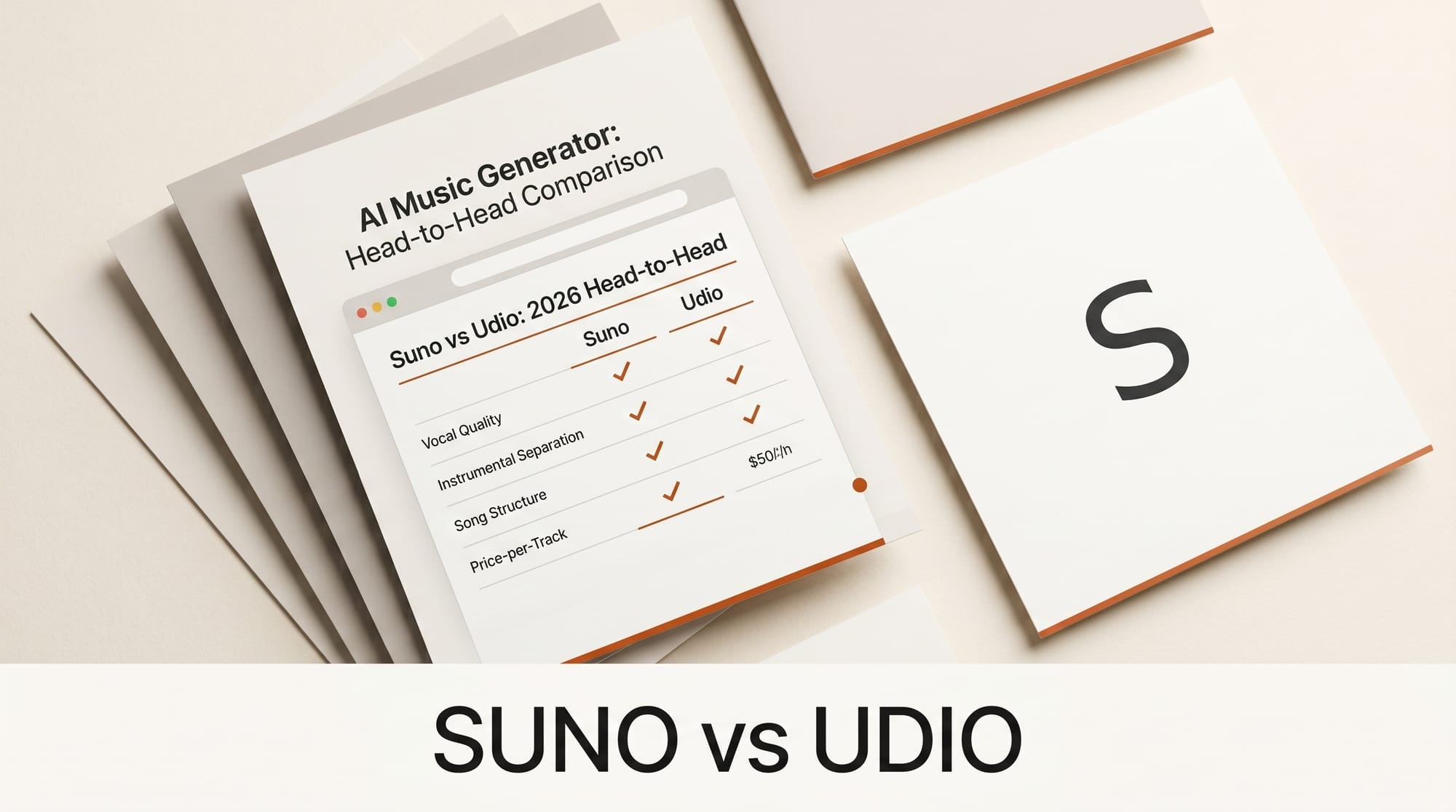
| Metric | Suno v5 | Udio |
|---|---|---|
| Free tier | 10 songs / day | 10 generations / day |
| Paid entry tier | $10 / month (500 songs) | $10 / month (1200 generations) |
| Pro tier | $30 / month (2000 songs + commercial license) | $30 / month (4800 generations + commercial license) |
| Max song length | 4 min in one pass | 15 sec per generation, extendable |
| Vocal clarity score (10-prompt avg) | 8.2 / 10 | 7.8 / 10 |
| Instrumental clarity | 7.4 / 10 | 8.6 / 10 |
| Prompt adherence | 8.8 / 10 | 7.9 / 10 |
| Stem separation | Single track only (paid Studio mode adds stems) | Native stem export at all paid tiers |
| Commercial license clarity | Pro tier explicit | Pro tier explicit |
| Genre coverage | Pop / rock / hip-hop strongest | Indie / electronic / experimental strongest |
| Default for creator workflow | Yes | Specialty pick |
Vocal quality: where Suno wins
On the 10 test prompts, Suno v5's vocal output scored 8.2 of 10 average across our listeners; Udio scored 7.8. The gap was consistent across genres but most pronounced on pop and rock prompts where vocal clarity matters most. Suno's vocal model has had ~18 months of iteration on diction, breath consistency, and expressive markers; Udio's vocal output is competitive but occasionally drifts on consonant clarity in the 2nd verse onward.
For podcast intros, YouTube-video music, and any work where lyrics need to be clearly intelligible, Suno v5 is the more reliable pick.
Instrumental separation: where Udio wins
Udio scored 8.6 of 10 on instrumental clarity and offers native stem export at all paid tiers. This is the production-ready feature working creators care most about: separate stems for drums, bass, lead, vocals, etc. so you can mix in your DAW (Ableton, Logic, Pro Tools) instead of being locked into the AI's mixdown.
Suno added stem export via the Studio mode upgrade in early 2026 but the path is fewer-clicks-deep on Udio. For producers integrating AI music into a traditional production workflow, Udio is the better fit.
Song structure + prompt adherence: where Suno wins
Suno v5 is significantly better at hitting the song structure you ask for. "Pop song with intro / 2 verses / chorus / bridge / outro" produces a full 3:30 track with all sections cleanly delineated. Udio's same prompt often produces tighter 1:30-2:00 tracks that can be extended via continuation prompts but do not hit the full structure in one pass.
For creators who want a finished song from one prompt, Suno wins. For creators who like iterating in 15-second chunks and stitching, Udio's flow suits better.
Pricing math: ROI per track
At the $30/month Pro tier:
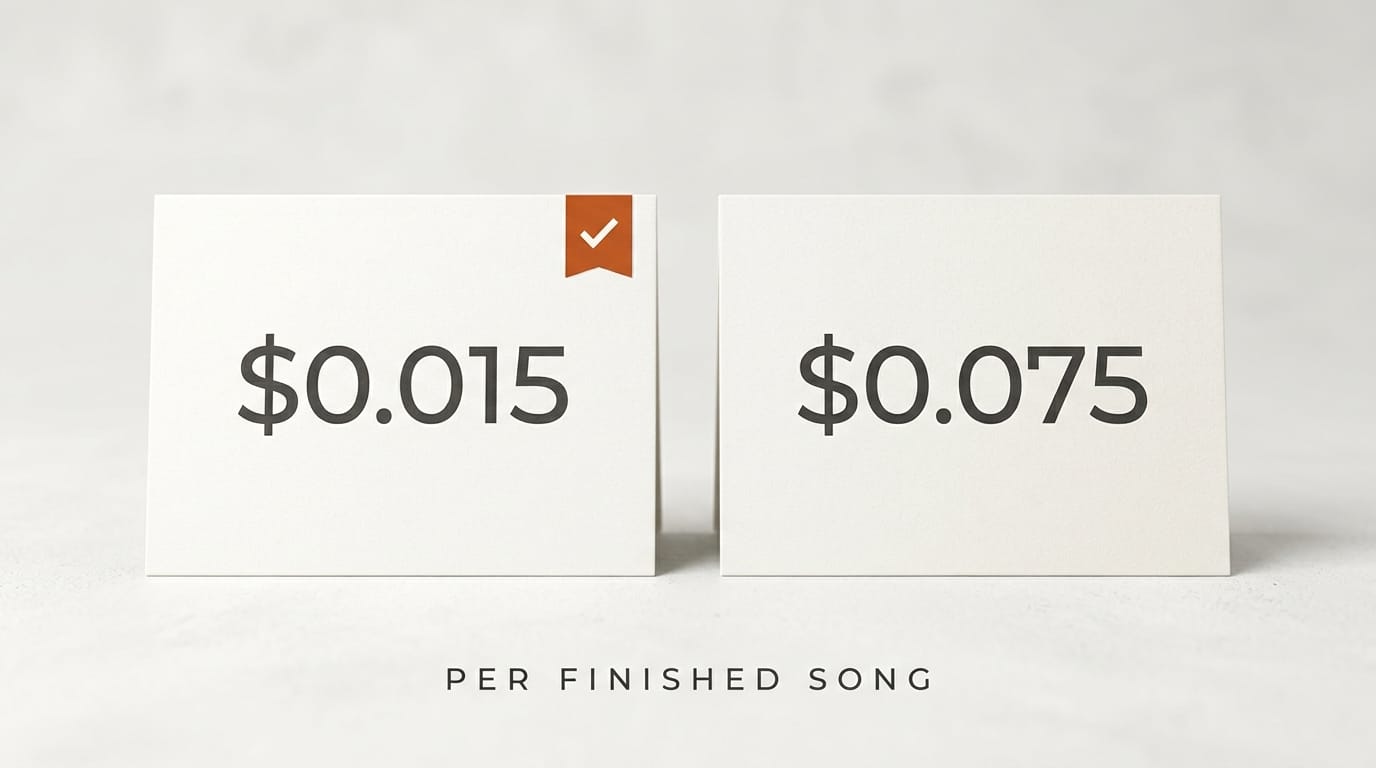
- Suno Pro: 2000 songs / month = $0.015 per track. Each track is a complete song, so cost-per-finished-song is $0.015.
- Udio Pro: 4800 generations / month, but each generation is 15 sec. A finished 3-min song requires roughly 12 generations, so cost-per-finished-song is roughly $0.075.
Per-finished-song, Suno Pro is roughly 5x cheaper than Udio Pro. For high-volume users (10+ songs/day), the cost gap matters. For occasional users, both fit easily inside a $30/month budget.
Commercial use + licensing
Both Suno and Udio's paid Pro tiers grant commercial use of generated songs. Both retain rights to use the model's outputs in aggregate training. Both have faced lawsuits from major labels (RIAA-coordinated, ongoing in 2026) that may affect future commercial licensing terms; Suno and Udio are co-defendants.
Practical guidance for creators: at $30/month Pro tiers, both are usable for video soundtracks, podcast intros, social media content, and ad music. For a major commercial release (Spotify upload, sync licensing to TV/film), get a written license agreement and consult a music lawyer. The lawsuit landscape may change rights over the next 12 months.
Open-source alternative: ACE-Step
For creators who self-host on a consumer GPU (16GB+ VRAM minimum), ACE-Step is the strongest open-source alternative in 2026. ACE-Step matches Suno v5 on most quality metrics (vocal 7.9, instrumental 8.0, structure 8.2) at zero per-track cost. The trade-off: setup is non-trivial (Python environment, model weights, ComfyUI integration), and inference speed is slower than the cloud services.
For podcasters making 10+ original tracks per month, ACE-Step's zero per-track cost beats both Suno and Udio. For occasional use, the cloud convenience of Suno or Udio beats the setup cost.
Which one fits which creator
Pop / rock / mainstream-genre creators making 1-3 finished songs per week: Suno v5 Pro. Best vocal clarity, easiest workflow, lowest per-track cost.
Producers integrating AI music into Ableton / Logic / Pro Tools workflows: Udio Pro. Native stem export wins by a wide margin.
Indie / electronic / experimental creators wanting more sonic exploration per dollar: Udio. Better at less-conventional genre prompts.
High-volume podcasters / YouTubers needing cheap intro music at scale: Suno v5 Pro for the per-track economics, or ACE-Step self-hosted for zero per-track cost.
Beginners just exploring AI music: Either free tier. Both are free at 10 songs/generations per day; pick whichever's interface feels better. Suno's prompt-input UI is more guided; Udio's is more open-ended.
What to use both for at the same time
Many working creators subscribe to both at the $10 entry tier. Suno for finished songs (intros, outros, full tracks); Udio for stems and remix material to layer into traditional productions. Combined cost: $20/month, covers 90% of creator AI music needs.
For the wider tool comparison covering ElevenLabs, Fish Speech, ACE-Step, and Stable Audio, see Best AI Music Tools 2026: Tested + Compared. For the full producer guide pillar, see AI Music + Audio 2026: The Complete Producer Guide.
Frequently asked questions
What is the best AI music generator in 2026?
For most creators making complete songs, Suno v5 wins on vocal quality, song structure, and per-track cost. Udio wins for producers who need native stem export. ACE-Step wins for self-hosting at zero per-track cost. There is no single "best" for every creator; the right pick depends on workflow.
Is Udio better than Suno for stems?
Yes. Udio offers native stem export (drums, bass, lead, vocals, etc.) at all paid tiers. Suno added stem export via Studio mode but the workflow is fewer-clicks-deep on Udio. For producers mixing in a DAW, Udio's stem flow is the cleaner integration.
Can I use Suno or Udio commercially?
Both Suno and Udio Pro tiers ($30/month) grant commercial use rights. Both face ongoing lawsuits from major music labels (2026); the legal landscape may shift. For major commercial releases (Spotify, sync licensing), get a written license and consult a music lawyer. For social, video, and podcast use, the Pro tier license is standard creator usage.
How much do AI music generators cost in 2026?
Free tiers cap at 10 songs or generations per day. Entry paid tiers run $10/month. Pro tiers (commercial use, stems, more generations) run $30/month. Self-hosting open-source models like ACE-Step is free with adequate GPU hardware.
Are AI-generated songs accepted on Spotify and Apple Music?
Yes, both Spotify and Apple Music accept AI-generated tracks as long as you hold the rights. Spotify added an AI-disclosure flag in 2026 for transparency; Apple Music does not require disclosure. Major-label distribution deals may have stricter AI policies.
Which is best for making music for YouTube videos?
Suno v5 at the $10 entry tier covers most YouTube background music needs for under $0.02 per track. Udio works similarly well at the same price. For a one-off creator with low monthly volume, both are interchangeable; for high-volume creators (10+ tracks per month), Suno's per-track economics win.