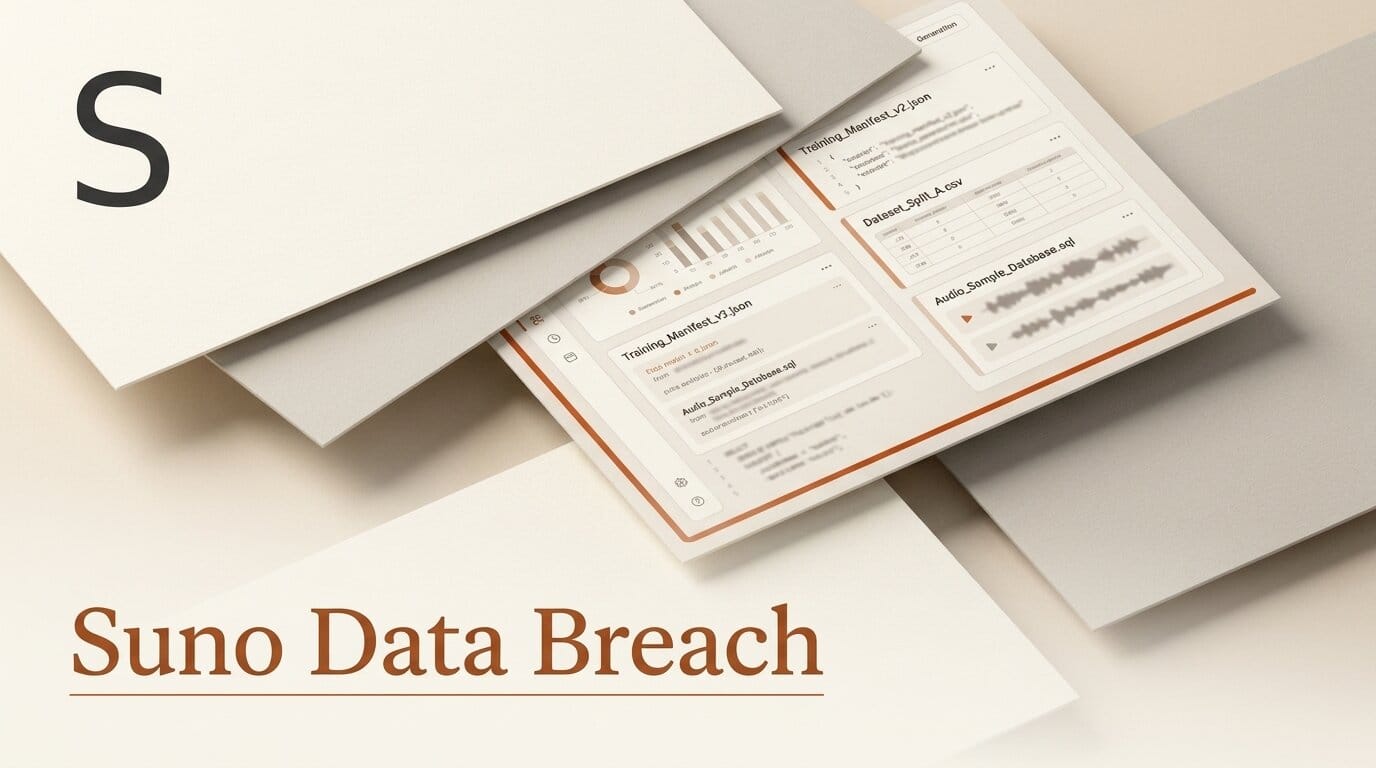
A hacker who breached Suno has handed 404 Media internal files that spell out exactly where the AI music generator got its training data, and the list reads like a map of the open web's audio: 2,013,545 music clips scraped from YouTube Music, plus catalogs pulled from Deezer, Genius, Pond5, Jamendo, Freesound, and roughly 420,000 podcasts harvested through RSS feeds. The breach, disclosed on July 15, 2026, arrives weeks before a July summary-judgment hearing in the Sony Music and Universal Music Group copyright case against Suno, and it turns a question the company has dodged for two years into a documented inventory. For anyone releasing AI-generated music commercially, the leak changes what you can reasonably claim about where your tracks come from.
What the Suno breach exposed
The intrusion was carried out by a hacker using the handle ellie.191, who accessed Suno source code dating from 2023 to 2024, customer records for hundreds of thousands of users, and Stripe payment details. The entry point, according to 404 Media, was the Shai-Hulud worm, a supply-chain attack that harvested employee credentials rather than breaking a single password. The most consequential part of the haul is not the customer data but the training manifests, which name the sources and quantify the scale in hours.
Suno responded that its "AI models have been trained on publicly available music files, the majority of which exist on the open Internet," and that the material was "accessible on third-party websites." That framing matters, because "publicly accessible" is not the same as "licensed," and the labels suing Suno argue that pulling audio from YouTube through stream ripping is piracy regardless of whether the page was public. Here is the scale the leaked files describe:
| Source | What was taken | Reported scale |
|---|---|---|
| YouTube Music | Music clips, stream-ripped | 2,013,545 clips; 113,879 hours |
| YouTube (tagged content) | Labeled audio for training signal | 152,162 hours |
| Pond5 | Stock music library | 62,117 hours |
| Deezer | Streaming catalog | Catalog-scale (unspecified) |
| Genius | Song lyrics | Lyrics corpus |
| Jamendo / Freesound / IMSLP | Open and CC-tagged audio | Multiple libraries |
| Podcasts (RSS) | Spoken-word audio | ~420,000 podcasts |
Why this matters for AI music creators
Suno has never confirmed its training sources in public. It has defended itself in court on the theory that training on copyrighted recordings is transformative fair use, a legal argument that only works if a judge accepts it. The leaked manifests remove the ambiguity that the fair-use defense partly relied on, because they show deliberate, catalog-level collection from named commercial services rather than incidental scraping. That is the exact evidence Sony and UMG have been assembling. In May 2026 the labels used the audio-fingerprinting service Audible Magic to identify their recordings inside Suno's training set and moved to add 61,026 recordings to the case.
The timing is what makes this urgent for creators rather than just for lawyers. The Suno case is heading to a summary-judgment hearing this July. If the court rules against Suno's fair-use defense, every model trained the same way inherits legal exposure, and tracks generated by those models sit on uncertain ground for commercial use. Warner already settled and pivoted to a licensing partnership in late 2025, which tells you which way the major labels expect this to resolve.

Training-data transparency across the major tools
The breach is a good moment to compare how the leading AI music tools source their data, because that is now the single biggest differentiator between them for anyone who needs to release work commercially. The pattern is a split between scraped-and-litigating and licensed-and-disclosed.
| Tool | Training-data posture | Legal status |
|---|---|---|
| Suno | Scraped from YouTube, Deezer, Genius and others (now leaked) | Active Sony/UMG litigation; Warner settled |
| Udio | Pivoted to a UMG-licensed joint platform | Settled with UMG in late 2025 |
| ElevenLabs Music | Launched with label and publisher licensing deals | Licensed catalog approach |
| Sonilo | Built on a Shutterstock-licensed music library | Licensed by design |
What this means for your commercial tracks
If you have released Suno-generated music commercially, nothing is retroactively illegal today, but the risk profile has changed and it is worth acting before the July ruling rather than after. Practical steps:
- Inventory where your published tracks came from. Separate anything generated on Suno or Udio's pre-settlement models from tracks made on licensed tools, so you know your exposure if the ruling goes against fair use.
- Prefer licensed-catalog tools for paid client work. For anything with a contract, indemnification, or a brand attached, a tool with disclosed licensing is a safer input than one whose training set is the subject of active litigation.
- Read the terms you actually agreed to. Most AI music tools grant you a usage license, not copyright ownership, and that distinction governs sync licensing, monetization, and takedown risk.
- Keep your prompts and project files. If provenance is ever questioned, being able to show how a track was made is your cheapest form of protection.
The leak does not mean creators should abandon AI music. It means the "we don't disclose our training data" era is ending, and the tools that already license their catalogs are about to look a lot more attractive than the ones fighting about it in court. Suno itself remains well funded, having raised another $400 million in June even with the lawsuits open, so it is not going anywhere. The question is what its output is worth to you commercially once a court weighs in.

Frequently asked questions
What did the Suno hack actually reveal?
Internal files shared with 404 Media by a hacker named ellie.191 listed Suno's training sources, including 2,013,545 music clips from YouTube Music, catalogs from Deezer, Genius, Pond5, Jamendo, Freesound and IMSLP, and around 420,000 podcasts pulled through RSS. The breach also exposed source code, customer records, and Stripe payment data.
Does this make Suno-generated music illegal to use?
No. There is no ruling that makes existing AI-generated tracks illegal, and Suno maintains its training was fair use of publicly accessible material. The leak increases legal uncertainty rather than settling it, which is why the July summary-judgment hearing matters so much.
How did the breach happen?
404 Media reports the attacker used the Shai-Hulud worm, a supply-chain attack that harvested Suno employee credentials, then accessed source code from 2023 to 2024 along with customer and payment data.
Which AI music tools disclose or license their training data?
Udio moved to a UMG-licensed joint platform, ElevenLabs Music launched with label and publisher licensing, and Sonilo is built on a Shutterstock-licensed library. Suno is the outlier still litigating over scraped data. See our guide to the best AI music generators for a full comparison.
Should I stop using Suno?
Not necessarily. For personal projects the practical risk is low. For paid client work, brand campaigns, or anything requiring indemnification, a licensed-catalog tool is the safer input until the court rules. Compare the options in our Suno vs Udio breakdown.
When will the Suno lawsuit be decided?
A summary-judgment hearing is scheduled for July 2026. A ruling against Suno's fair-use defense would reset the risk calculus for the entire AI music category; a ruling in its favor would weaken the labels' leverage in future negotiations.