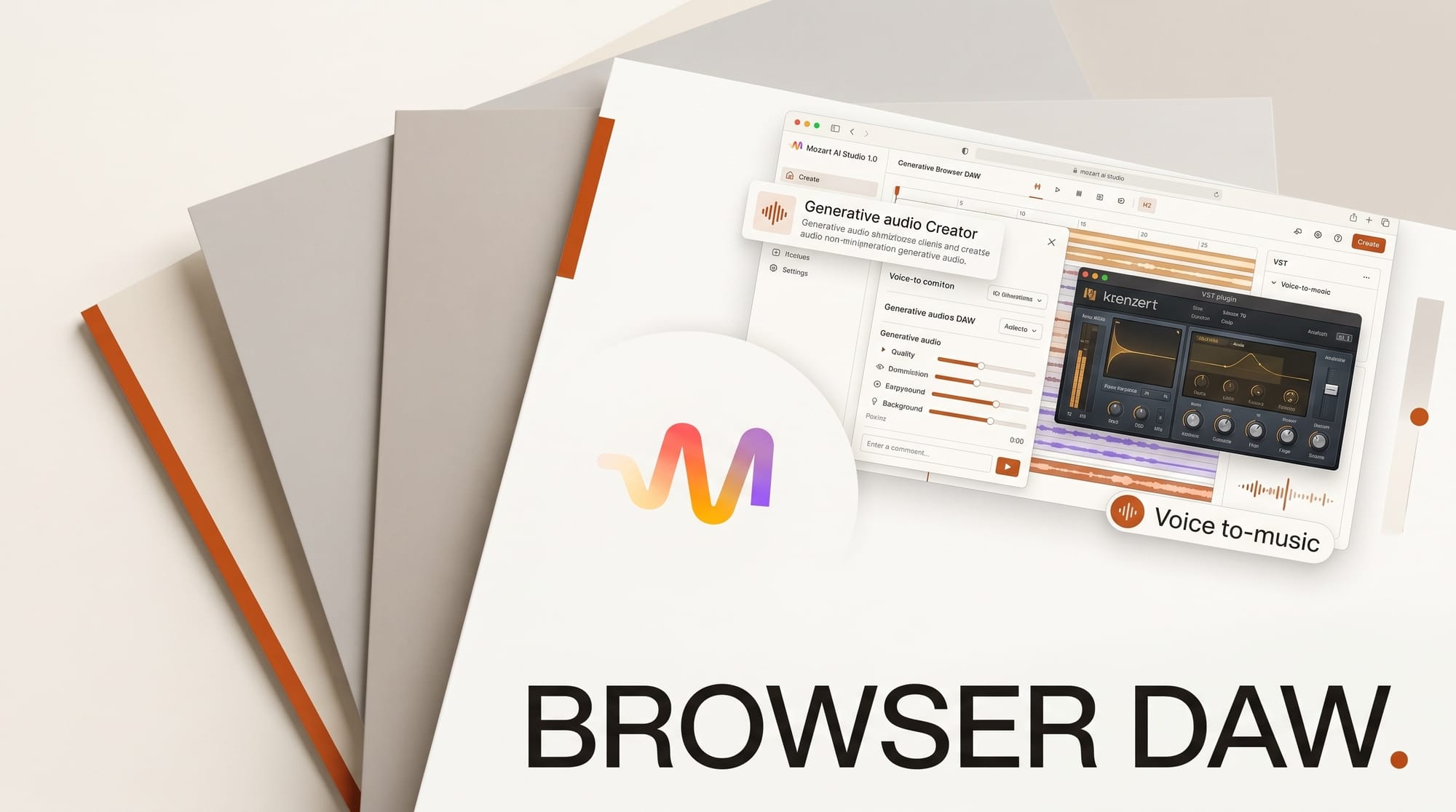
London-based Mozart AI launched Studio 1.0 on April 24, 2026, adding VST plugin support to its browser-based generative audio workstation. The release lets musicians connect third-party instrument and effect plugins inside the online DAW alongside voice-to-music prompts, stem generation, piano roll editing, and built-in mastering.
For the broader landscape, see our complete producer guide to AI music and audio in 2026.
What Happened
Mozart AI co-founders Adrien Ropartz and Christopher Commander shipped Studio 1.0 today with three headline changes: VST hosting in the browser, a unified interface that merges prompt-based generation with manual editing, and a new music video generator. The startup positions the workstation as a middle path between fully automated text-to-song tools and traditional desktop DAWs like Ableton and Logic.
Under the hood, Studio 1.0 routes audio through a WebAssembly engine that can host user-loaded VST3 plugins without desktop installation. Composition features include context-aware stem generation, real-time MIDI progression suggestions, drum pattern fills, and synth generation. The platform also adds a dedicated mastering chain and a music video pipeline that pairs generated tracks with AI visuals.
Why It Matters
Mozart's pitch is creative control, not one-click songs. That target sits between prompt generators like Suno and full-depth DAWs, and it lines up with the broader shift toward AI music tools that produce editable stems rather than locked mixes. Google's Lyria 3 in Flow and Udio's recent remix tooling have pushed in the same direction.
Adding VST support is the harder problem. Most browser DAWs rely on built-in synths because hosting third-party plugins in WebAssembly is slow and bug-prone. If Mozart's implementation holds up, producers can pull in their existing plugin libraries without leaving the browser, which removes one of the main reasons to stay on desktop tools.
Key Details
- Company: Mozart AI, London-based, led by Balderton Capital in a $6 million seed round in February 2026.
- Traction: Over 100,000 users and 1 million songs created within two months of the September 2025 beta, per SiliconANGLE.
- Model stack: A mix of proprietary models and licensed third-party systems. ElevenLabs provides voice generation, and the company says its training data comes from commercially cleared catalogs rather than scraped music.
- Platforms: Web browser and mobile apps on iOS and Android.
- Pricing: Free tier available; paid plans gated behind usage and export limits. Commercial rights included on paid tiers.
What to Do Next
Producers who want to try the new VST support can open Studio directly at mozartai.com, load a plugin from their library, and route generated stems through it. The free tier is enough to test the workflow before committing credits. If you already work in Ableton or Logic, the voice-to-music prompt plus the export-to-stems path is the feature to stress-test first since that is where Mozart's workflow is most different from a traditional DAW.
AI music funding has been steady through the spring. Two weeks ago GRAI raised $9 million for AI music remixing, and ElevenLabs, Suno, and Udio have each shipped new features this month. Expect more DAW-side integrations now that licensed training data and hosted VSTs are both in production.