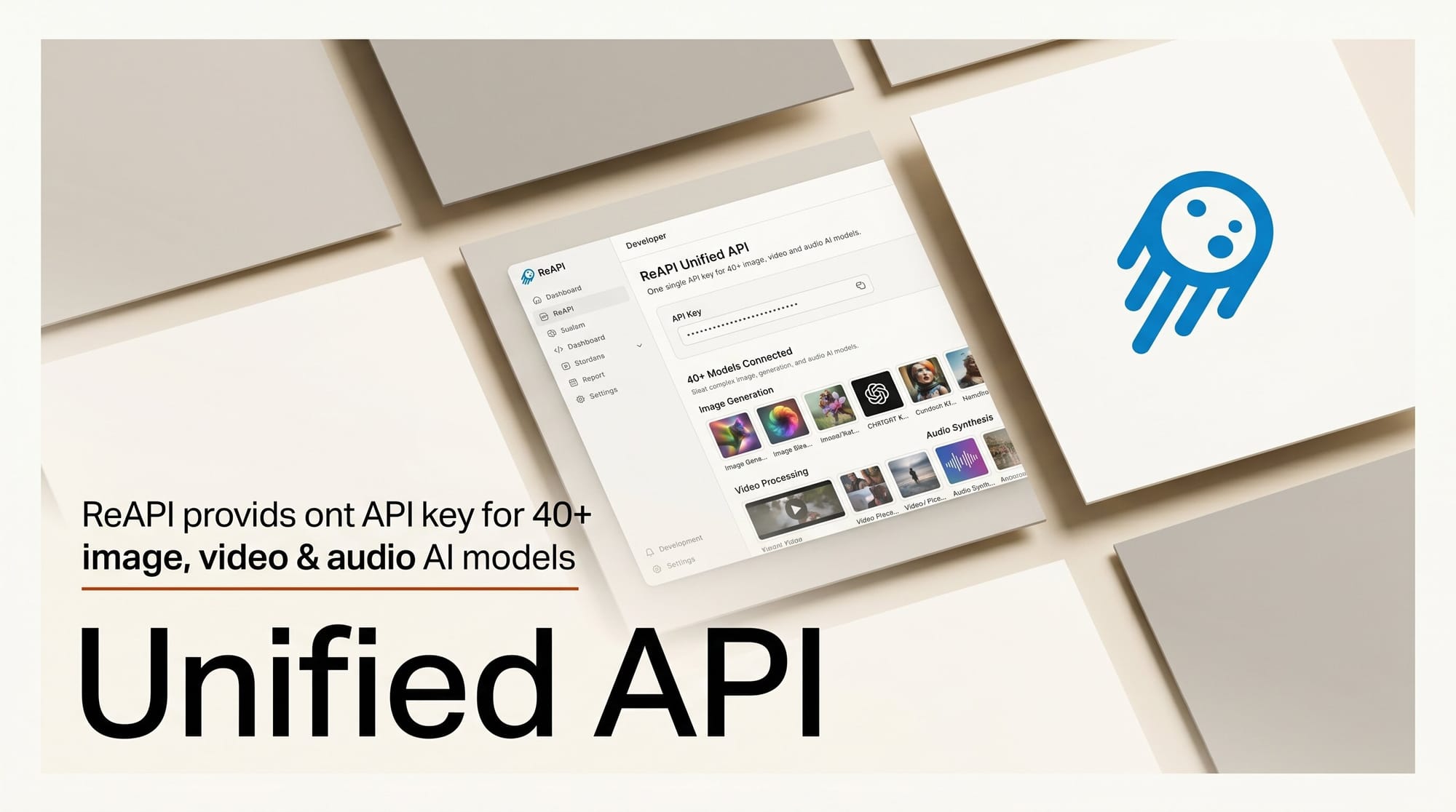
ReAPI is a public beta platform that routes creative AI requests to more than 40 models across image generation, video generation, music, audio processing, and chat through a single OpenAI-compatible endpoint. One API key covers every supported model. One billing account covers every vendor. Automatic failover kicks in when a model endpoint goes down.
For creators running multi-model pipelines, that eliminates the main friction point: managing separate accounts, rotating API keys, and writing fallback logic for each provider.
What Happened
ReAPI entered public beta with a unified API layer built on top of the major commercial AI generation services. The base URL is https://reapi.ai/api/v1, which accepts standard OpenAI-format requests. Any tool or SDK already configured for the OpenAI API can point to ReAPI instead by changing one environment variable.
The catalog spans five generation categories relevant to creative workflows: image, video, music, audio processing, and large language models. Supported image providers include Black Forest Labs FLUX Pro and FLUX Kontext, GPT Image 2, Seedream 5.0, Qwen Image, and Imagen 4. Video generation covers Veo 3.1, Seedance 2.0, Runway, Kling, Happyhorse, Grok Imagine, and Vidu Q3. Music generation uses Suno for full-track output with vocals and instrumentation. Audio tooling includes Whisper transcription, voice enhancement, and stem separation.
Why It Matters for Creators
A standard creative AI production pipeline in 2026 touches multiple model providers. Image generation typically goes to FLUX or GPT Image 2 via separate keys. Video goes to Runway or Kling via their own authentication. Audio cleanup uses Whisper via OpenAI directly. Music generation means a separate Suno account. Each provider has different rate limit structures, different billing dashboards, and different SDK patterns.
The cost of that fragmentation is not just inconvenience. Failed requests require custom retry logic per-provider. Rate limits vary across accounts with no unified view. Billing is spread across five or more invoices. For agentic pipelines that chain these steps, the integration surface multiplies.
ReAPI collapses that into a single endpoint. The zero-logging policy addresses a concern that comes up in professional creative workflows: whether prompts and generated content are stored by an intermediary. The per-key spend cap feature lets teams set hard monthly limits without relying on individual provider billing alerts. Region pinning to EU, US, or APAC data centers addresses latency and regulatory requirements.
Key Details
Model catalog by category

| Category | Available Models |
|---|---|
| Image generation | FLUX Pro, FLUX Kontext, GPT Image 2, Seedream 5.0, Qwen Image, Imagen 4 |
| Video generation | Veo 3.1, Seedance 2.0, Runway, Kling, Happyhorse, Grok Imagine, Vidu Q3 |
| Music | Suno (full-track generation with vocals) |
| Audio tools | Whisper, voice enhancement, stem separation |
| Chat / LLM | GPT-5.5, Claude 4.7 Sonnet, Claude Opus, Gemini 2.5 Pro, Kimi K2, DeepSeek-V3, Qwen 3 |
Pricing structure

ReAPI passes through per-model pricing from the underlying providers. Current public beta examples from the pricing table:
- GPT Image 2: $0.0066 to $1.47 per request, varying by resolution and quality tier
- Seedance 2.0 video: $0.06 to $0.40 per render, varying by resolution
The platform does not add a margin on top of provider rates in the public beta. Per-key spend caps prevent runaway costs. Idempotent retry tokens stop duplicate charges when a network failure triggers a retry.
API integration

The integration path is designed for minimal friction. From the ReAPI documentation: "Mint a key, point your existing OpenAI client at reAPI." The key dashboard is at /settings/apikeys. From there, update base_url in any OpenAI-compatible SDK to https://reapi.ai/api/v1 and replace the API key. The request format stays identical.
This matters because most AI creative tools built in the last two years target the OpenAI API format. Switching them to test a different image model through ReAPI requires no code changes beyond configuration.
Reliability layer

The platform routes across multiple vendor endpoints per model. When a primary endpoint returns an error, ReAPI routes to the next available endpoint for that model. The claimed 99.96% uptime reflects this redundancy layer rather than the uptime of any single underlying model provider. Streaming support and multimodal inputs are included.
How ReAPI Compares to Alternatives
The two most common alternatives for multi-model API access are Replicate and fal.ai. Replicate centers on open-source models hosted in containers, with strong community model support but limited coverage of commercial models like Suno or Veo 3.1. fal.ai focuses on fast inference for diffusion models and supports FLUX well, but does not cover video generation at the same breadth.
ReAPI's differentiation is the combination of commercial model breadth (Suno, Veo 3.1, GPT Image 2), OpenAI-compatible format, and automatic failover across providers. The tradeoff is that ReAPI sits between the caller and the model provider, so teams with existing direct commercial relationships with OpenAI or Google will not save on per-token costs. The value is integration simplicity and reliability, not discounted compute.
Creator Workflow: How to Integrate
The practical workflow for a creator testing ReAPI:
- Sign up at reapi.ai and mint a key from the dashboard
- Update
OPENAI_BASE_URL=https://reapi.ai/api/v1andOPENAI_API_KEY=<your-reapi-key>in your environment - Run an existing image generation script unchanged. It will route to FLUX or GPT Image 2 depending on the model ID specified
- Add a Seedance 2.0 video generation call by changing the model parameter to the Seedance model ID
- Add a Suno music generation call in the same session, same key, same billing account
The full model ID list and parameter schemas for each generation type are documented at reapi.ai/docs.
For workflows already using ComfyUI with multi-GPU setups for local inference, ReAPI serves a complementary role: handle the models that require cloud compute (Veo 3.1, Suno, GPT Image 2) through ReAPI while keeping open-source generation local.
What to Do Next
ReAPI is accepting signups at reapi.ai in public beta. The fastest test is to swap base_url in any existing OpenAI SDK integration and run a side-by-side image generation comparing FLUX Kontext against GPT Image 2 in the same request loop, with the same key.
If you already use Runway for video generation directly, the Runway MCP integration is better suited for agent-native workflows where Runway is the primary tool. ReAPI fits best in code-first pipelines that need flexibility across multiple video models in the same script.
For music generation, Suno is the only music provider in the current catalog. Teams that need ElevenLabs Music v2 for genre-transition control will still need a direct ElevenLabs integration alongside ReAPI.
Frequently Asked Questions
Does ReAPI store prompts or generated images?
ReAPI states a zero-logging policy for request content. Prompts and generated outputs are not retained by the intermediary layer.
Can any OpenAI-compatible SDK use ReAPI?
Yes. Any SDK that accepts a configurable base URL works by setting base_url to https://reapi.ai/api/v1 and substituting a ReAPI key. This includes the official Python and Node.js OpenAI libraries.
Does ReAPI support video generation beyond Runway?
Yes. The current catalog includes Veo 3.1, Seedance 2.0, Kling, Happyhorse, Grok Imagine, Vidu Q3, and Runway. Each has a distinct model ID and pricing tier.
Is Suno available through the API or only the consumer interface?
ReAPI includes Suno for full-track generation including vocals and instrumentation through the API. Standard Codex generation is listed in the public beta pricing table.
How does automatic failover work?
When a model endpoint returns an error, ReAPI routes the request to the next available endpoint for that model. Idempotent retry tokens prevent duplicate charges during retries.
Does ReAPI support region selection for data residency?
Yes. Region pinning is available for EU, US, and APAC data centers to address latency and data residency requirements.