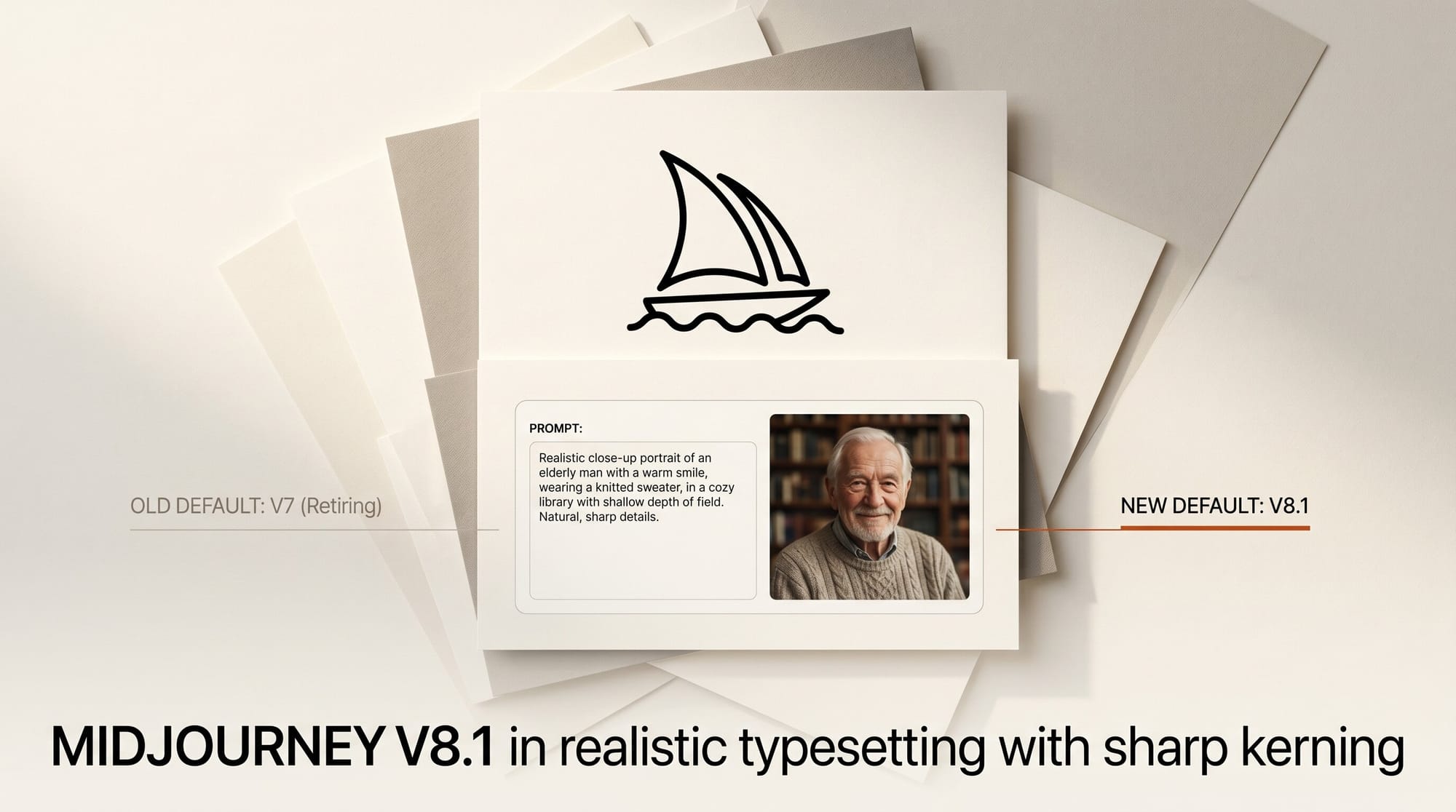
Midjourney has made V8.1 its default model, retiring V7 from the front of the generation pipeline as of June 11, 2026. The upgrade is incremental on paper but meaningful in practice: sharper prompt adherence, better text rendering, and an HD mode that outputs roughly four times the resolution of V7. The bigger question for working creators is not what changed inside Midjourney, but how V8.1 now sits against an image-generation field that has shifted hard toward open weights and structured control in 2026.
What Changed in Midjourney V8.1
V8.1 replaces V7 as the default model for every new prompt. According to Midjourney's announcement, the model is "smarter, more coherent, better adheres to detailed prompts, and renders text better than ever." Style references, personalization, and aesthetic settings carry over from V7 without re-tuning, so existing profiles keep working.
The headline upgrade is resolution. With HD mode enabled, V8.1 renders at twice the linear size and four times the pixel count of V7, landing around 2K on the long edge. Speed stays usable: a standard image returns in about four seconds, and an HD image in about twelve. The older V8.0 alpha is being deprecated within two weeks of the announcement, while V7 omni-reference stays available during continued V8 training.
How V8.1 Compares to the 2026 Image-Gen Field
The competitive picture matters more than the version bump. In 2026, the strongest pressure on Midjourney is not another closed subscription tool but the open-weight wave: Ideogram 4 shipped as a 9.3B open-weight model with structured JSON prompting, and FLUX.2 Klein, from Black Forest Labs, runs entirely on-device. Midjourney remains closed and subscription-only, betting on aesthetic quality and ease over local control.
| Model | Type | Max resolution | Standout strength | Access |
|---|---|---|---|---|
| Midjourney V8.1 | Closed | ~2K (HD mode) | Aesthetics, coherence, ease | Subscription (web, Discord) |
| Ideogram 4 | Open weight | High | Text rendering, JSON layout control | Weights on Hugging Face |
| FLUX.2 Klein | Open weight | High | On-device, local-first | Local install |
| Reve 2 | Closed | 4K | Layout control, native 4K | Web app |
The table makes the trade-off clear. Midjourney still wins on out-of-the-box look and minimal prompt engineering, which is why it stays the default choice for moodboards, concept art, and social visuals. But if you need exact text placement, programmatic layout, or 4K output, tools like Ideogram 4 and Reve 2 now have a real edge. The independent Artificial Analysis text-to-image rankings and LMArena are the fastest way to track where each model lands week to week.
The deeper split is strategic. The open-weight camp is selling control and ownership: you run the model locally, fine-tune it, and wire it into a pipeline without per-image fees or rate limits. Midjourney is selling a finished look with almost no prompt engineering, delivered through a hosted subscription. Neither approach is strictly better. A studio standardizing a repeatable production pipeline will lean toward open weights and structured prompting, while a solo creator who needs a striking frame in under a minute will keep reaching for Midjourney. V8.1 sharpens the second pitch without answering the first.
The HD Mode Workflow for V8.1
The practical way to use V8.1 is a two-speed loop. Iterate in standard mode, where four-second renders let you explore composition and prompt direction quickly without burning time on resolution you will throw away. Once a frame is locked, switch to HD mode for the final pass and take the four-times resolution gain for print, large social formats, or upscaling sources.
Because style references and personalization transfer from V7 unchanged, you do not need to rebuild your aesthetic profiles. Run your existing reference codes against V8.1 first to confirm the look holds, then commit. For text-heavy designs, V8.1's improved typography reduces the cleanup pass, though dedicated text-layout tools still produce more reliable results for posters and packaging.
Why It Matters for Creators
For the large base of Midjourney users, V8.1 becoming the default means better output with zero workflow change: the same prompts and profiles now produce sharper, higher-resolution images. That is a genuine quality lift for anyone shipping concept art, thumbnails, or campaign visuals on a daily cadence.
The strategic read is that Midjourney is defending its aesthetic moat with steady quality gains rather than chasing the open-weight and structured-control features its rivals are racing on. If your work depends on look and speed, V8.1 strengthens the case for staying. If it depends on precise control, local deployment, or 4K, this release does not close that gap, and the open-weight field is where the action is.
Where V8.1 Still Falls Short
An honest comparison has to name the gaps. V8.1 tops out around 2K, so creators who need native 4K still go to a tool like Reve, whose Reve 2 model generates at 4K with layout control. There is no local or on-device option, which rules Midjourney out for offline work, privacy-sensitive pipelines, and anyone trying to avoid per-image costs at scale. And while text rendering improved, Midjourney still does not offer the bounding-box and JSON-style layout control that makes open-weight models predictable for posters, packaging, and UI mockups.
None of these are new misses, and that is the point. V8.1 is a quality refresh, not a strategic pivot. The creators it serves best are the ones who were already happy with Midjourney's trade-offs and now get a free resolution and coherence bump on top.
Frequently asked questions
Is Midjourney V8.1 free?
No. Midjourney remains subscription-only across its web app and Discord. V8.1 is now the default model for all paid plans at no extra cost, replacing V7.
What resolution does Midjourney V8.1 output?
With HD mode enabled, V8.1 renders at twice the linear size and four times the pixel count of V7, reaching roughly 2K on the long edge. Standard mode outputs lower resolution but renders in about four seconds.
Do my V7 style references still work in V8.1?
Yes. Midjourney states that style references, personalization, and aesthetics remain consistent between V7 and V8.1, so existing profiles carry over without re-tuning.
How does V8.1 compare to open-weight models like Ideogram 4?
Midjourney leads on out-of-the-box aesthetics and ease of use, while open-weight models such as Ideogram 4 and FLUX.2 lead on structured control, text rendering, and local deployment. The right pick depends on whether you prioritize look or control.
Is V8.0 still available?
The V8.0 alpha model is being deprecated within two weeks of the V8.1 announcement. V7 omni-reference remains available during continued V8 training.
Should I switch to Midjourney V8.1 from another tool?
If you already use Midjourney, V8.1 is automatic and worth taking. If you are choosing between tools, decide by need: pick Midjourney for fast, high-quality aesthetics with minimal prompting, and pick an open-weight model for local control, 4K output, or structured layout. Many creators run both, drafting in one and finishing in another.