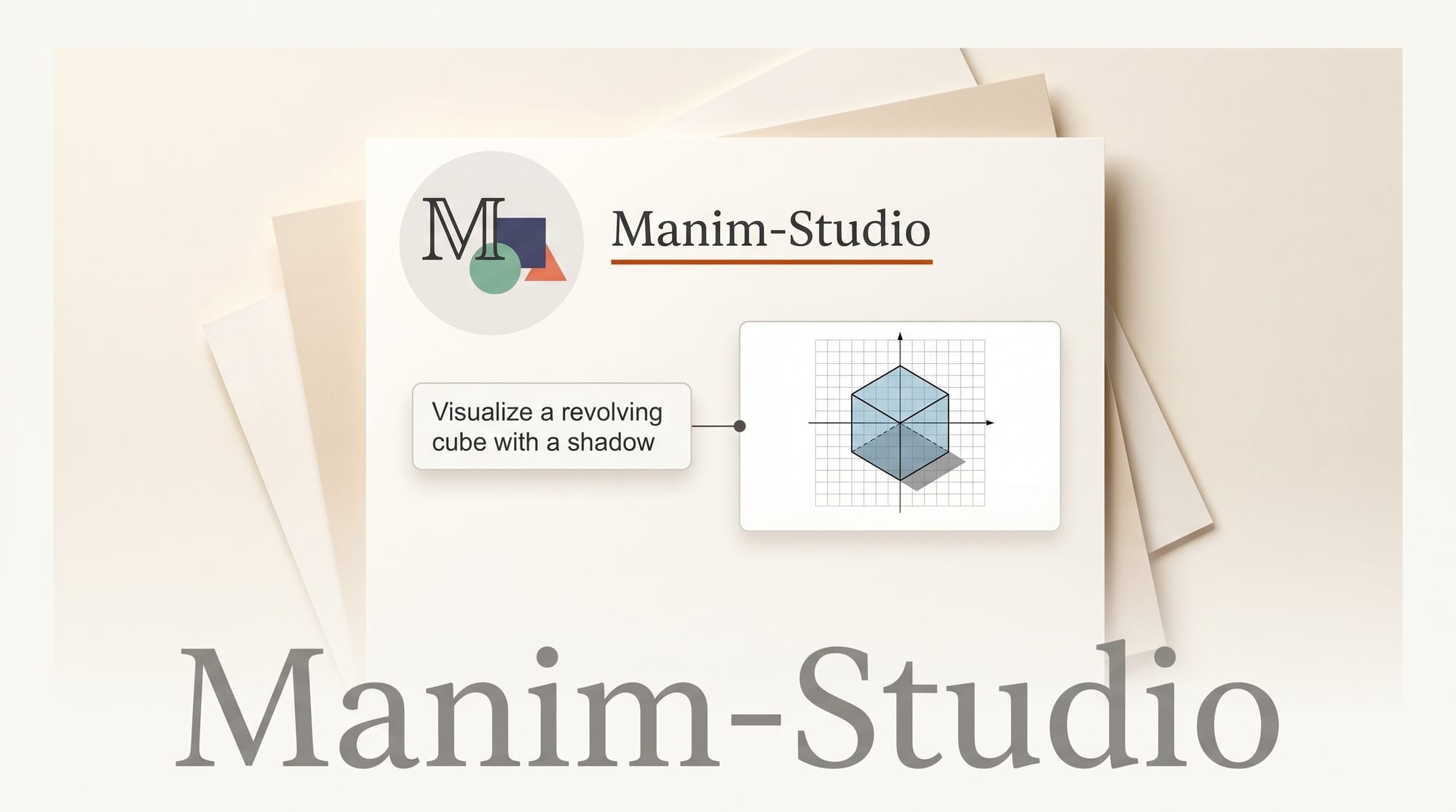
A new open-source project called Manim-Studio turns a plain-English prompt into a rendered math animation video in the visual style popularized by 3Blue1Brown. You type what you want to explain, and the tool writes the animation code, runs it, and hands back an MP4. It launched as a Show HN on June 14, 2026.
What Happened
Manim-Studio, built by the team behind InstaVM, was released as a free, MIT-licensed web app and code repository. The pitch is simple: describe a concept like "show how a Fourier series builds a square wave," and the system generates an animated explainer instead of making you hand-write scene code. A live demo accompanied the launch, and the full source is on GitHub for anyone to self-host.
Why It Matters
Animated math and concept videos are among the most time-consuming content a creator can produce. The underlying engine, Manim, is powerful but has a steep learning curve: you script every shape, transform, and timing cue in Python. Manim-Studio collapses that barrier by letting a language model write the scene for you, which means educators, YouTubers, and course builders can prototype an explainer in seconds rather than hours. For anyone making technical or educational content, that is a meaningful shift in how fast an idea becomes a finished clip.
Key Details
Under the hood, Manim-Studio sends your prompt to OpenAI's API, which generates Manim scene code. That code is then executed and rendered to video inside isolated virtual machines, using the open-source Manim Community library (version 0.20.1). The architecture uses a long-lived coordinator VM that spawns short-lived render machines with roughly 15-second cold starts, keeping each render sandboxed. The stack is FastAPI with a SQLite job store on the backend and a lightweight HTML, CSS, and JavaScript front end. Because rendering happens in disposable microVMs, generated code runs without touching your own machine.
What to Do Next
If you make educational or explainer content, try the live demo with a single concept you already teach and see how close the generated animation gets to what you would have built by hand. Expect to refine: AI-generated Manim code often needs a pass for pacing, color, and accuracy, so treat the output as a fast first draft rather than a final render. Developers who want full control can clone the repository and run it locally, swapping in their own API key and tuning the render settings. Either way, it is a low-risk way to test whether prompt-to-animation belongs in your production workflow.