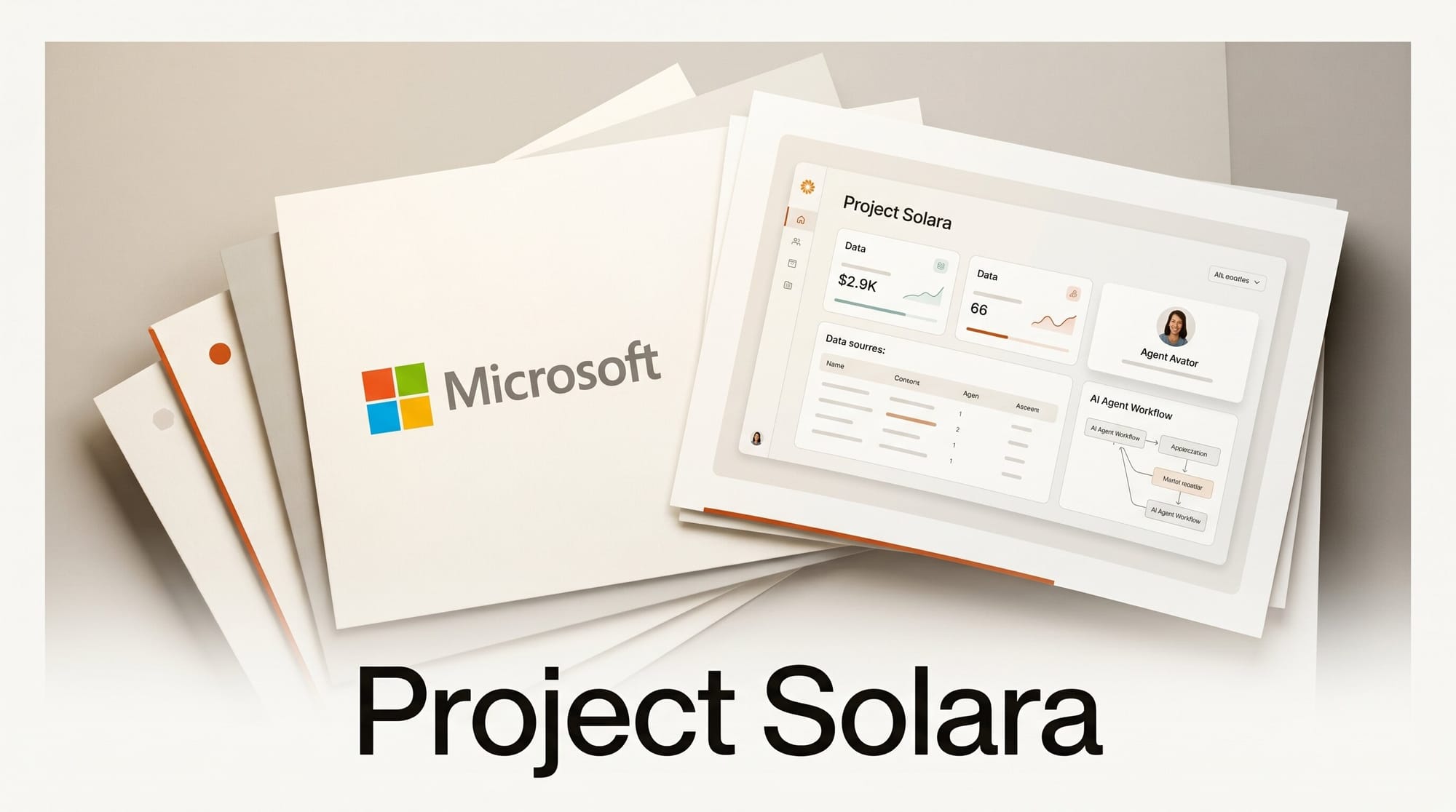
Microsoft unveiled Project Solara on June 2, 2026, a new Android-based operating platform built for AI agent interactions rather than traditional app navigation. The announcement arrived during Microsoft Build 2026 alongside a broader set of agentic infrastructure releases, signaling a fundamental rethinking of how humans interact with AI on dedicated hardware. Engadget first reported the details, with Ars Technica providing additional technical analysis of the MDEP architecture underlying the platform.
Where today's devices run apps that users launch and switch between, Solara devices run agents that respond to context and intent. The platform supports multiple simultaneous AI agents and lets users select their preferred agent, rather than relying on a single default assistant baked into the operating system. For creators and developers building with AI tools, this shift represents the clearest example yet of where agent-first computing is heading at the hardware layer.
What Is Project Solara?
Project Solara is built on MDEP (Microsoft Device Ecosystem Platform), an enterprise-focused fork of Android that Microsoft has deployed in products like the Surface Duo and Teams-certified room displays. Solara adds a proprietary agent coordination layer on top of MDEP, optimized for AI-first interaction rather than app management.
Microsoft describes the platform as "specifically designed for the new era of agent-first devices." Rather than presenting users with a home screen of icons, Solara surfaces relevant agents and information based on context, role, and time of day. The goal is to replace the imperative model of computing (open this app, do that task) with a conversational and declarative model (schedule this, summarize that, find the relevant contact). Ars Technica describes it as Android redesigned specifically for the agent era, with proprietary Microsoft layers added for enterprise orchestration.
The platform launches with chip-level support from Qualcomm and MediaTek, both announced as hardware partners for Solara-compatible device manufacturing. Microsoft's broader Build 2026 post frames Solara within a six-layer agent platform stack spanning GitHub Copilot for development, Microsoft IQ for context grounding, Azure Foundry for orchestration, and Agent 365 for governance.
How Just-in-Time UI Works
The defining technical feature of Project Solara is what Microsoft calls "just-in-time UI," an approach where the device generates interface elements on demand rather than displaying a fixed set of apps. When you ask an agent to check your calendar, the calendar view appears. When you ask it to process a payment, a payment interface appears. Nothing persists unnecessarily after the interaction completes. Microsoft's official Project Solara announcement describes the goal as removing the concept of an app launcher entirely in agent-first contexts.
This design philosophy makes Solara practical at smaller form factors where a conventional Android app drawer would be unusable. A smart key badge with a 2-inch screen cannot run a traditional home screen, but it can surface precisely the right information at the right moment. A 10-inch smart display can show an agent-driven workflow that adapts in real time based on the ongoing customer interaction.
Just-in-time UI also enables multi-agent workflows that would be clunky on a traditional OS. A Solara device can run a customer service agent, a scheduling agent, and a knowledge base agent simultaneously, routing each request to the appropriate handler without requiring the user to switch apps or manually navigate between contexts. Users can also explicitly select their preferred AI agent, meaning the platform is not locked to Microsoft's own models.
The Hardware: Smart Displays and Smart Badges
Microsoft demonstrated two reference hardware designs at Build 2026:
Smart Display: An Echo Show-style form factor designed for workplace or retail mounting. The device pulls from Microsoft 365 data including emails, calendar, Teams, and SharePoint, and presents it through agent-driven interfaces. Employees can ask questions, assign tasks, and retrieve contextual answers without a phone or laptop in hand.
Smart Key Badge: A wearable device with 5G connectivity, a touchscreen, and a built-in camera. Workers at Target, CVS Health, and Best Buy are participating in early pilot programs with this form factor. The badge surfaces inventory data, customer lookup, and internal communications in a frontline worker's hand without requiring a dedicated handheld device.
Both designs run on Qualcomm or MediaTek chipsets certified for the MDEP platform. Microsoft has not announced any consumer-facing hardware. Both reference designs explicitly target enterprise and frontline worker deployments.
Enterprise Pilot Programs: Target, CVS Health, Best Buy
The most concrete near-term Solara deployments are in retail. According to Engadget's reporting, Target, CVS Health, and Best Buy have confirmed participation in launch pilot programs for the smart key badge. Each of these companies employs tens of thousands of frontline workers who currently rely on shared handheld scanners or personal phones to access work systems.
The pitch is operational efficiency. Rather than a worker pulling out a device, unlocking it, opening an app, and navigating to inventory data while a customer waits, a Solara badge can surface that data in response to a spoken or typed query during the interaction itself. Microsoft's agent framework handles the backend integration with each retailer's existing systems, which is a significant implementation advantage.
The enterprise-pilot-first model is familiar from Microsoft's recent hardware history. Products like HoloLens and Surface Hub both found their most durable adoption in enterprise use cases before any consumer play materialized. Solara appears to follow the same deliberate rollout pattern.
What This Means for AI Creators and Developers
Project Solara is an enterprise product today, but the design decisions embedded in it have broad implications for anyone building AI tools and workflows. Three patterns are worth tracking:
Multi-agent selection is becoming an OS-level feature. Solara devices let users explicitly choose which AI agent handles a request. This pattern is already appearing in Microsoft 365 Copilot and other agent-aware platforms, but Solara bakes it into the operating system itself. Creators building AI-assisted tools should expect users to be running multiple agents simultaneously and switching between them intentionally, not relying on a single assistant for everything.
Context-aware interface generation changes how agents surface tools. Just-in-time UI is not just a mobile design pattern. It is a model for how AI agents will wrap any capability in a temporary, task-specific interface generated for the moment. If you are building tools that agents will call as steps in a workflow, the interface your tool exposes may be generated dynamically rather than designed once as a fixed product screen.
Microsoft 365 is becoming an AI distribution channel at the OS level. Solara devices pull from Microsoft 365 data by default, which means documents, emails, and files stored in SharePoint and OneDrive become the context layer for agent responses on these devices. If your team's creative assets, briefs, and production files live in the Microsoft ecosystem, they become accessible to hardware agents without additional integration.
How to Prepare Your Workflows for Agent-First Computing
Project Solara's consumer timeline remains unclear, and the immediate impact on most creators and developers is indirect. But there are concrete steps worth taking now to build the skills and context that agent-first platforms will require:

Experiment with agent orchestration on existing hardware. Microsoft's open-source Windows Agent Framework, released at Build 2026, lets you run coordinated multi-agent pipelines on standard Windows machines. Working with multi-agent setups today builds the operational intuition that Solara-style interfaces will require at scale.
Think about how agents will consume your tools and APIs. If you build with APIs or MCP servers, start considering how an AI orchestrator (not a human developer) will call your endpoints. Structured output, deterministic behavior, and clear capability descriptions matter far more when the caller is an agent coordinating a pipeline than when it is a developer following documentation.
Keep your Microsoft 365 data structured and searchable. If your team uses Microsoft 365, the way you name files, organize SharePoint folders, and tag documents will directly determine the quality of agent responses on any Solara or Copilot-connected device. Disordered file systems produce disordered agent context.
Frequently Asked Questions
What is Project Solara and how does it differ from standard Android?
Project Solara is Microsoft's agent-first platform built on MDEP, an enterprise fork of Android. Unlike standard Android, Solara does not use a traditional app launcher or home screen. It generates interface elements dynamically based on agent context and supports simultaneous operation of multiple AI agents with user-selectable preferences.
Which devices will run Project Solara?
Microsoft has announced two reference hardware designs: a smart display similar to an Amazon Echo Show and a wearable smart key badge with 5G connectivity and a camera. Both run on Qualcomm or MediaTek chips certified for the MDEP platform. No consumer devices have been announced as of June 2026.
Which companies are participating in Project Solara pilots?
Target, CVS Health, and Best Buy have confirmed participation in enterprise pilot programs for the Solara smart key badge, with a focus on frontline retail worker use cases.
Can you choose your own AI model on a Solara device?
Microsoft has confirmed that Solara allows users to manually select their preferred AI agent, suggesting openness to multiple model providers beyond Microsoft's own MAI family. Specific third-party model compatibility details have not been formally announced as of the Build 2026 disclosure.
How does just-in-time UI work in practice?
Instead of a fixed app grid, Solara generates interface elements on demand for each task. Ask the agent to check inventory and an inventory screen appears. When the task is done, it dismisses. This removes the overhead of app switching and makes compact form factors viable for complex multi-step workflows.
When will Project Solara be available publicly?
Microsoft has not announced a public release date. Enterprise pilot programs are active as of June 2026 with Target, CVS Health, and Best Buy. Broader availability depends on hardware partner production timelines and Microsoft's enterprise deployment roadmap.