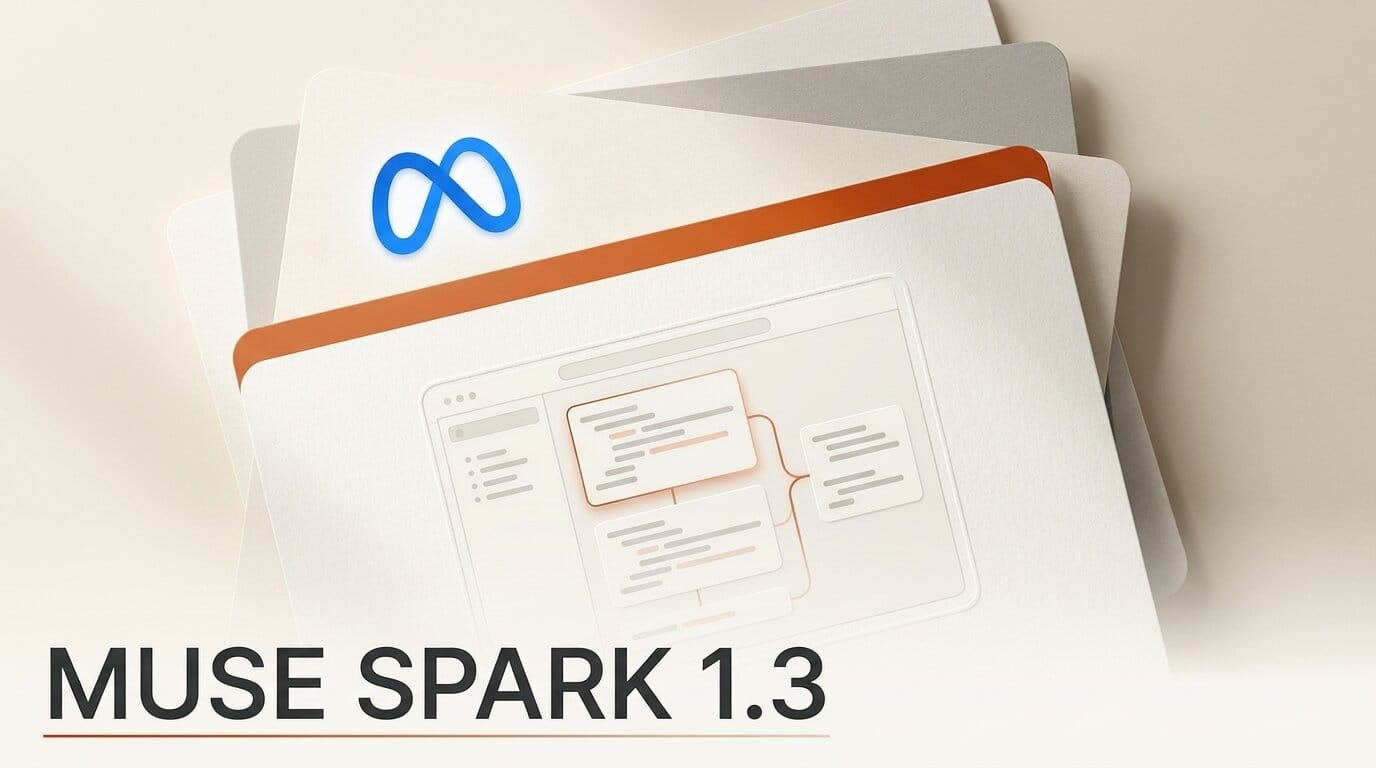
The most important number in the new coding-model race is not a benchmark score. It is the count of tool calls and tokens a model burns to finish one real task. Meta made that the whole story on September 2, 2026, when it shipped Muse Spark 1.3 as a generally available update to its agentic coding model, delivered through Muse Code and the Meta Model API. The pitch is not "smarter." The pitch is "cheaper to run for the same work," and that reframing tells you where the frontier fight has actually moved.
Background
Muse Spark is Meta's proprietary, paid coding model line. The company crossed into a commercial tier earlier this year with Muse Spark 1.1 in July, moving from open-weight releases toward a hosted, billed API aimed squarely at agentic coding. Version 1.3 continues that arc, but the framing changed. Where earlier releases leaned on capability gains, 1.3 leads with efficiency: Meta reports that on coding workflows the model completes tasks with roughly 20 percent fewer tool calls and 25 percent fewer tokens than the 1.2 release, alongside gains on agent, instruction-following, and long-context evaluations.
Two delivery surfaces carry it. Muse Code is Meta's coding-agent client, installable with a single shell command and pinnable to 1.3. The Meta Model API exposes the raw model for teams that run their own agent harness. The release also lands within an ecosystem Meta has been building all summer, days after it expanded the family with the Muse Code SDK and multi-agent workflows. In other words, 1.3 is not a lone model drop. It is an efficiency tune-up dropped into an agent stack that already has an orchestration layer.

Deep Analysis
Why efficiency, not raw score, is the real cost driver
An agentic coding model does not answer one question and stop. It plans, reads files, edits, runs tests, reads the errors, and tries again, looping until a task is done. Every loop spends two resources you pay for directly: tokens (the text the model reads and writes) and tool calls (each shell command, file read, or test run the agent issues). A model that reaches the same finished result in fewer loops costs less on the same work, full stop.
That is why Meta's headline is a 20 to 25 percent reduction rather than a leaderboard win. For anyone running an agent at volume, the bill is a function of tokens and tool calls, not of where a model sits on a benchmark chart. A model can score marginally higher on a coding test and still be more expensive to operate if it wanders through more steps to get there. Two models that both "solve" a task can differ two- or three-fold in what that solution costs, and that gap is invisible on a pass-or-fail benchmark. Efficiency is the metric that survives contact with a monthly invoice.
There is a second reason efficiency matters more than score right now: the top models have converged on capability. When the leading coding models can all handle the same broad class of tasks, the differentiator shifts from "can it do this" to "what does it cost to have it do this, repeatedly, unattended." Meta is betting the next round is won on cost per completed task. Framing 1.3 around fewer tool calls and fewer tokens is a direct wager on that thesis.
Muse Spark 1.3 in the agentic-coding lineup
Meta benchmarks 1.3 against its own 1.2, plus GPT 5.6 Sol and Opus 5 at their top settings, across agent, coding, instruction-following, and long-context tests, with the full scorecard in its evaluation report. Rather than repeat unverifiable head-to-head numbers, the more durable comparison is structural: how each tier is delivered, how it bills, and what kind of job it fits. The table below is qualitative on purpose. The efficiency and cost figures Meta cites are specific to its own 1.2-to-1.3 comparison and do not translate into per-task numbers for rival models.
| Agent tier | Delivery surface | How it bills | Efficiency posture | Openness |
|---|---|---|---|---|
| Muse Spark 1.3 (via Muse Code) | Muse Code client plus Meta Model API | Paid, hosted API; tokens and tool calls | Explicitly optimized this release for fewer tool calls and tokens per task | Proprietary, paid tier |
| Claude Code | First-party CLI plus Anthropic API | Paid API by tokens, or subscription plans | Positioned on task-completion quality and long-horizon agent reliability | Proprietary, paid tier |
| OpenAI Codex | Codex CLI and cloud agent plus API | Paid API by tokens, or subscription plans | Positioned on breadth and reasoning depth across the model family | Proprietary, paid tier |
| Gemini coding | Gemini CLI plus API and IDE integrations | Paid API by tokens, with a free CLI tier | Positioned on very long context and Google ecosystem reach | Proprietary, with a free CLI on-ramp |
Read the table as a map of trade-offs, not a ranking. Every tier here is a proprietary, hosted product with its own client and its own billing meter. What Muse Spark 1.3 does differently is make the efficiency dimension the headline of the release rather than a footnote, and it backs that with a concrete self-comparison. Whether that translates into a lower bill than a rival on your specific workload is exactly the thing you have to measure, because none of these vendors publish a comparable tokens-per-task figure you can lift from a chart.
Delivery through Muse Code and the Model API
The two surfaces target two different buyers. Muse Code is for developers who want a working agent client now: install it with a single shell command, point it at 1.3, and the efficiency gain shows up as faster runs and lower cost on the same prompts, with no workflow rewrite. Because 1.3 is generally available rather than a preview or waitlist, that swap is a same-day change for anyone already on Muse Code, who can update and pin 1.3 so new agent runs use it by default.
The Meta Model API is for teams that have already built their own harness and want the raw model behind it. That is the path for a company running coding agents at scale in CI, in internal tools, or inside a product, where the difference between 1.2 and 1.3 is not a nicer client but a line-item change in the compute budget. Pairing the model with the Muse Code SDK and its multi-agent workflows compounds the effect: in a design where several agents fan out across a task, a per-task efficiency gain multiplies across every agent in the swarm, so a 20-to-25 percent reduction at the unit level is worth more the more agents you run.
Install it via Muse Code, or wire the model directly through the API documentation. Either way, the model is the same; the surface is a choice about how much of the agent scaffolding you want Meta to own versus how much you build yourself.

Which coding agent for which job
The honest answer is that the choice is now a fit question, not a winner question. If your bottleneck is the running cost of high-volume, unattended agent work, an efficiency-led release like Muse Spark 1.3 is the one to measure first, precisely because its pitch is denominated in the resources you are billed for. If your bottleneck is long-horizon reliability on gnarly multi-step tasks, the tier you weigh is the one positioned on task-completion quality. If you live inside a particular platform or need a generous free on-ramp for experimentation, ecosystem reach and a free CLI tier may outweigh a marginal cost difference.
The practical method is the same regardless of vendor: take one of your real coding tasks, run it through each candidate, and record the token and tool-call counts alongside whether the task actually completed correctly. That single measurement tells you more than any published benchmark, because it is your workload, your harness, and your definition of done. Muse Spark 1.3's contribution to this exercise is that it makes the efficiency axis explicit, which nudges the whole field toward reporting the number that actually predicts your bill.
Impact on Creators
For solo builders and small teams, the efficiency turn is the difference between an agent being a novelty and being a habit. When each unattended run costs meaningfully less, you stop rationing agent usage and start pointing it at the boring, repetitive work you used to skip: migrations, test scaffolding, dependency bumps, refactors that touch fifty files. The value of an agentic coding model is not what it can do in one impressive demo; it is what it can do cheaply enough that you let it run all day.
Creators building products on top of coding agents feel this most directly. If your app embeds an agent that generates or fixes code for your users, a 20-to-25 percent reduction in tokens and tool calls per task flows straight to your margin, or lets you offer more generous limits at the same price. And because 1.3 dropped into an existing SDK and multi-agent framework, the people best positioned to benefit are the ones who already invested in an agent architecture: the efficiency gain rides on the scaffolding they built earlier in the summer rather than asking them to start over.
The caution for creators is to verify rather than assume. The 20-to-25 percent figure is Meta's own 1.2-to-1.3 comparison on coding workflows, not a promise about your codebase. The right move is to instrument one real task, watch the counters, and let your own numbers decide whether the switch pays for itself.

Key Takeaways
- Muse Spark 1.3 is generally available now, delivered through Muse Code and the Meta Model API, not as a preview or waitlist.
- Meta's headline claim is efficiency: roughly 20 percent fewer tool calls and 25 percent fewer tokens per coding task versus 1.2, plus gains on agent, instruction-following, and long-context evaluations.
- Tool calls and tokens per completed task, not raw benchmark score, are the metric that actually drives what an agent costs to run at volume.
- Across the agentic-coding tiers, the meaningful comparison is qualitative: delivery surface, billing model, and openness, since no vendor publishes a comparable per-task efficiency number.
- The efficiency gain compounds in multi-agent workflows, where a per-task reduction multiplies across every agent in the run.
- The only reliable test is your own: run a real task through each candidate and record token and tool-call counts plus whether it completed correctly.
What to Watch
The open question is whether efficiency becomes a reported metric or stays a marketing line. Meta framed 1.3 around tokens and tool calls per task, which is the right axis, but the field still lacks a shared, auditable way to compare efficiency across vendors the way benchmark suites compare capability. If the coding-model race really has moved from "smartest" to "cheapest to run for the same work," the next competitive pressure is on every vendor to publish a comparable cost-per-completed-task figure, or on independent evaluators to build one. Until that exists, the number that matters most is the one you measure on your own workload, and the vendors who make that measurement easiest, by instrumenting their agents to surface tokens and tool calls per task in plain sight, will be the ones creators can actually trust when they compare the bill.