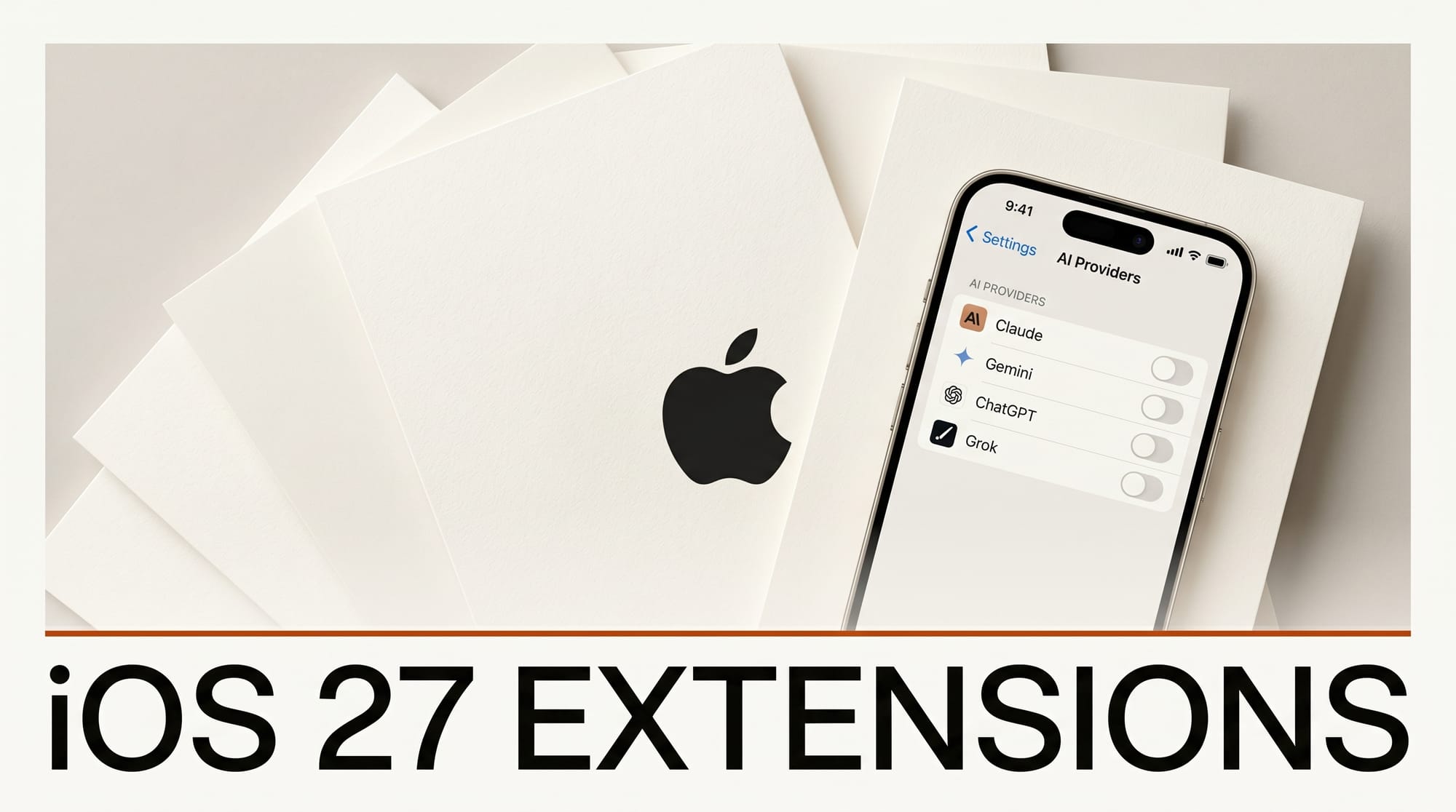
Apple plans to let iPhone, iPad, and Mac users choose their preferred AI model for Apple Intelligence features in iOS 27. A Bloomberg report published today, picked up by MacRumors, reveals a system called "Extensions" that lets creators swap in Claude, Gemini, ChatGPT, or Grok for Siri, Writing Tools, and Image Playground starting this fall.
What Happened
According to 9to5Mac, Apple is building an "Extensions" layer into iOS 27 that routes Apple Intelligence requests through a user-selected AI provider. The system description reads: "Extensions allow you to access generative AI capabilities from installed apps on demand, through Apple Intelligence features such as Siri, Writing Tools, Image Playground and more."
Apple already has a native partnership with Google worth a reported $1 billion annually, giving Gemini a baseline position in Apple Intelligence. iOS 27 extends beyond that by letting users pick any compatible provider from their installed App Store apps.
Why It Matters for Creators
Three Apple Intelligence features directly affect creative work on iPhone and iPad: Writing Tools rewrites and expands text across any app, Image Playground generates visuals from prompts, and Siri handles complex multi-step requests. All three become model-selectable in iOS 27.
If you prefer Claude for longer-context creative drafting or Gemini for image generation, you will be able to set those preferences in Settings once Extensions ships. As Digital Trends notes, the change also extends to voice: Siri will use distinct voices per provider, so responses clearly identify whether Apple's own system or a third-party model is answering.
Key Details
- Feature name: Extensions (Settings menu assignment per task)
- Supported providers: Claude (Anthropic), Gemini (Google), ChatGPT (OpenAI), Grok (xAI)
- Covered tasks: Siri responses, Writing Tools, Image Playground
- Requirement: third-party AI app must be installed from the App Store
- Formal announcement: WWDC, June 8-12, 2026
- Availability: iOS 27, iPadOS 27, and macOS 27 (fall 2026)
What to Do Next
Nothing changes today. Extensions ships with iOS 27 in fall 2026. When it arrives, you will assign models per feature type based on your creative workflow: Claude for writing-heavy tasks, Gemini for image generation, and ChatGPT or Grok for coding and research needs.
TechCrunch notes the pattern mirrors how Apple introduced ChatGPT in iOS 26: one partner first, then expanded choice in the next major version. Expect a developer preview of Extensions at WWDC on June 8 before the public fall release.
For context on the existing Gemini integration that iOS 27 builds on, see Apple Rebuilds Siri With Gemini AI: What the $1B Deal Means for Creators.
Which AI model fits which Apple Intelligence task

iOS 27 Extensions ships in fall 2026, but the choice you'll need to make is already clear. Each AI model has different strengths across the three Apple Intelligence task types. Side-by-side picks for working creators in 2026:
| Task | Best pick | Why | Runner-up |
|---|---|---|---|
| Writing Tools (rewrite, expand, summarize, proofread) | Claude (Anthropic) | Longest-context coherence, best at preserving voice across long edits, strongest on nuanced rewrites | ChatGPT (OpenAI) for shorter punchy drafts |
| Image Playground (image generation from prompts) | Gemini (Google) | Native image generation through gemini-image-2 with strong photoreal text rendering and consistent aesthetic | ChatGPT for stylized illustration via DALL-E successor |
| Siri (multi-step requests, on-device assistance) | ChatGPT (OpenAI) | Strongest tool-use across the cluster, best at chaining 3+ steps with reliable function calling | Grok (xAI) for real-time web context |
How to integrate Extensions into a creator workflow

Once iOS 27 ships, the practical setup for a creator working across iPhone, iPad, and Mac will look like this:
- Install all four AI apps from the App Store: Anthropic Claude, Google Gemini, OpenAI ChatGPT, xAI Grok. Sign in to each.
- Open Settings > Apple Intelligence > Extensions. Assign one model per Apple Intelligence task type.
- Pick by workflow, not preference: if you write long-form, set Writing Tools to Claude. If you generate marketing visuals, set Image Playground to Gemini. If you live in Siri voice flows, set Siri to ChatGPT.
- Verify per-app behavior: some apps may override Extensions and use their own AI provider. Check Mail, Notes, Pages, and Keynote separately.
- Voice identification: Siri uses distinct voices per provider in iOS 27. If you hear an unexpected voice, check which Extension is configured for that task.
Pricing math: which Extensions are free vs paid
Each AI provider's app has its own free and paid tier, and Extensions inherits whatever access tier you have authenticated in that app:
- Claude: Free Claude tier handles Writing Tools at limited rate. Claude Pro at $20/month removes rate limits and adds longer-context support.
- Gemini: Free tier covers basic Writing Tools and Image Playground. Gemini Advanced at $20/month adds the strongest image generation.
- ChatGPT: Free GPT covers basic tasks. ChatGPT Plus at $20/month adds GPT-5.5 reasoning and advanced image generation. ChatGPT Pro at $200/month adds Sora video and higher rate limits.
- Grok: X Premium tier required for Grok access starting at $8/month, scaling to $40/month for Grok 4.x access with real-time web search.
Stacking subscriptions across all four runs $48 to $268 per month. For most creators, two paid subscriptions (Claude Pro + ChatGPT Plus, or Gemini Advanced + Claude Pro) cover 95 percent of Apple Intelligence task types at $40/month total.
Frequently asked questions
When does iOS 27 Extensions ship?
Apple's typical release cadence: developer preview at WWDC June 8-12, 2026. Public beta in July. iOS 27 stable release in mid-September 2026. Extensions ships as part of iOS 27, iPadOS 27, and macOS 27 simultaneously.
Which devices support Apple Intelligence Extensions?
Apple Intelligence currently requires iPhone 15 Pro or newer, iPad with M1 or newer, and Mac with M1 or newer. iOS 27 Extensions inherits this hardware floor. Older devices remain locked to Apple's first-party Apple Intelligence layer without third-party model choice.
Will Extensions support local on-device models?
Apple has not announced support for self-hosted or open-source models in Extensions. The system routes through App Store apps that authenticate to a hosted AI provider (Claude, Gemini, ChatGPT, Grok). Self-hosted Llama or Mistral via local network calls is not supported in the announced design.
How does this compare to the existing ChatGPT integration in iOS 26?
iOS 26 introduced ChatGPT as a single fallback for Siri queries Apple's own intelligence couldn't handle. iOS 27 Extensions extends that pattern to four providers and three task types, with per-task model assignment. The pattern mirrors how Apple introduced Apple Pay (one partner, then expanded) and CarPlay (one app, then expanded).
Can I switch models per app?
Per the announced design, Extensions assigns models at the system level by task type (Writing Tools, Image Playground, Siri). Per-app override is not in the public spec but may exist in developer-facing APIs. Expect WWDC sessions to clarify which apps can override Extensions defaults.
What about privacy when using third-party models?
When you use Apple's first-party Apple Intelligence, Apple's Private Cloud Compute handles inference with strong privacy guarantees. When you use Extensions, requests route to the third-party provider (Claude, Gemini, ChatGPT, Grok) under that provider's privacy terms. For sensitive content, keep the default first-party Apple Intelligence; for power-user flexibility, switch to Extensions and accept the third-party privacy stance.
For a step-by-step Settings walkthrough, Apple Gadget Hacks has a longer explainer of the Extensions UI.