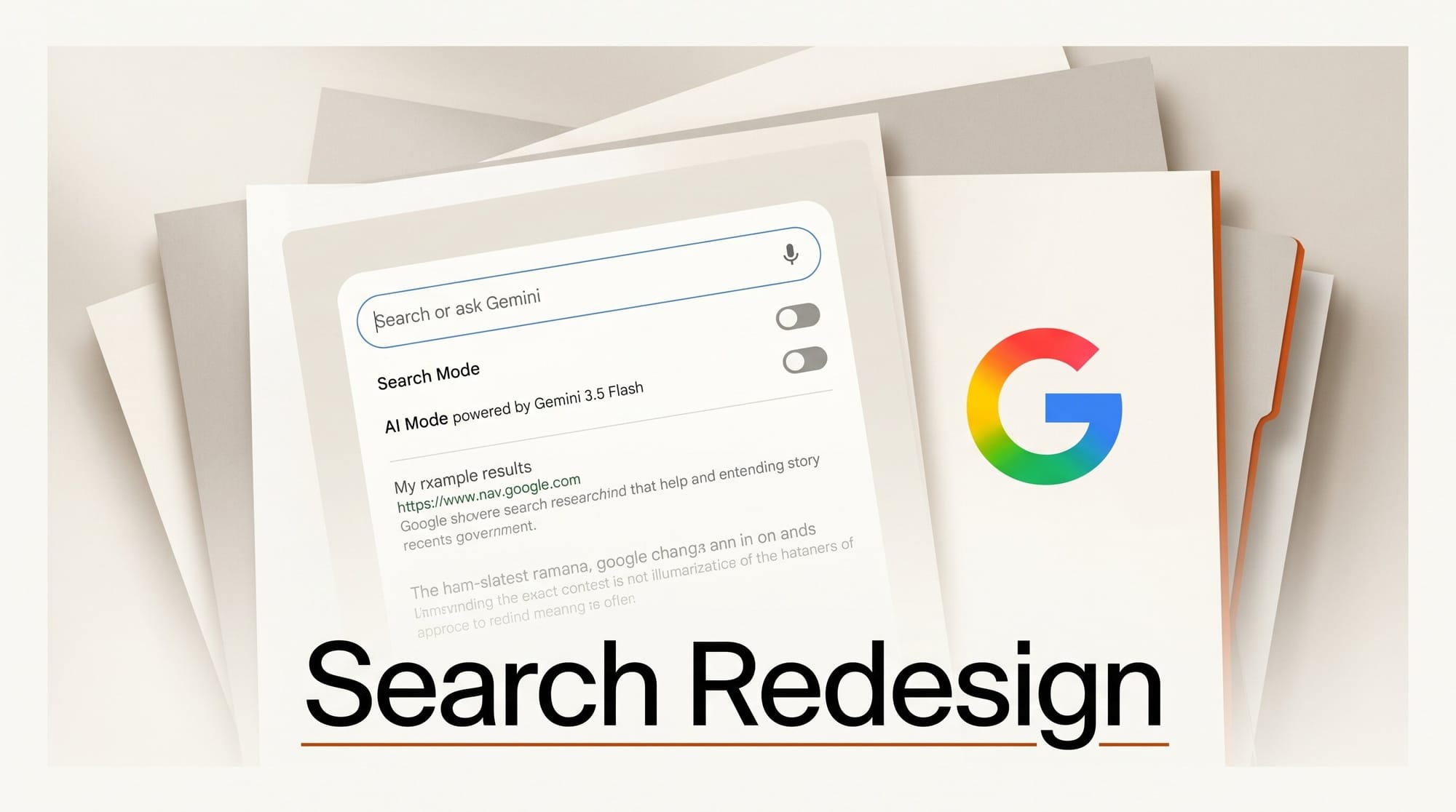
Google announced the biggest redesign to its search box in over 25 years at Google I/O 2026 on May 19. The new "intelligent" search box expands as you type for conversational queries, adds shortcuts for AI Mode (Gemini 3.5 Flash), voice search (Talk), and image creation (Create), and introduces information agents that monitor the web in the background to deliver synthesized updates without you initiating a search. Over 1 billion people use AI Mode monthly as of this announcement.
What Happened
For the first time since the late 1990s, Google's search box itself is changing shape. At Google I/O 2026, the company revealed what it calls an "intelligent" search box that expands as you type to accommodate longer conversational queries rather than the brief keyword strings that defined search for a generation. Below the input field, three shortcuts appear: AI Mode (Gemini-powered AI answers), Talk (Search Live for voice), and Create (Nano Banana in Google Lens for image generation). A plus menu adds document and image upload support directly from the search bar.
AI Mode: Now on Gemini 3.5 Flash for 1 Billion Users

AI Mode, Google's AI-first search experience that lives alongside traditional results, is now powered by Gemini 3.5 Flash globally with over 1 billion monthly users. When users tap "Show more" on standard AI Overviews results, they transition seamlessly into AI Mode, a transition rolling out worldwide.
The shift to Gemini 3.5 Flash as the global default for AI Mode is significant. Flash is faster and cheaper to run than previous models, meaning Google can handle the scale of its entire search user base on AI responses rather than just a subset of queries. The internal link to Gemini 3.5 Flash capabilities covers what this model can do for developers.
Information Agents: Always-On Background Search

The most consequential new feature is information agents: autonomous systems that run continuously in the background, monitoring blogs, news, social posts, and real-time data streams for topics you specify. When something relevant appears, they deliver synthesized updates without you needing to search.
Google announced specific use cases at I/O 2026:
- Apartment hunting: agents notify you when listings matching your exact criteria appear online
- Sneaker drops: instant alerts when athletes you follow announce limited collaborations
- Finance and sports: real-time synthesized updates on tracked topics, companies, or teams
Information agents launch this summer for Google AI Pro and Ultra subscribers. They represent a fundamental shift from search as a reactive query-response tool to an always-on intelligence layer that works whether you're in Search or not.
Mini Apps and Generative UI
Google is adding "mini apps" for ongoing multi-session tasks: custom dashboards and interactive trackers generated on demand for projects like wedding planning, home moves, or product research. Instead of re-running searches for the same goal across multiple sessions, Search builds a persistent workspace.
Alongside mini apps, generative UI uses the latest Gemini models to create dynamic layouts with graphs, simulations, and interactive tables in real-time based on your query. You don't get a static page of links. Instead, you get a generated interface. Generative UI launches free for all users this summer. Mini apps arrive for Pro/Ultra subscribers in the US first, then globally.
How the Search Box Changed in 25 Years
| Feature | Legacy Search (1998-2026) | Redesigned Search (I/O 2026) |
|---|---|---|
| Input format | Fixed-width box, keyword strings | Expanding box, full conversational queries |
| Input types | Text only | Text, voice, images, documents |
| Query style | "best mirrorless camera 2026" | "What's the best mirrorless camera for travel vlogging under $1,500?" |
| AI responses | AI Overviews (opt-in) | AI Mode default via Gemini 3.5 Flash |
| Background activity | None (reactive only) | Information agents (continuous monitoring) |
| Session memory | None (each search independent) | Mini apps (persistent task workspaces) |
| Result format | Ranked link list | Synthesized answers plus generative UI |
Creator Workflow: 5 Ways to Use the New Search
The expanded input, AI Mode, and agents unlock different research and production patterns for creators. Here's how to adapt your workflow:
- Write full research questions instead of keywords. The expanding box is designed for queries like "Find AI video tools released in 2026 that support batch processing for YouTube creators" rather than "AI video tools 2026." Synthesized answers replace link-browsing for initial research.
- Set up information agents for trend monitoring. Rather than manually checking news sources every day, configure agents to track AI tool releases, competitor announcements, or industry news. Available for Pro/Ultra subscribers starting summer 2026.
- Upload documents directly into Search for analysis. Spec sheets, competitor content, research PDFs, or client briefs can go into Search via the plus menu for AI synthesis without needing a separate AI tool.
- Build mini apps for multi-week projects. Content calendars, product launches, and research series benefit from persistent workspaces. Start a mini app once and let Search keep the dashboard updated instead of re-searching each session.
- Use Search Live (Talk) for hands-free research. The Talk shortcut surfaces voice-driven AI search for when you're away from the keyboard, whether in the studio, on location, or reviewing footage.
Pricing and Rollout
The redesigned search box and AI Mode on Gemini 3.5 Flash are free for all users and rolling out globally now. Generative UI (dynamic graphs, simulations, interactive tables) launches free this summer. Information agents and mini apps require a Google AI Pro or Ultra subscription. Pro/Ultra subscribers in the US get mini apps first.
Frequently Asked Questions
What changed about Google's search box at I/O 2026?
The search box now expands as you type to support longer conversational queries. It adds three shortcuts below the input: AI Mode (Gemini), Talk (voice search), and Create (Nano Banana image generation), plus a plus menu for uploading images and documents directly into Search.
Is this the first redesign of Google Search in 25 years?
Google described it as the biggest upgrade to the search box in over 25 years. The original fixed-width box dates to the late 1990s. This is the first time the fundamental input mechanism, not just the results page, has been redesigned.
What is AI Mode in Google Search?
AI Mode is Google's Gemini-powered search experience that delivers synthesized answers instead of a ranked link list. As of I/O 2026, AI Mode runs on Gemini 3.5 Flash globally with over 1 billion monthly users. Tapping "Show more" on standard AI Overviews transitions users into AI Mode.
What are Google Search information agents?
Information agents are autonomous background systems that monitor blogs, news, social media, and real-time data streams for topics you specify. They deliver synthesized updates without you initiating a search. Available to Google AI Pro and Ultra subscribers from summer 2026.
What are Google Search mini apps?
Mini apps are custom interactive dashboards generated by Search for ongoing multi-session tasks. Instead of re-running searches for the same project, Search builds a persistent workspace with relevant data, trackers, and updates. Available for Pro/Ultra subscribers in the US first.
Is the new Google Search free?
The redesigned search box and AI Mode are free for all users globally. Generative UI is also free starting this summer. Information agents and mini apps require a Google AI Pro or Ultra subscription.
What to Do Next
The search box redesign is rolling out globally now. To shift your research workflow:
- Open Google Search and start writing full research questions instead of keywords
- Read the complete I/O 2026 Search announcement at 9to5Google (linked above in What Happened)
- If you use Google AI Pro or Ultra, watch for information agents this summer. They could replace manual RSS monitoring and daily news checks