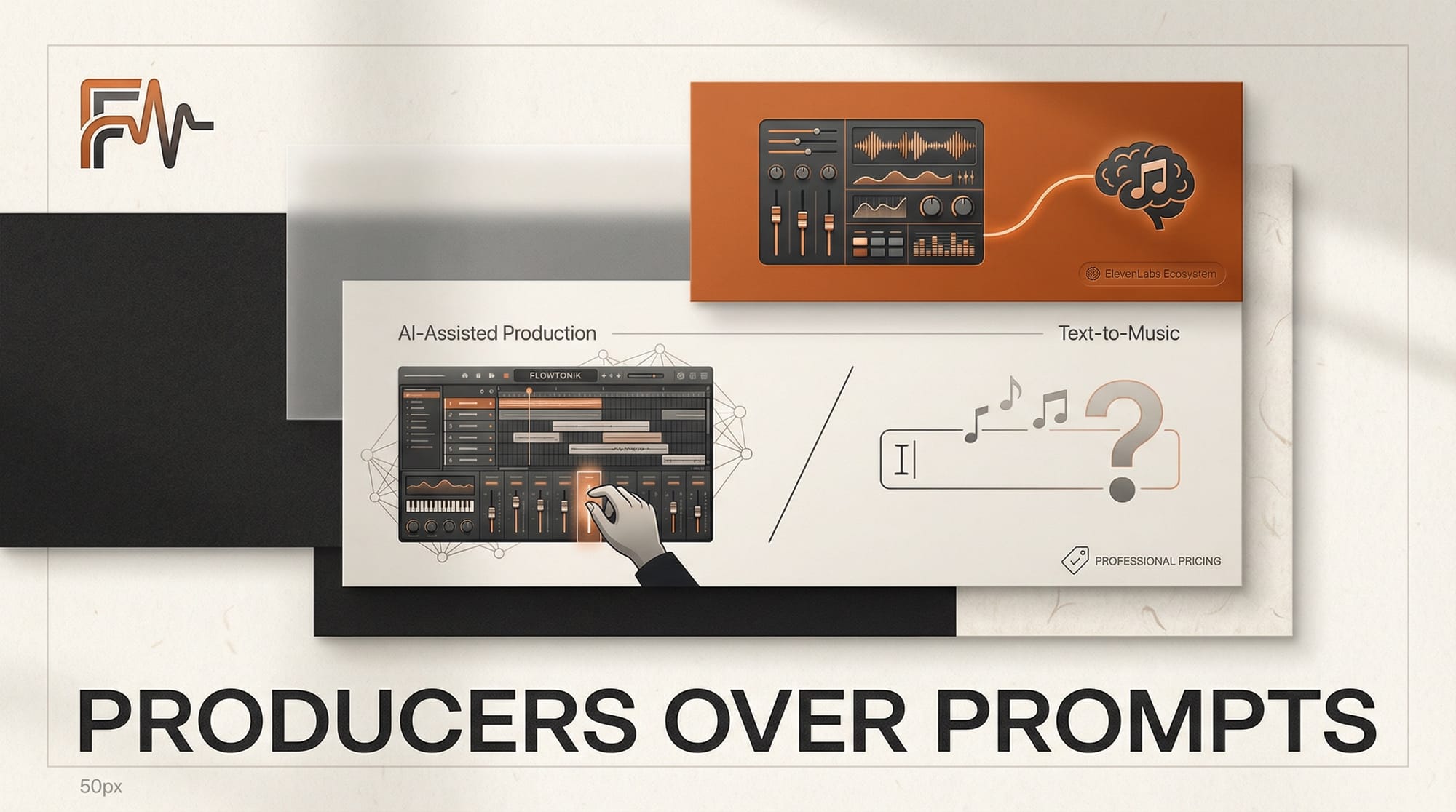
The AI music market has split into two distinct camps. On one side, tools like Suno and Udio generate complete tracks from text prompts. On the other, a new wave of AI-native DAWs is embedding intelligence directly into the production workflow. Flowtonik, a macOS digital audio workstation from Stems Labs, represents the strongest statement yet that professional music producers want AI as an assistant, not a replacement.
Background
Stems Labs is not a newcomer to AI-powered audio. The company released Lowkey, a remixing application, in December 2024 before pivoting to the more ambitious Flowtonik project. The DAW launched on March 20, 2026 with a free tier and two paid plans, targeting experienced producers on macOS 12.0 and later.
What sets Flowtonik apart from the crowded AI music space is its approach. Rather than replacing the production process with a text box, it layers conversational AI assistants on top of a full-featured DAW environment complete with edit and mix views, audio and MIDI recording, routing control, and automation lanes. The company has also received a grant from ElevenLabs and is actively collaborating with its team, signaling deeper integration ahead.
Deep Analysis
Two Philosophies: Text-to-Music vs. AI-Assisted Production
The AI music landscape is experiencing a philosophical split. Text-to-music generators like Suno V5 Studio and Udio appeal to non-musicians who want finished tracks from a prompt. These tools have grown rapidly, but they face a ceiling: professional producers do not want to relinquish control over arrangement, mixing, and sound design decisions.
Flowtonik sits firmly in the second camp. Its AI handles specific production tasks (stem generation, MIDI ideation, stem separation, arrangement refinement, mixing adjustments) while the producer retains full manual control. This mirrors how AI has been adopted in other creative fields. Designers use AI to generate options, then refine manually. Writers use AI for drafts, then edit extensively. Music production is following the same pattern, and Flowtonik is betting that producers will pay for tools that accelerate their existing workflow rather than replace it.
The timing matters. As covered in our analysis of the AI music and audio tools landscape, the category is maturing beyond pure generation toward integrated creative tools. Flowtonik enters a market where the initial novelty of AI-generated music has faded and creators are asking harder questions about utility and control.
Inside Flowtonik's Conversational Workflow
Flowtonik's core innovation is its conversational AI pane. Producers can issue natural language commands to handle track edits, clip operations, mixing moves, timeline control, and tempo changes. Instead of navigating nested menus or memorizing keyboard shortcuts, a producer can type "boost the kick at 80Hz by 3dB" or "generate a four-bar bass pattern in E minor" and watch the DAW respond.
The bundled Tonik plugin includes over 300 production-ready sounds across drums, keys, bass, and texture layers. Combined with AI-powered MIDI generation, this gives producers a starting palette that can be shaped through conversation. Stem separation handles the reverse direction: pulling apart existing tracks into isolated vocals, drums, bass, and instrument channels for remixing or sample work.
What is notably absent is any text-to-full-song capability. Flowtonik does not generate finished tracks. Every output is a component (a stem, a MIDI pattern, an arrangement suggestion) that the producer must incorporate into their session manually. This constraint is intentional. It keeps the producer in the driver's seat while eliminating the repetitive technical work that slows sessions down.
The ElevenLabs Ecosystem Play
The ElevenLabs grant and collaboration add a strategic dimension to Flowtonik's launch. ElevenLabs has built the dominant platform for AI voice synthesis and is expanding aggressively into music through its Music Marketplace and Eleven Music tools. By investing in Flowtonik, ElevenLabs extends its reach from AI audio generation into AI-assisted audio production.
This ecosystem approach mirrors what happened in image generation. Stability AI built the model layer, then tools like ComfyUI and Automatic1111 created the production interface. In audio, ElevenLabs is building the generation layer while Flowtonik provides the production environment. If the collaboration deepens, producers using Flowtonik could gain direct access to ElevenLabs voice, sound effect, and music generation APIs without leaving the DAW.
For Stems Labs, the ElevenLabs backing provides credibility and potentially access to generation models that would take years and millions of dollars to build independently. For ElevenLabs, Flowtonik offers a professional-grade frontend that positions its technology for serious music producers rather than just casual users.
Pricing Signals a Professional Bet
Flowtonik's pricing structure reveals its market positioning. The free Studio tier includes basic AI credits, enough for evaluation. The Pro tier at $49 per month ($500 annually) provides 10x AI credits and priority features. The Master tier at $199 per month ($2,000 annually) unlocks unlimited AI credits, premium models, and real-time AI capabilities.
These are professional prices. For context, established DAWs like Logic Pro cost $199 as a one-time purchase, while Ableton Live Suite runs $749 outright. Flowtonik's subscription model at $500 to $2,000 per year puts it in the premium tier, above most traditional DAWs on an annual basis. The bet is that AI-powered productivity gains justify the recurring cost for working producers.
The tiered credit system also suggests that AI features carry real compute costs. Unlike traditional DAW plugins that run locally, Flowtonik's AI assistants appear to require cloud processing for generation and separation tasks. This creates a dependency on cloud infrastructure that producers accustomed to fully offline workflows may resist, particularly those working on unreleased material under NDA.
Impact on Creators
For music producers, Flowtonik represents a meaningful shift in how AI enters the studio. Rather than asking whether AI will replace producers (a question the text-to-music tools raised), Flowtonik asks how AI can make existing producers faster. The conversational workflow lowers the barrier to complex technical operations while preserving the creative decision-making that defines a producer's sound.
The free tier makes evaluation low-risk. Producers can test the AI-assisted workflow against their current setup before committing to subscription pricing. The macOS-only restriction limits the addressable market, but it aligns with the professional audio world where macOS remains the dominant platform for music production.
Comparisons to BandM8, which launched at GTC 2026 with a music-to-music approach, are inevitable. Both tools target producers rather than prompt-based generation, but BandM8 focuses on expanding a single instrument into a full band arrangement while Flowtonik provides a complete DAW environment with AI throughout the workflow. They may end up complementary rather than competitive.
Key Takeaways
- AI as assistant, not generator: Flowtonik deliberately avoids text-to-song features, instead embedding AI into specific production tasks like stem separation, MIDI generation, and conversational mixing.
- ElevenLabs ecosystem: The grant and collaboration position Flowtonik within a growing audio AI platform that spans voice, music, and now production tools.
- Professional pricing: At $49 to $199 per month, Flowtonik targets working producers willing to pay for AI-powered productivity, not casual music creators.
- macOS only: The platform limitation narrows the market but targets the dominant OS in professional audio production.
- Cloud dependency: AI credit-based pricing implies cloud processing, which may concern producers working on confidential material.
What to Watch
The next six months will determine whether Flowtonik's producer-first approach gains traction. Watch for deeper ElevenLabs integration, particularly direct access to voice and music generation models within the DAW. Track whether the pricing model sustains at professional tiers or if competitive pressure from established DAWs adding AI features forces adjustments. As reported by Music Ally, Flowtonik is part of a broader wave of AI music tools. The question is whether the market wants AI built into existing workflows or as a separate generation layer. Flowtonik and Landr's acquisition of Reason Studios suggest the industry is leaning toward integration.