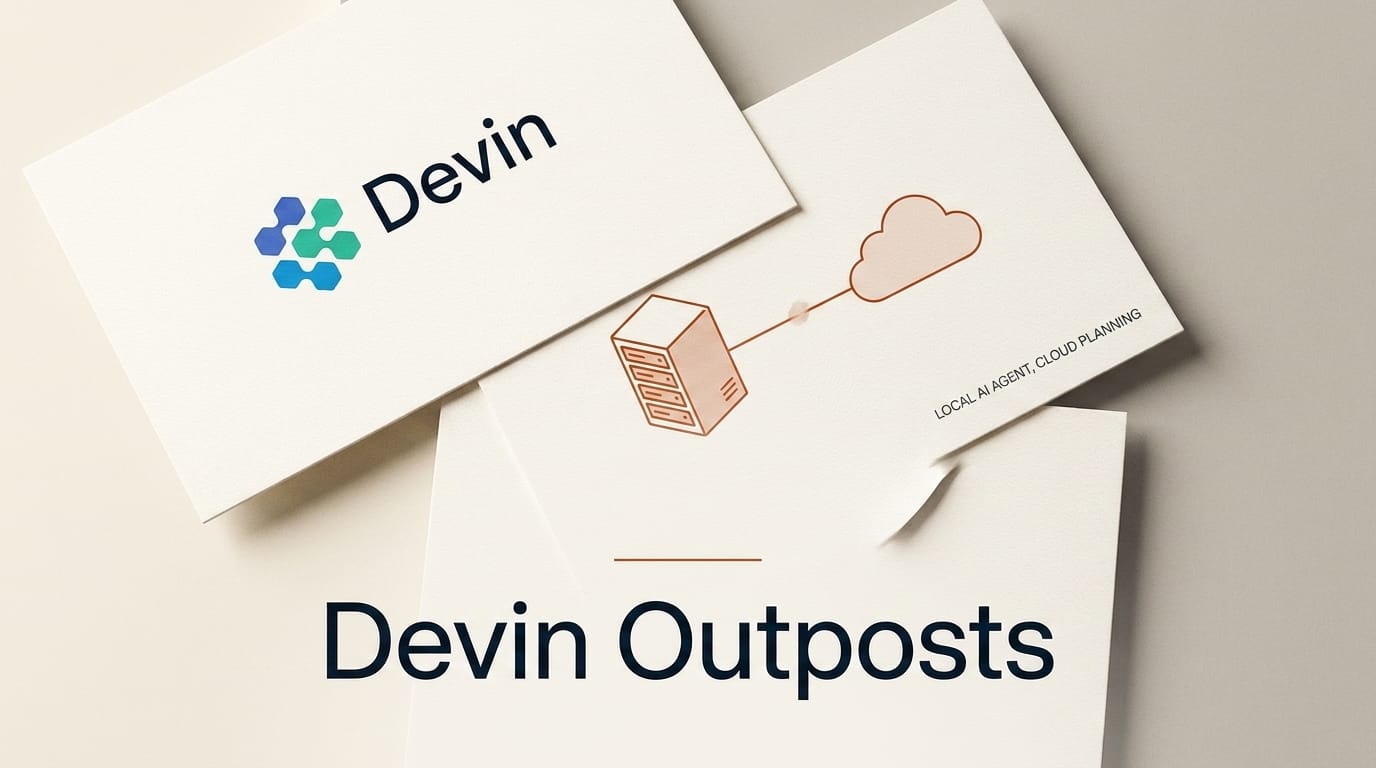
Cognition shipped Devin Outposts on July 21, 2026, and it changes where an autonomous coding agent actually does its work. Instead of running every session inside Cognition's managed cloud, Devin can now execute on a GPU box in your lab, a virtual machine inside your private network, a Kubernetes cluster next to your internal services, or a Mac mini on your desk. The planning and inference stay in the cloud. Only the hands, the part that clones your repo, runs your toolchain, and touches your GPUs, move onto hardware you control. For any creator or team that has wanted a capable agent but could not send code or data to a vendor sandbox, that split is the whole story.
Background
Cloud coding agents have always carried the same friction: the agent works in a clean, isolated sandbox that looks nothing like your real environment. Your licensed compiler is not there. Your internal database is unreachable. Your CUDA drivers and model weights live on a machine the agent cannot see. So the agent produces code that compiles in its sandbox and breaks the moment it lands in your stack. Teams with data-residency rules or network isolation could not use these agents at all, because the first requirement was shipping the repo to someone else's cloud.
Self-hosting is the answer the whole category has been circling. We have covered the local side of it, from running parallel coding agents locally on a Mac to the model-routing layer Cognition built into Devin's own agent stack. Outposts is the version where the orchestration and reasoning stay managed, so you do not run a frontier model yourself, but the execution comes home.
Deep Analysis
A split agent: cloud brain, local hands
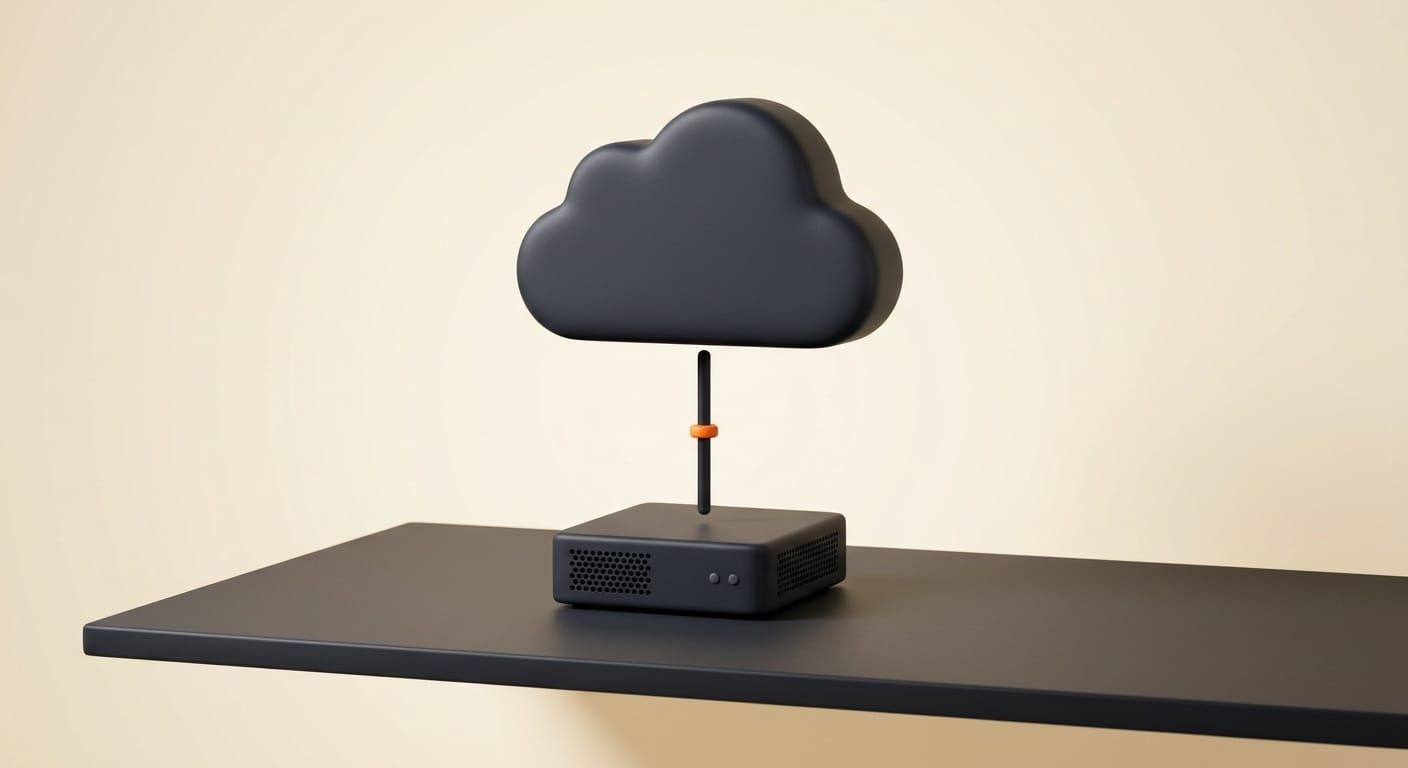
The core design is a clean separation. Devin's reasoning, planning, and model calls run on Cognition Cloud, exactly as before. What moves is execution. When you start a session on an Outpost, the session enters a queue, and one of your workers claims it. Cognition describes the claim as atomic, so exactly one worker wins even when several are attached to the same Outpost. That queue is exposed through an orchestration API that tells your infrastructure which sessions are waiting at any moment, which means workers do not have to sit always-on. You can spin capacity up when the queue has work and down when it is empty. Attach three machines to one Outpost and Devin spreads sessions across all of them.
Self-hosted, local, or cloud sandbox: which execution model fits
Outposts is not the only way to keep an agent close to your code, and it is worth being precise about what it does and does not change. The table below compares the three practical options a creator faces today.
| Approach | Where inference runs | Where execution runs | Network model | Best for |
|---|---|---|---|---|
| Devin Outposts | Cognition Cloud | Your GPU, VM, Kubernetes, or Mac mini | Outbound only, no inbound required | A managed agent that still needs internal-network and data-residency access |
| Local parallel agents | Local models or your own API keys | Your own Mac or workstation | Fully local, no vendor dependency | Offline or air-gapped work and running several agents at once |
| Cloud sandbox agents | Vendor cloud | Vendor cloud sandbox | Vendor managed | Fastest setup with no hardware to maintain |
The trade is straightforward. Cloud sandboxes are the lowest-effort path, but your code and its runtime live on someone else's machine. Fully local agents give you total control, including inference, at the cost of running and paying for the model yourself. Outposts sits in the middle: you keep the frontier reasoning as a managed service and pull only the execution onto trusted hardware. If your blocker was never the model quality but the fact that the agent could not reach an internal service or was not allowed to leave your network, Outposts is aimed directly at you.
The isolation model, and why it still needs guardrails
Cognition made two security choices worth noting. Execution runs as an unprivileged user, not root, and the connectivity model is outbound only, so no inbound connections into your network are required for a worker to claim and run sessions. That is a sane default for something you place next to internal services. Launch partners went further: Cloudflare published a sandbox tutorial that wraps execution in an isolated sandbox with all traffic flowing through customizable proxies, so you can inspect and constrain what the agent reaches. Even so, an autonomous agent with a shell on a machine that can see your database deserves caution. The same failure modes we documented in coding-agent sandbox escapes apply here, only now the blast radius is your own infrastructure. Scope the worker's filesystem and network access before you point it at anything that matters.
Setup in three steps
Standing up an Outpost is deliberately short. First, create a new Outpost, which is a named queue, in your Devin Cloud settings. Second, install an Outpost worker on the target machine with the Devin CLI. Third, select that Outpost as the runtime when you start a session. The full walkthrough lives in the Outposts documentation. Cognition built deployment guides with launch partners including Modal, Daytona, E2B, Namespace, and NVIDIA Brev, plus a Kubernetes template for cluster deployments, so the worker can land on managed sandbox infrastructure rather than a raw box if you prefer.

Impact on Creators
The obvious winners are teams with rules. If your work carries data-residency requirements, sits behind a private VPC, or depends on internal services the agent must reach, Outposts turns Devin from a non-starter into something you can actually deploy. The agent can hit an internal database, use a licensed compiler, or run CUDA workloads on your own GPUs without any of that data leaving your network.
It matters for solo builders too. A Mac mini with Xcode and Apple Silicon becomes a persistent execution target for iOS or on-device model work that a generic cloud sandbox cannot replicate. A single GPU box in a home lab lets Devin run and test CUDA code against the exact drivers you ship on. And because the queue can be driven by an API and workers do not need to stay always-on, the cost model is closer to on-demand than to a rented, idling cloud instance. You bring the hardware you already own, and you pay for the managed reasoning, not for a sandbox that duplicates your environment badly.

Key Takeaways
Devin Outposts splits the agent so planning and inference stay on Cognition Cloud while execution moves to your GPU, VM, Kubernetes cluster, or Mac mini. Setup is three steps through the Devin CLI, sessions are claimed atomically from a queue you can drive by API, and the connectivity model is outbound only with execution running as an unprivileged user. The practical unlock is access: the agent can finally see your internal services, licensed tools, and GPUs without your code leaving your network. Compared with fully local agents you give up self-hosted inference, and compared with cloud sandboxes you take on hardware, but you get the middle ground most regulated and hardware-bound teams actually needed.
What to Watch
The open questions are operational. Cognition has not published pricing or data-residency guarantees for the managed reasoning layer, so teams with strict rules will want that in writing before they commit. The orchestration API is the piece to watch: if it is flexible enough, expect community tooling that autoscales Outpost workers on Modal, E2B, or Kubernetes the way people already autoscale CI runners. And because the pattern of pulling execution onto trusted hardware is now shared across the coding-agent field, watch whether rivals answer with their own split-execution modes or whether Devin's head start on partner integrations, from Cloudflare sandboxes to a ready Kubernetes template, keeps it the default for teams that cannot ship their code to the cloud.