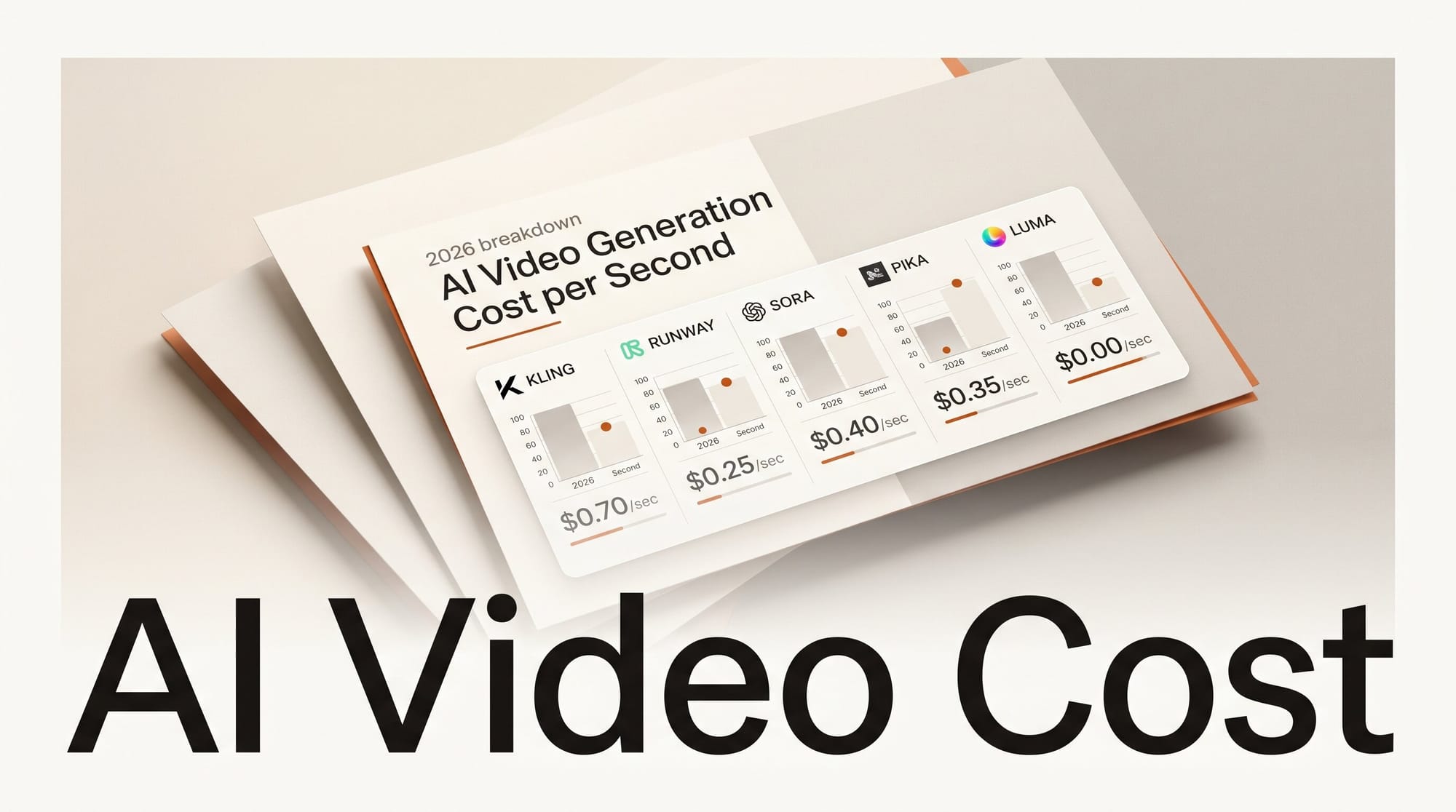
If you generate AI video at any real volume, the price you pay is set by one number almost nobody advertises clearly: the cost per second of finished footage. In 2026 that number ranges from half a cent to more than forty cents, an 80x spread for output that often looks similar at a glance. This guide pins down what each major model actually costs per second, separates the tools that publish transparent rates from the ones that hide cost behind credits, and shows where the real savings are.
The short version: open-weight and "lite" tiers have collapsed the price floor, premium models with native audio still command a steep premium, and the credit-based platforms make true per-second cost almost impossible to read off the pricing page. Methodology below is simple. Where a model publishes a per-second API rate, that rate is quoted directly. Where a model sells credits, the per-second figure is derived from the published plan price divided by the credits the plan grants, then multiplied by the credits each second of video consumes.
Background
For two years AI video was priced like a luxury good. A few seconds of footage cost real money, and creators rationed generations. Two shifts changed that. First, the major labs split their flagship models into Standard, Fast, and Lite tiers, so the same family now spans an 8x internal price range. Second, distillation made cheap open-weight models viable: Avataar's Varya, distilled from Alibaba's Wan 2.2 and released as an open-weight model, runs at roughly $0.005 per second on its hosted service, the lowest published rate we have seen.
At the other end, the market lost one of its most-watched names. OpenAI's consumer Sora app shut down in April 2026, with its API scheduled to sunset later in the year. That removed a familiar reference point and pushed creators toward Google's Veo family, Runway, Kling, Luma, and the new low-cost open-weight tier. Cost, not novelty, is now the deciding factor for most production work.

Deep Analysis
The transparent tier: models that publish a per-second rate
Google's Veo family is the clearest pricing in the market because the official Gemini API pricing lists an explicit per-second rate for every variant, with audio included by default. Veo 3.1 Lite runs $0.05 per second at 720p and $0.08 at 1080p. Veo 3 and Veo 3.1 Fast cost $0.10 per second at 720p and $0.12 at 1080p. The full Standard tier is $0.40 per second at 720p or 1080p and $0.60 per second for 4K. Veo 2 sits at $0.35 per second. You are charged only for video that successfully generates.
Avataar Varya undercuts all of them at about $0.005 per second hosted, and because it ships as open weights, self-hosting reduces the marginal cost to raw GPU compute. The catch is quality and feature ceiling: a distilled model trades some fidelity and control for that price. For high-volume, template-style social video where a 720p clip is fine, the math is hard to argue with.
| Model | Pricing basis | Cost per second | Native audio |
|---|---|---|---|
| Avataar Varya (hosted) | Per-second API | ~$0.005 | No |
| Veo 3.1 Lite (720p) | Per-second API | $0.05 | Yes |
| Runway Gen-4 Turbo | Credits (5/sec) | ~$0.06 to $0.10 | No |
| Veo 3 / 3.1 Fast (720p) | Per-second API | $0.10 | Yes |
| Runway Gen-4 | Credits (~12/sec) | ~$0.15 to $0.23 | No |
| Veo 2 | Per-second API | $0.35 | Yes |
| Veo 3 / 3.1 Standard (720p/1080p) | Per-second API | $0.40 | Yes |
| Runway Gen-4.5 | Credits (25/sec) | ~$0.31 to $0.48 | No |
| Veo 3 / 3.1 Standard (4K) | Per-second API | $0.60 | Yes |
The credit maze: Runway, Kling, Luma, and Pika
Credit-based platforms are where per-second cost gets murky. Runway's published plans are the most decodable: the Standard plan is $12 per user per month on annual billing for 625 credits, and Pro is $28 per month for 2,250 credits. Gen-4 Turbo burns 5 credits per second, Gen-4 around 12, and Gen-4.5 about 25. Divide plan price by credits and you get roughly $0.06 to $0.10 per second for Gen-4 Turbo, climbing toward $0.31 to $0.48 per second for Gen-4.5. The effective rate improves on higher tiers, which is the opposite of intuitive: heavier users pay less per second.

The others are harder still. Kling's membership plans run from a free tier of 66 credits per day up to a $180-per-month Ultra plan, but the credits a clip consumes change with mode, resolution, and whether you add audio, so a single public per-second number does not exist. Luma's Dream Machine plans ($30, $90, and $300 per month) sell usage in bulk with no published per-second API rate at all. Pika's subscription tiers grant 150 to 6,000 credits per month, with per-video cost that "depends on what type of video you are creating." For budgeting, this is the real lesson: a low monthly sticker price can hide a high per-second cost once you account for how fast credits drain.
Why native audio is the hidden cost multiplier
The per-second numbers are not apples-to-apples on one axis: audio. Veo's rates include synchronized audio in a single generation. Runway, Kling, and most credit platforms generate silent video, so a realistic pipeline adds a second pass through a tool like ElevenLabs or Suno, plus editing time to sync it. When you compare a $0.40 Veo second against a $0.10 silent second elsewhere, the gap narrows once you price in the audio trip. For dialogue-driven or sound-design-heavy work, native audio can be cheaper end to end despite the higher headline rate.
Impact on Creators
For most creators the decision is not "which model is best" but "which model is cheap enough at the quality my deliverable needs." A creator producing dozens of short, silent, template-style social clips per week should live in the sub-$0.10 tier: Avataar Varya, Veo 3.1 Lite, or Runway Gen-4 Turbo. The per-second savings compound fast. At 100 ten-second clips a month, the difference between $0.005 and $0.40 per second is roughly $5 versus $400.

For client-facing hero shots, branded spots, or anything needing 4K and clean audio, the premium Veo Standard tier or Gen-4.5 earns its cost. The mistake to avoid is paying premium rates for throwaway drafts. Generate cheap while you iterate on prompt, framing, and motion, then run only the locked shot through the expensive model. If your work centers on image generation and short loops, our breakdown of the best AI video generators in 2026 covers quality and feature fit alongside this cost lens, and the cheap end of the market is detailed in our coverage of Avataar Varya at half a cent per second.
Key Takeaways
1. The per-second price floor has collapsed to about $0.005 (Avataar Varya) while premium tiers hold at $0.40 to $0.60, an 80x spread.
2. Only Google's Veo family and a handful of open-weight models publish a clean per-second rate; Runway is derivable, while Kling, Luma, and Pika hide cost inside credits.
3. Veo's rates include native audio, so the headline gap versus silent-video tools narrows once you price the separate audio pass.
4. Iterate on a cheap tier and reserve the premium model for the final locked shot to cut spend without cutting quality.
What to Watch
Two forces will keep pushing the floor down. Open-weight distillation, the technique behind Varya, is spreading, and every new sub-cent model pressures the paid tiers to add cheaper variants. Watch for the credit-based platforms to respond, either by publishing honest per-second rates or by shipping their own lite tiers to compete on the number that actually drives volume buyers. The platforms that keep cost buried in credits will increasingly lose high-volume creators to whoever states a rate plainly, the same way transparent token pricing reshaped the LLM market we tracked in our look at what AI tokens really cost a creator's budget. The next price war is per-second, and it favors whoever is willing to print the number.
Frequently Asked Questions
What is the cheapest AI video generator per second in 2026?
Avataar Varya is the cheapest with a published rate, at roughly $0.005 per second on its hosted service. Because it is open-weight, self-hosting can lower the marginal cost further to raw compute, though quality and control are below the premium models.
How much does Google Veo 3 cost per second?
Per Google's official Gemini API pricing, Veo 3 and Veo 3.1 Standard cost $0.40 per second at 720p or 1080p and $0.60 at 4K, with audio included. The Fast tier is $0.10 per second at 720p, and the 3.1 Lite tier is $0.05 per second at 720p.
Why is Runway's cost per second hard to calculate?
Runway sells credits rather than seconds. You derive the per-second cost by dividing a plan's price by its monthly credits, then multiplying by the credits each model burns per second (5 for Gen-4 Turbo, about 12 for Gen-4, 25 for Gen-4.5). The effective rate drops on higher-tier plans.
Do cheaper AI video models include audio?
Usually not. Google's Veo rates include synchronized audio, but Runway, Kling, and most low-cost tiers generate silent video. A realistic budget for those adds a separate audio-generation pass and the editing time to sync it.
Is a monthly subscription cheaper than per-second API pricing?
It depends on volume and how fast the platform's credits drain. A low monthly sticker price can hide a high effective per-second cost. For steady high-volume work, a transparent per-second API rate is easier to budget and often cheaper than a credit plan once you account for premium-mode credit costs.