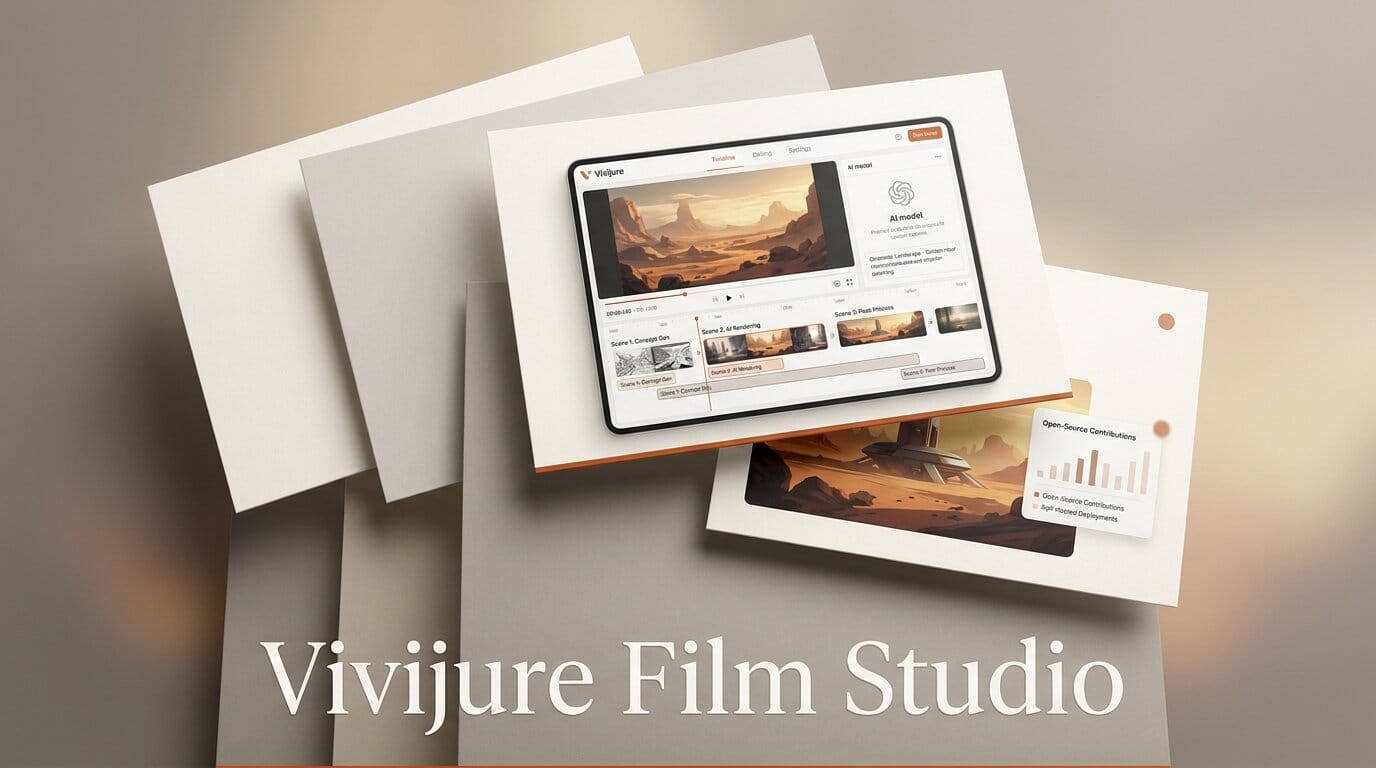
A developer has released Vivijure, a free and open-source AI film studio that runs on your own hardware instead of a paid cloud service. Version 1.0.0 shipped on July 13, 2026, bundling a storyboard-to-video pipeline that stitches more than a dozen image, video, audio, and lip-sync models behind a single web interface.
Try It: Storyboard to Video Without a Subscription
You can test the workflow in minutes through the public demo. Write a short storyboard, generate keyframes with SDXL, then send those frames to a motion model to render a clip. Vivijure can route rendering to your own GPU with Wan 2.2, or to a cloud backend such as Kling, Google Veo, Seedance, MiniMax Hailuo, or Vidu when you want more horsepower. Add narration with the built-in speech and music modules, then apply lip-sync and upscaling before export.
Why It Matters for Creators
Most AI video studios lock the full pipeline behind a monthly SaaS fee and keep your footage on their servers. Vivijure is self-hosted and AGPL-licensed, so filmmakers and homelab builders keep their assets and swap models freely. It joins a growing wave of local-first creative tools, like our coverage of LocalClip, and it leans on Cloudflare Workers for a control plane that is cheap to run.
Key Details
License: AGPL-3.0, fully open source, with docs on the project site.
Models: SDXL keyframes, Wan 2.2 local motion, plus Kling, Google Veo, Seedance, MiniMax Hailuo, and Vidu Q3 as cloud motion backends.
Extras: MuseTalk lip-sync, Real-ESRGAN upscaling, MiniMax music and speech, subtitle generation, and a Discord screenwriting bot.
Compute: Runs on a local GPU or a RunPod serverless backend, with an MCP server so AI agents can drive the pipeline.
What to Do Next
Clone the repository and follow the deployment guide to self-host, or open the demo first to see the four showcase films the author rendered end to end. If you already run a local stack, pair it with open audio tools like our writeup of ZeroLabs to round out voice and narration.