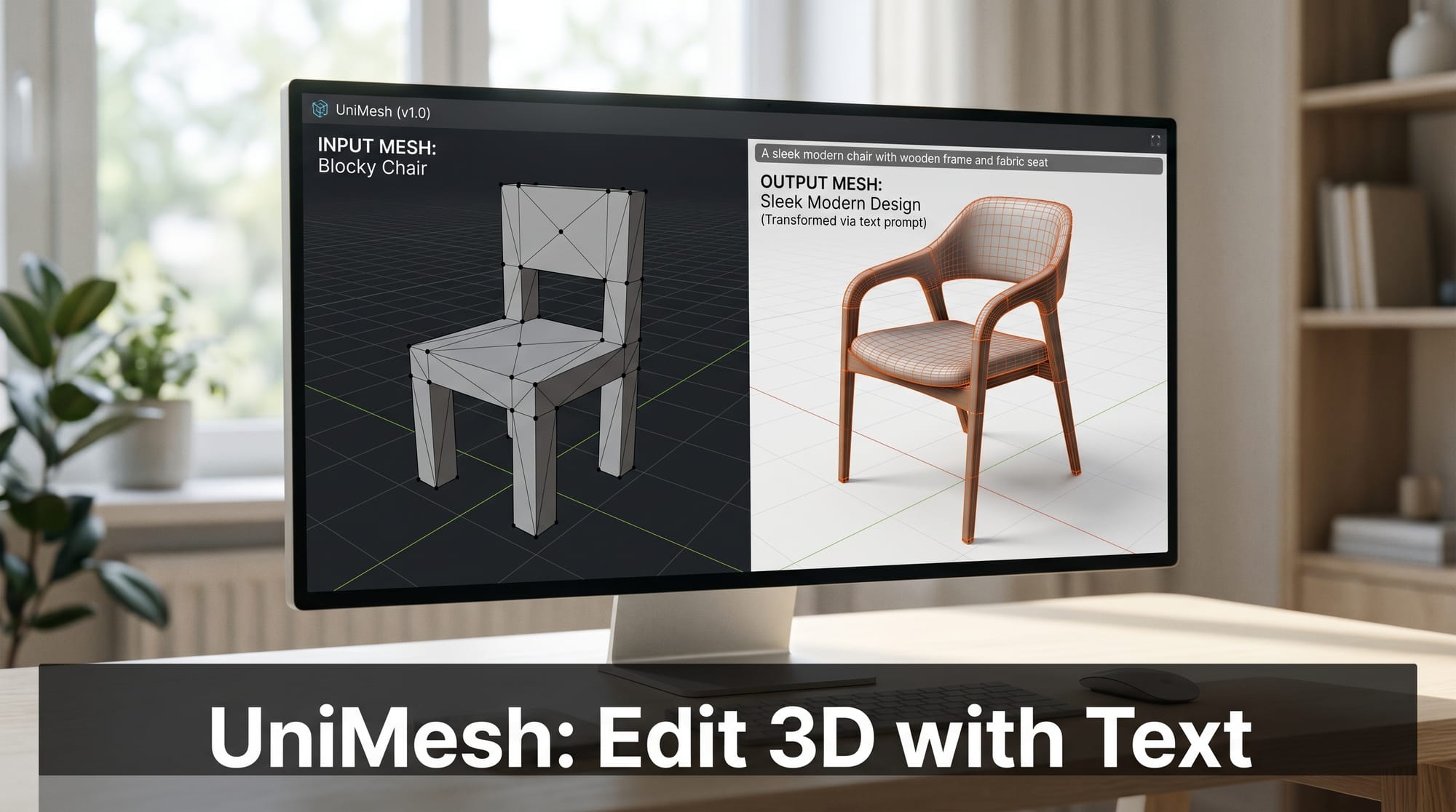
Researchers from Boston University and Peking University published UniMesh on April 19, 2026, a unified 3D framework that generates meshes from text prompts and supports iterative editing through natural language. Its Chain-of-Mesh mechanism lets users modify generated 3D objects by typing instructions like "make it red" or "add wings," without retraining or parameter updates.
What Happened
UniMesh connects BAGEL, ByteDance multimodal generation model built on FLUX and Qwen, with Hunyuan3D, Tencent 3D shape generator, through a purpose-built "Mesh Head" module. This interface translates BAGEL image latents directly into Hunyuan3D conditioning space, bypassing the intermediate RGB rendering step that degrades geometric fidelity in earlier pipeline approaches.
On the DreamFusion text-to-3D benchmark using 404 prompts, UniMesh achieves a CLIP Image-Text similarity of 0.296, outperforming InstantMesh, LGM, and Flex3D. It also posts the best FID score (0.113) on the Cap3D 3D captioning benchmark across 3,186 objects.
Why It Matters
Current 3D asset workflows require specialized software to make structural or material changes after an initial generation pass. Changing the color of a generated object means re-entering Blender or another tool and modifying mesh properties manually. UniMesh proposes a different approach: type what you want changed and regenerate.
The Chain-of-Mesh loop operates entirely at inference time with no fine-tuning required. The latent representation of the current mesh is combined with a new text instruction and fed back through the generation pipeline. Demonstrated edits include changing object color, adding structural elements, modifying geometry (tracks to wheels on a bulldozer), and removing objects from a scene.
For teams already working with open-source 3D generation, this approach complements image-to-3D tools like TRELLIS.2, which handles image-to-mesh conversion and now runs on Apple Silicon.
Key Details
- Mesh Head: A new cross-model interface that maps BAGEL FLUX image latents into Hunyuan3D conditioning space, eliminating lossy RGB reconstruction steps between the two systems.
- Chain-of-Mesh (CoM): Iterative text-guided 3D editing at inference time, no retraining or additional datasets required for new edits.
- Self-Reflection: An Actor-Evaluator triad that improves 3D captioning accuracy by iteratively reviewing and correcting captions through verbal feedback loops.
- Training base: Mesh Head fine-tuned on Cap3D with LoRA rank 4, using Hunyuan3D-2 Mini Turbo during training and full Hunyuan3D-2 at inference.
What to Do Next
UniMesh is at early research stage. The GitHub repository is a placeholder without usable code currently. Read the full paper on arXiv for implementation details, and track community discussion on the Hugging Face paper page for news on when training code drops.
BAGEL is publicly available for image generation and Hunyuan3D-2 is open-source, so a community reproduction is plausible once the Mesh Head training code is released.