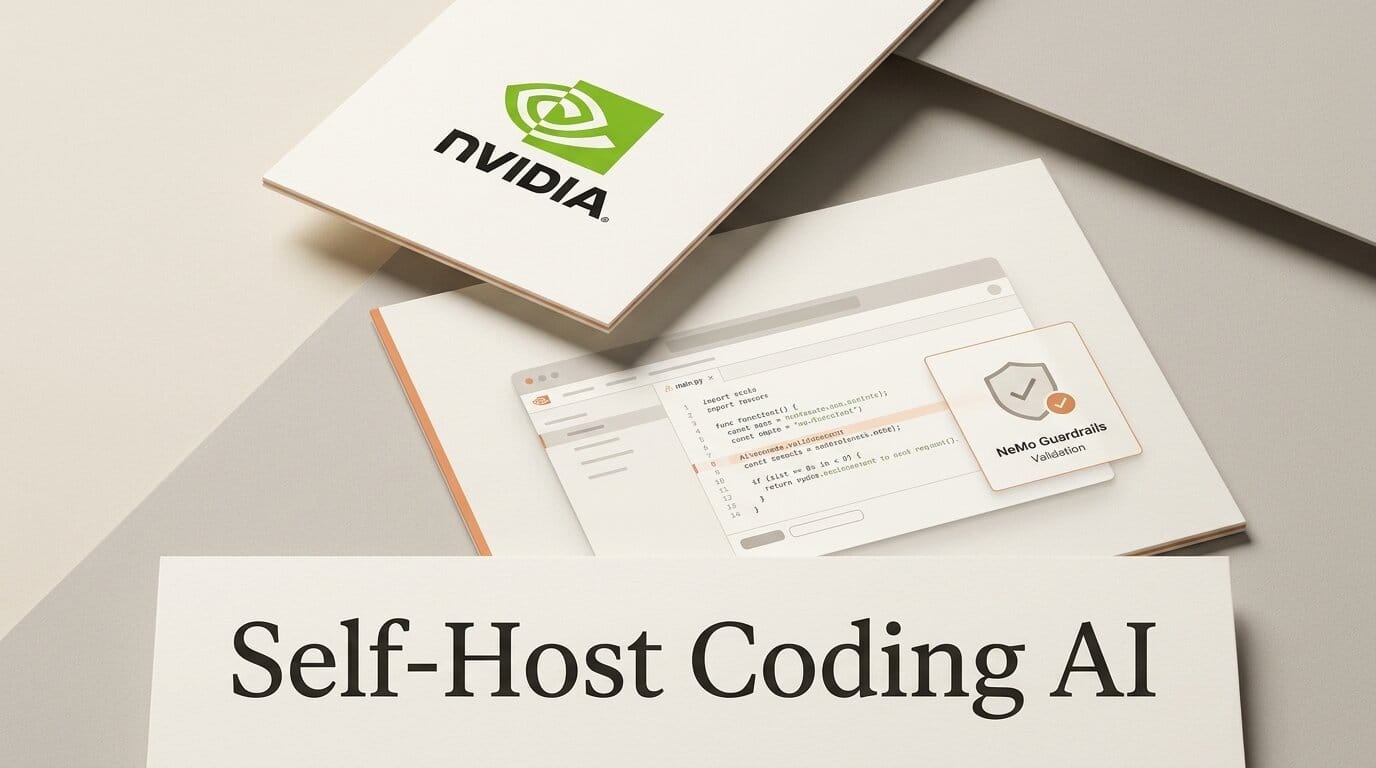
NVIDIA published a hands-on guide on July 29 for self-hosting a validated AI coding assistant that never sends your source code to a third-party API. The stack pairs an open code model, StarCoder2-7B, with a policy-enforcing proxy, so every completion is checked for hallucinated packages and logged for audit.
What This Enables
If you build software and cannot paste proprietary code into a hosted assistant, this gives you a private alternative you run yourself. You deploy StarCoder2-7B as a container with an OpenAI-compatible endpoint, point your IDE at it, and route every request through NeMo Guardrails. The proxy rejects prompts that break your policies and runs dependency checks that catch "slopsquatting," where a model invents a package name an attacker could register on a public registry. The full walkthrough is a seven-step pipeline, from the model container to CI gates to outcome metrics, and nothing leaves your machine or your own GPU.
Why It Matters for Creators
Coding agents have had a rough month on the safety front, from data-loss incidents to permission escapes. A self-hosted, guardrailed setup is the opposite posture: you own the model weights, the logs, and the policy rules. For solo builders and small studios shipping client work under NDA, that removes the biggest blocker to putting AI in the loop at all, because the code and the audit trail both stay in-house.
Key Details
Model: StarCoder2-7B, deployed as an NVIDIA NIM microservice that needs at least a 24GB GPU. The open model card lists its training corpus and license terms.
Guardrails: NeMo Guardrails runs as a proxy with task-based policies, CI verification gates for secret scanning and license checks, and commit-level traceability via Git hooks.
Monitoring: Prometheus and Grafana track defect-escape rates, while optional domain adaptation runs on the NeMo Framework.
What to Do Next
Start with the deploy step if you have a compatible GPU, then wire the OpenAI-compatible endpoint into your editor before layering guardrails on top. If you are weighing safer agent setups more broadly, our rundown of a Claude Code security plugin covers the terminal side of the same problem.