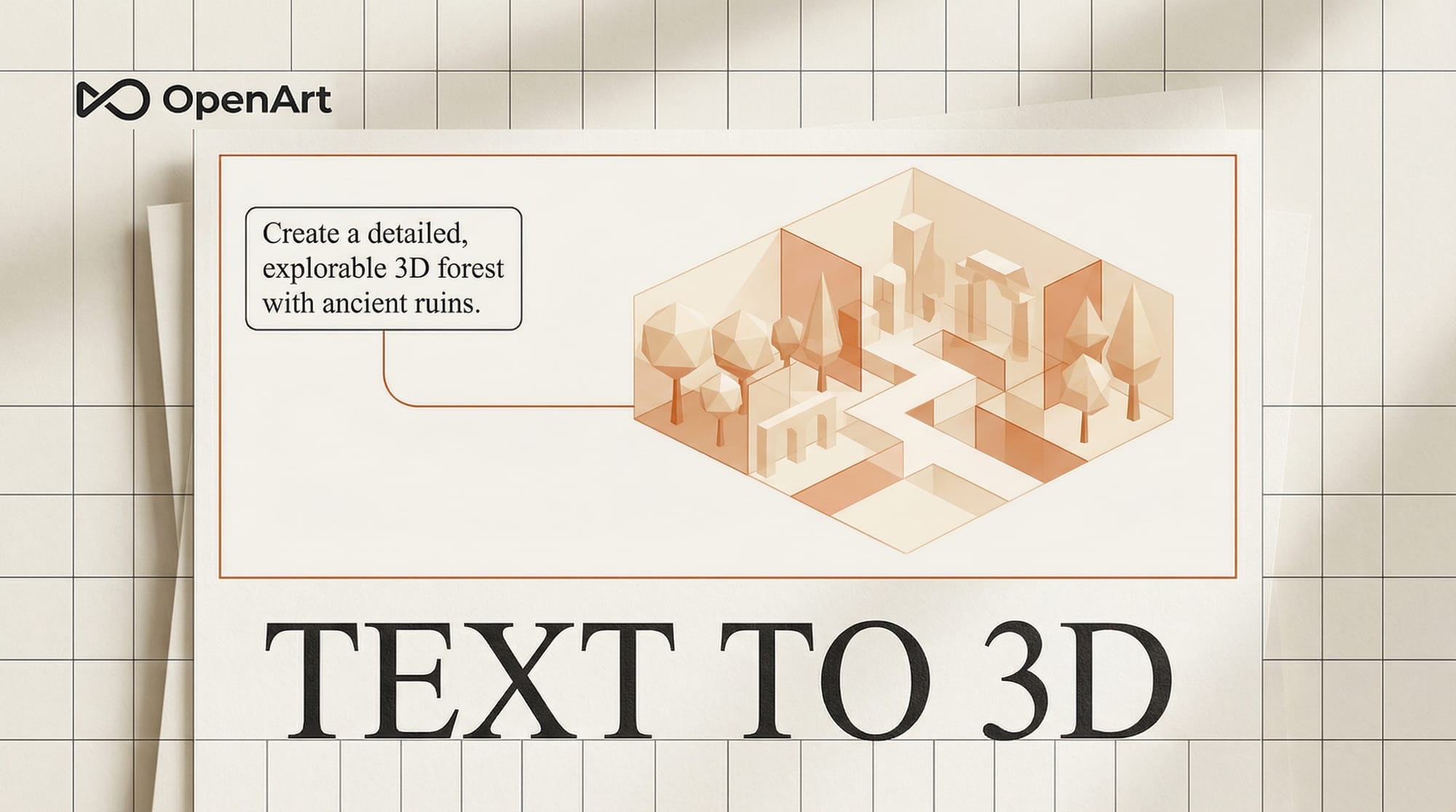
OpenArt launched Worlds on March 18, 2026, a spatial creative tool that generates persistent, navigable 3D environments from a single text prompt or image. Powered by World Labs spatial AI, Worlds lets creators walk through generated scenes and capture production-ready 2D images from any angle.
What Happened
OpenArt added Worlds to its creative suite, making World Labs' spatial generation technology available to its user base for the first time. Creators enter a text prompt or upload an image, and the system generates a fully navigable 3D environment. Unlike standard image generators that produce a single fixed output, Worlds creates a persistent scene that users can move through freely, choosing camera angles and compositions before taking a shot.
At the moment of capture, creators can add characters, objects, or other elements via additional prompts. Every generated world saves permanently in the user's library, so the same environment can be reused across multiple projects without regeneration. The system uses Gaussian splats as its underlying 3D representation, with plans to export to standard 3D formats for use in Unreal Engine and Blender.
Why It Matters
Current AI image generators give creators no spatial control. Each generation is a one-shot output with no way to reposition the camera, revisit the scene, or maintain consistency across multiple images from the same environment. Worlds changes that by treating the generated space as a persistent location rather than a disposable render.
This matters most for creators who need consistent settings across a series of images, like storyboard artists, game concept designers, or content creators building visual narratives. Instead of prompting the same scene repeatedly and hoping for consistency, they can generate the environment once and shoot it from as many angles as needed.
World Labs, founded by Stanford AI pioneer Fei-Fei Li alongside Justin Johnson, Christoph Lassner, and Ben Mildenhall, is backed by A16z, Nvidia, Intel, and Adobe. The growing interest in 3D AI tools at this year's GDC and GTC conferences signals that spatial generation is becoming a serious category alongside 2D image and video generation.
Key Details
- Input: Text prompt or uploaded image generates a full 3D environment
- Navigation: Free movement through generated scenes with full camera control
- Capture: Add or modify elements at the moment of shot, output production-ready 2D images
- Persistence: Worlds save permanently for reuse via @Image tag references
- Technology: Built on World Labs spatial AI using Gaussian splat representation
- Coming soon: Export to Gaussian splat, 3D mesh, Unreal Engine, and Blender formats
- Access: Available at openart.ai/suite/world using OpenArt's credit system (free tier: 50 credits/month, paid plans from $7/month)
What to Do Next
Worlds is available now inside OpenArt Suite. If you work on projects that require consistent environments across multiple images, try generating a scene and capturing it from several angles. The free tier includes 50 credits per month to test the workflow before committing to a paid plan.