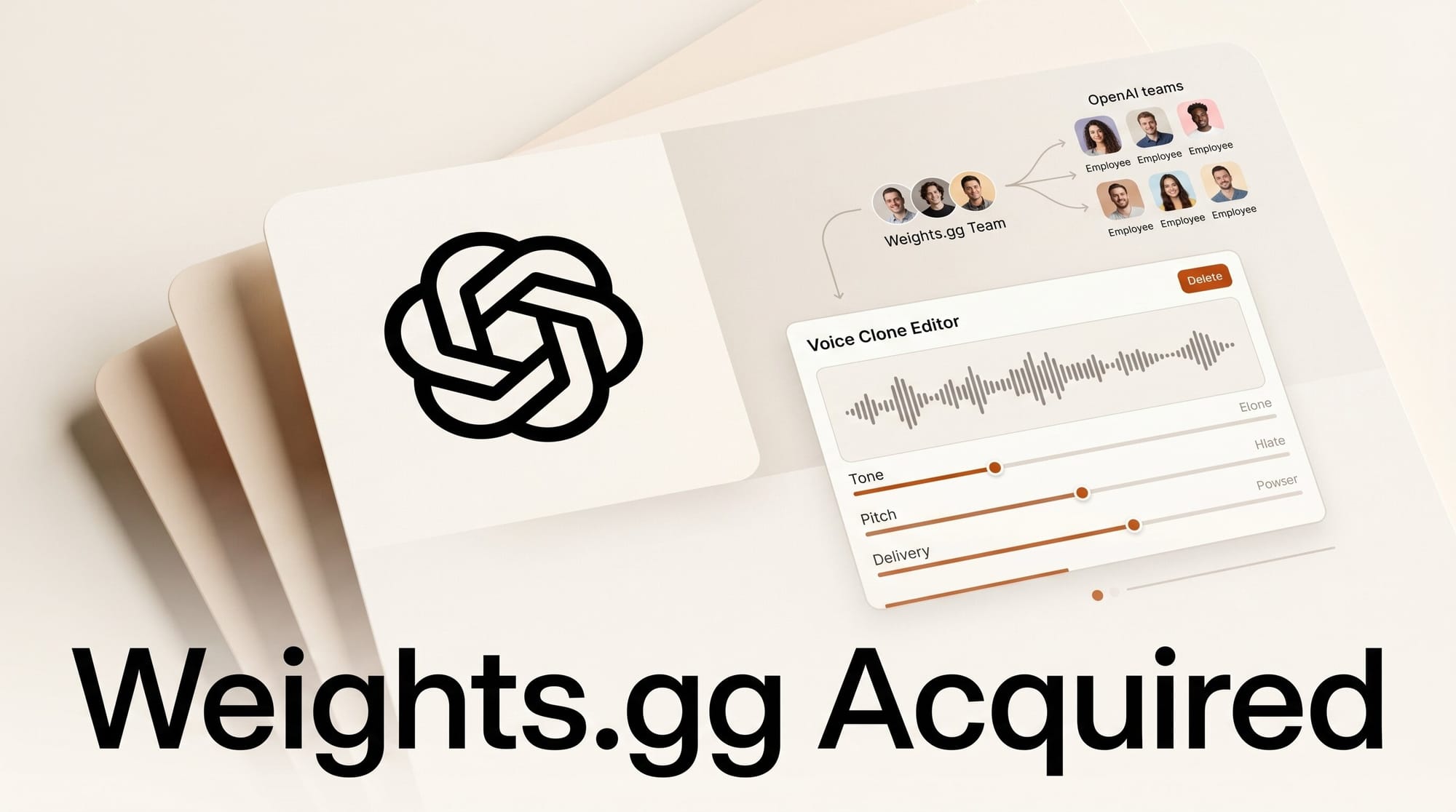
OpenAI quietly bought voice-cloning startup Weights.gg earlier this year, dispersed its six-person team across existing OpenAI groups, and folded the underlying tech into ongoing voice-model work, according to a report first surfaced by Mike Isaac at The New York Times on May 15. Terms were not disclosed. Weights.gg had raised roughly $4 million per PitchBook and was best known for Replay, a consumer app that hosted unauthorized voice models of celebrities including Taylor Swift, Samuel L. Jackson, Kanye West, and members of Blackpink.
What this means for voice creators
If you are a podcaster, musician, audio editor, or AI voice creator, this acquisition is a signal more than a tool ship: OpenAI is consolidating talent and IP before any public consumer voice-cloning product. Voice Engine, OpenAI's in-house cloning tool, has been in limited preview since 2024 and remains restricted to a small group of trusted partners on safety grounds. Two practical takeaways for the next 24 hours: stop building any production workflow around the Replay app or scraped Weights.gg model files (the public catalog is gone), and assume the next OpenAI voice product is a Sora-style controlled rollout rather than an open API. If you need cloned or stylized voices today, your shipping options remain ElevenLabs, Resemble.AI, PlayHT, and the open-weights Coqui XTTS line, not OpenAI.
Why it matters
Acquihires inside the voice category have been rare; most consolidation has happened in image and video. Pulling in a team that explicitly built unauthorized celebrity-voice clones is a strong tell about where OpenAI thinks the safety bar should land before it ships a creator-facing product. The move also further thins the independent voice-cloning bench: Weights.gg shut down its hosted services on March 31, and now the talent is gone too. ElevenLabs, Suno, and the open-source TTS community become the practical default for everyone outside OpenAI's limited-preview circle.
Key details
Weights.gg was founded in 2023 and raised about $4 million in seed funding. Its Replay app let anyone clone a voice from a short sample and generate songs or speech in that voice, which made the platform a magnet for unauthorized celebrity clones and takedown demands. PYMNTS confirms the six-person team has been split across multiple OpenAI groups rather than kept intact as a product squad. OpenAI did not respond to requests for comment from the original NYT report. Convergence Now notes the timing lines up with OpenAI's broader push to lock down voice and synthetic media IP ahead of its anticipated 2026 public listing, alongside the Voice Engine limited preview and the previously announced Sora-style controlled-distribution model.
What to do next
Audit any voice work that depended on Weights.gg or Replay model exports and migrate to a supported provider with documented consent and usage terms. Add Voice Engine to your watch list, but do not pencil it into a Q3 launch plan: OpenAI's last public statement still describes it as a limited preview. If your workflow needs cloned voices in the next month, ElevenLabs and Resemble.AI remain the production-ready paths.


